
基于STEM解决问题的思维方式。
Ways of thinking in STEM-based problem solving.
作者信息
English Lyn D
机构信息
Queensland University of Technology, Brisbane, Australia.
出版信息
ZDM. 2023 Mar 3:1-12. doi: 10.1007/s11858-023-01474-7.
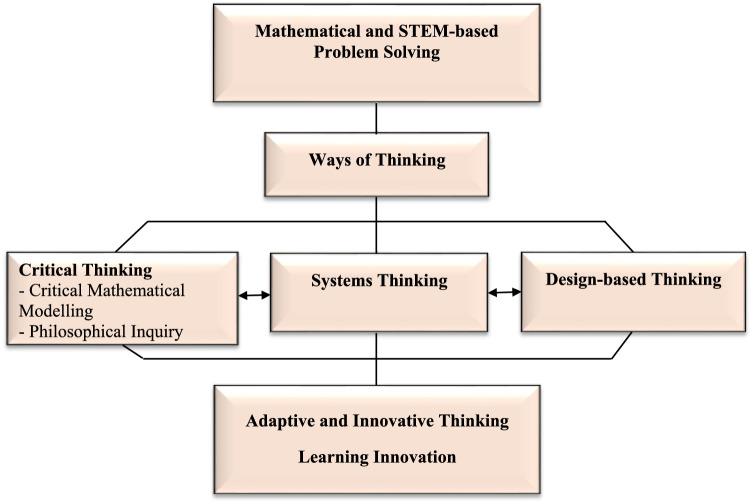
This article proposes an interconnected framework, , which addresses cognitive processes that facilitate learning, problem solving, and interdisciplinary concept development. The framework comprises critical thinking, incorporating critical mathematical modelling and philosophical inquiry, systems thinking, and design-based thinking, which collectively contribute to adaptive and innovative thinking. It is argued that the pinnacle of this framework is learning innovation, involving the generation of powerful disciplinary knowledge and thinking processes that can be applied to subsequent problem challenges. Consideration is first given to STEM-based problem solving with a focus on mathematics. Mathematical and STEM-based problems are viewed here as goal-directed, multifaceted experiences that (1) demand core, facilitative ways of thinking, (2) require the development of productive and adaptive ways to navigate complexity, (3) enable multiple approaches and practices, (4) recruit interdisciplinary solution processes, and (5) facilitate the growth of learning innovation. The nature, role, and contributions of each way of thinking in STEM-based problem solving and learning are then explored, with their interactions highlighted. Examples from classroom-based research are presented, together with teaching implications.
本文提出了一个相互关联的框架,该框架涉及促进学习、解决问题和跨学科概念发展的认知过程。该框架包括批判性思维,其中融入了批判性数学建模和哲学探究、系统思维以及基于设计的思维,这些共同促成了适应性和创新性思维。有人认为,这个框架的巅峰是学习创新,它涉及生成强大的学科知识和思维过程,这些知识和过程可应用于后续的问题挑战。首先考虑基于STEM的问题解决,重点是数学。这里将数学和基于STEM的问题视为目标导向的多方面体验,这些体验:(1)需要核心的、促进性的思维方式;(2)需要发展富有成效和适应性的方式来应对复杂性;(3)允许多种方法和实践;(4)采用跨学科的解决过程;(5)促进学习创新的增长。然后探讨了每种思维方式在基于STEM的问题解决和学习中的性质、作用和贡献,并突出了它们之间的相互作用。文中呈现了基于课堂研究的实例以及教学启示。

 Zotero 插件