Shelkovnikova Tatiana A, Maksimova Aleksandra S, Ryumshina Nadezhda I, Mochula Olga V, Vaizov Valery K, Ussov Wladimir Y, Anfinogenova Nina D
Cardiology Research Institute, Branch of the Federal State Budgetary Scientific Institution "Tomsk National Research Medical Center of the Russian Academy of Sciences", 634012 Tomsk, Russia.
Meshalkin National Medical Research Center, 630055 Novosibirsk, Russia.
J Imaging. 2023 May 28;9(6):108. doi: 10.3390/jimaging9060108.
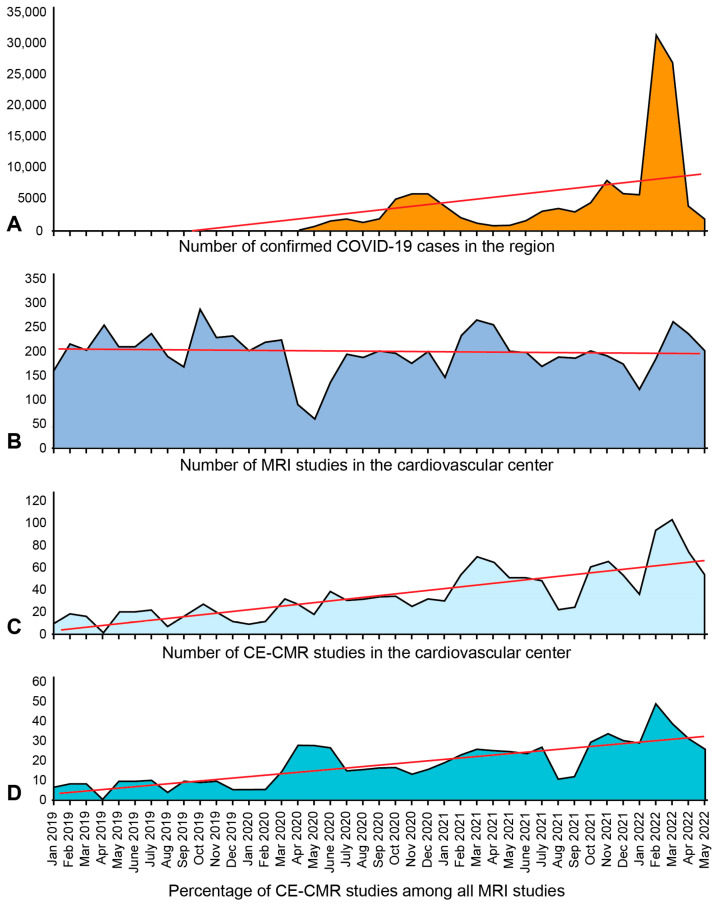
The aim of study was to investigate the transformative effect of the COVID-19 pandemic on magnetic resonance imaging (MRI) services in one tertiary cardiovascular center. The retrospective observational cohort study analyzed data of MRI studies ( = 8137) performed from 1 January 2019 to 1 June 2022. A total of 987 patients underwent contrast-enhanced cardiac MRI (CE-CMR). Referrals, clinical characteristics, diagnosis, gender, age, past COVID-19, MRI study protocols, and MRI data were analyzed. The annual absolute numbers and rates of CE-CMR procedures in our center significantly increased from 2019 to 2022 (-value < 0.05). The increasing temporal trends were observed in hypertrophic cardiomyopathy (HCMP) and myocardial fibrosis (-value < 0.05). The CE-CMR findings of myocarditis, acute myocardial infarction, ischemic cardiomyopathy, HCMP, postinfarction cardiosclerosis, and focal myocardial fibrosis prevailed in men compared with the corresponding values in women during the pandemic (-value < 0.05). The frequency of myocardial fibrosis occurrence increased from ~67% in 2019 to ~84% in 2022 (-value < 0.05). The COVID-19 pandemic increased the need for MRI and CE-CMR. Patients with a history of COVID-19 had persistent and newly occurring symptoms of myocardial damage, suggesting chronic cardiac involvement consistent with long COVID-19 requiring continuous follow-up.
本研究的目的是调查新冠疫情对一家三级心血管中心磁共振成像(MRI)服务的变革性影响。这项回顾性观察队列研究分析了2019年1月1日至2022年6月1日期间进行的MRI研究数据(n = 8137)。共有987例患者接受了对比增强心脏MRI(CE-CMR)检查。对转诊情况、临床特征、诊断、性别、年龄、既往新冠病史、MRI研究方案和MRI数据进行了分析。从2019年到2022年,我们中心CE-CMR检查的年度绝对数量和比率显著增加(p值<0.05)。肥厚型心肌病(HCMP)和心肌纤维化的时间趋势呈上升趋势(p值<0.05)。在疫情期间,与女性的相应值相比,男性心肌炎、急性心肌梗死、缺血性心肌病、HCMP、心肌梗死后硬化和局灶性心肌纤维化的CE-CMR表现更为普遍(p值<0.05)。心肌纤维化的发生率从2019年的约67%增加到2022年的约84%(p值<0.05)。新冠疫情增加了对MRI和CE-CMR的需求。有新冠病史的患者出现了持续和新出现的心肌损伤症状,提示与长期新冠一致的慢性心脏受累,需要持续随访。