Osinkin Denis, Bogdanovich Nina
Laboratory of Kinetics, Institute of High-Temperature Electrochemistry, Ural Branch of the Russian Academy of Sciences, Yekaterinburg 620066, Russia.
Department of Life Safety, Institute of Fundamental Education, Ural Federal University, Yekaterinburg 620002, Russia.
Membranes (Basel). 2023 Jun 15;13(6):603. doi: 10.3390/membranes13060603.
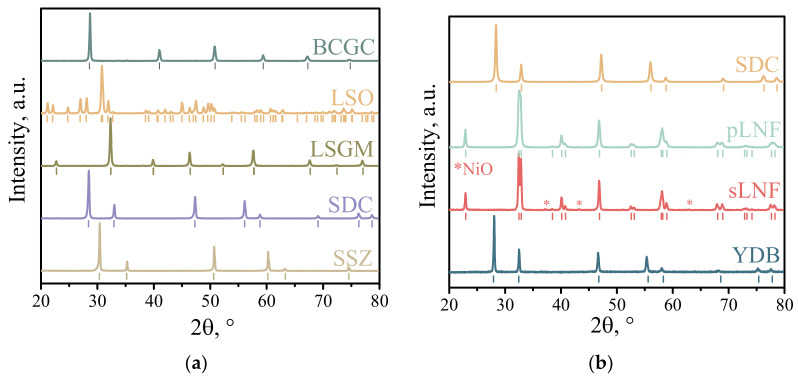
Strontium and cobalt-free LaNiFeO is considered one of the most promising electrodes for solid-state electrochemical devices. LaNiFeO has high electrical conductivity, a suitable thermal expansion coefficient, satisfactory tolerance to chromium poisoning, and chemical compatibility with zirconia-based electrolytes. The disadvantage of LaNiFeO is its low oxygen-ion conductivity. In order to increase the oxygen-ion conductivity, a complex oxide based on a doped ceria is added to the LaNiFeO. However, this leads to a decrease in the conductivity of the electrode. In this case, a two-layer electrode with a functional composite layer and a collector layer with the addition of sintering additives should be used. In this study, the effect of sintering additives (BiYO and CuO) in the collector layer on the performance of LaNiFeO-based highly active electrodes in contact with the most common solid-state membranes (ZrScO, CeSmO, LaSrGaMgO, La(SiO)O, and BaCeGdCuO) was investigated. It was shown that LaNiFeO has good chemical compatibility with the abovementioned membranes. The best electrochemical activity (polarization resistance about 0.02 Ohm cm at 800 °C) was obtained for the electrode with 5 wt.% BiYO and 2 wt.% CuO in the collector layer.
无锶钴的LaNiFeO被认为是固态电化学装置中最有前景的电极之一。LaNiFeO具有高电导率、合适的热膨胀系数、对铬中毒的耐受性令人满意,并且与氧化锆基电解质具有化学相容性。LaNiFeO的缺点是其氧离子电导率较低。为了提高氧离子电导率,向LaNiFeO中添加了一种基于掺杂二氧化铈的复合氧化物。然而,这会导致电极电导率下降。在这种情况下,应使用具有功能复合层和添加了烧结添加剂的集流体层的双层电极。在本研究中,研究了集流体层中的烧结添加剂(BiYO和CuO)对与最常见的固态膜(ZrScO、CeSmO、LaSrGaMgO、La(SiO)O和BaCeGdCuO)接触的LaNiFeO基高活性电极性能的影响。结果表明,LaNiFeO与上述膜具有良好的化学相容性。对于集流体层中含有5 wt.% BiYO和2 wt.% CuO的电极,在800℃时获得了最佳的电化学活性(极化电阻约为0.02 Ohm·cm)。