• 文献检索
  • 文档翻译
  • 深度研究
  • 学术资讯
  • Suppr Zotero 插件Zotero 插件
  • 邀请有礼
  • 套餐&价格
  • 历史记录
应用&插件
Suppr Zotero 插件Zotero 插件浏览器插件Mac 客户端Windows 客户端微信小程序
定价
高级版会员购买积分包购买API积分包
服务
文献检索文档翻译深度研究API 文档MCP 服务
关于我们
关于 Suppr公司介绍联系我们用户协议隐私条款
关注我们

Suppr 超能文献

核心技术专利:CN118964589B侵权必究
粤ICP备2023148730 号-1Suppr @ 2026

文献检索

告别复杂PubMed语法,用中文像聊天一样搜索,搜遍4000万医学文献。AI智能推荐,让科研检索更轻松。

立即免费搜索

文件翻译

保留排版,准确专业,支持PDF/Word/PPT等文件格式,支持 12+语言互译。

免费翻译文档

深度研究

AI帮你快速写综述,25分钟生成高质量综述,智能提取关键信息,辅助科研写作。

立即免费体验

新型冠状病毒肺炎所致急性呼吸窘迫综合征患者吸入一氧化氮治疗:治疗方式、临床反应及预后

Inhaled nitric oxide in patients with acute respiratory distress syndrome caused by COVID-19: treatment modalities, clinical response, and outcomes.

作者信息

Mekontso Dessap Armand, Papazian Laurent, Schaller Manuella, Nseir Saad, Megarbane Bruno, Haudebourg Luc, Timsit Jean-François, Teboul Jean-Louis, Kuteifan Khaldoun, Gainnier Marc, Slama Michel, Houeto Patrick, Lecourt Laurent, Mercat Alain, Vieillard-Baron Antoine

机构信息

Service de Médecine Intensive Réanimation, Hôpitaux Universitaires Henri-Mondor, AP-HP, 94010, Créteil, France.

CARMAS research group, Univ Paris Est Créteil, Faculté de Santé, 94010, Créteil, France.

出版信息

Ann Intensive Care. 2023 Jun 27;13(1):57. doi: 10.1186/s13613-023-01150-9.

DOI:10.1186/s13613-023-01150-9
PMID:37368036
原文链接:https://pmc.ncbi.nlm.nih.gov/articles/PMC10299982/
Abstract

BACKGROUND

Inhaled nitric oxide (iNO) has been widely used in patients with COVID-19-related acute respiratory distress syndrome (C-ARDS), though its physiological effects and outcome are debated in this setting. The objective of this cohort study was to describe the modalities of iNO use, clinical response, and outcomes in a large cohort of C-ARDS patients.

METHODS

Multicentre, retrospective cohort study conducted in France.

RESULTS

From end February to December 2020, 300 patients (22.3% female) were included, 84.5% were overweight and 69.0% had at least one comorbidity. At ICU admission, their median (IQR) age, SAPS II, and SOFA score were 66 (57-72) years, 37 (29-48), and 5 (3-8), respectively. Patients were all ventilated according to a protective ventilation strategy, and 68% were prone positioned before iNO initiation. At iNO initiation, 2%, 37%, and 61% of patients had mild, moderate, and severe ARDS, respectively. The median duration of iNO treatment was 2.8 (1.1-5.5) days with a median dosage of 10 (7-13) ppm at initiation. Responders (PaO/FiO ratio improving by 20% or more) represented 45.7% of patients at 6 h from iNO initiation. The severity of ARDS was the only predictive factor associated with iNO response. Among all evaluable patients, the crude mortality was not significantly different between responders at 6 h and their counterparts. Of the 62 patients with refractory ARDS (who fulfilled extracorporeal membrane oxygenation criteria before iNO initiation), 32 (51.6%) no longer fulfilled these criteria after 6 h of iNO. The latter showed significantly lower mortality than the other half (who remained ECMO eligible), including after confounder adjustment (adjusted OR: 0.23, 95% CI 0.06, 0.89, p = 0.03).

CONCLUSIONS

Our study reports the benefits of iNO in improving arterial oxygenation in C-ARDS patients. This improvement seems more relevant in the most severe cases. In patients with ECMO criteria, an iNO-driven improvement in gas exchange was associated with better survival. These results must be confirmed in well-designed prospective studies.

摘要

背景

吸入一氧化氮(iNO)已广泛应用于新型冠状病毒肺炎相关急性呼吸窘迫综合征(C-ARDS)患者,但其在此情况下的生理效应和预后仍存在争议。本队列研究的目的是描述一大群C-ARDS患者使用iNO的方式、临床反应和预后。

方法

在法国进行的多中心回顾性队列研究。

结果

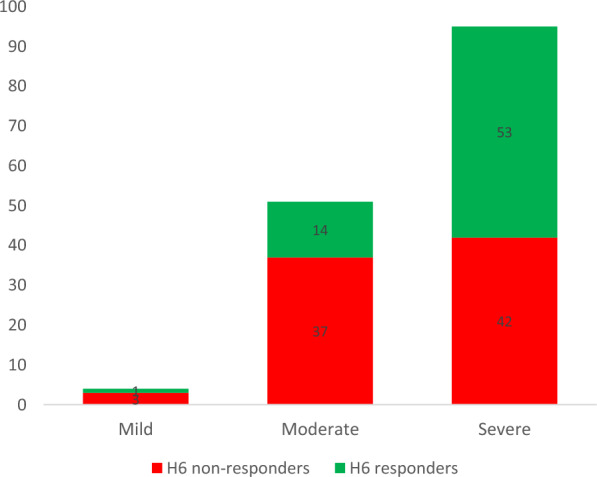
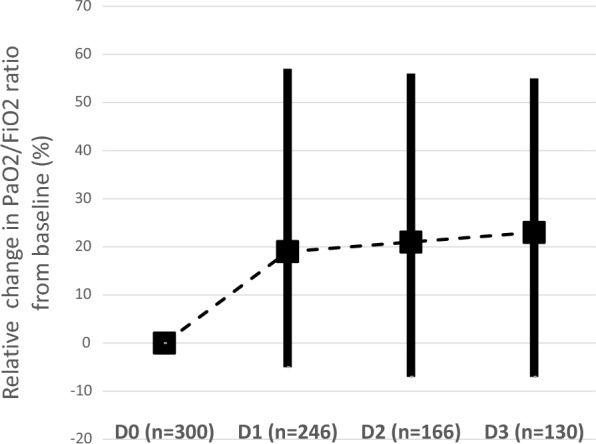
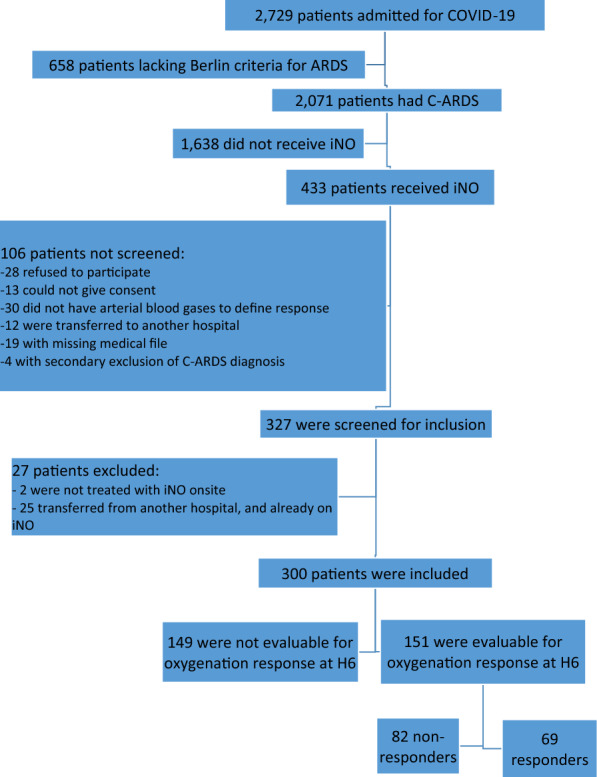
从2020年2月底至12月,纳入300例患者(22.3%为女性),84.5%超重,69.0%至少有一种合并症。入住重症监护病房(ICU)时,他们的年龄中位数(四分位间距)、简化急性生理学评分(SAPS)II和序贯器官衰竭评估(SOFA)评分分别为66(57 - 72)岁、37(29 - 48)和5(3 - 8)。所有患者均按照保护性通气策略进行通气,68%在开始使用iNO前采用俯卧位。开始使用iNO时,2%、37%和61%的患者分别患有轻度、中度和重度ARDS。iNO治疗的中位持续时间为2.8(1.1 - 5.5)天,开始时的中位剂量为10(7 - 13)ppm。在开始使用iNO后6小时,反应者(动脉血氧分压/吸入氧分数值改善20%或更多)占患者的45.7%。ARDS的严重程度是与iNO反应相关的唯一预测因素。在所有可评估的患者中,6小时时反应者与非反应者的粗死亡率无显著差异。在62例难治性ARDS患者(在开始使用iNO前符合体外膜肺氧合标准)中,32例(51.6%)在使用iNO 6小时后不再符合这些标准。后者的死亡率显著低于另一半(仍符合体外膜肺氧合标准者),包括在进行混杂因素调整后(调整后的比值比:0.23,95%置信区间0.06,0.89,p = 0.03)。

结论

我们的研究报告了iNO在改善C-ARDS患者动脉氧合方面的益处。这种改善在最严重的病例中似乎更显著。在符合体外膜肺氧合标准的患者中,iNO驱动的气体交换改善与更好的生存率相关。这些结果必须在设计良好的前瞻性研究中得到证实。
https://cdn.ncbi.nlm.nih.gov/pmc/blobs/4745/10299982/a295c59345c0/13613_2023_1150_Fig3_HTML.jpg
https://cdn.ncbi.nlm.nih.gov/pmc/blobs/4745/10299982/70dd39e18f2d/13613_2023_1150_Fig1_HTML.jpg
https://cdn.ncbi.nlm.nih.gov/pmc/blobs/4745/10299982/a5e452aa6b54/13613_2023_1150_Fig2_HTML.jpg
https://cdn.ncbi.nlm.nih.gov/pmc/blobs/4745/10299982/a295c59345c0/13613_2023_1150_Fig3_HTML.jpg
https://cdn.ncbi.nlm.nih.gov/pmc/blobs/4745/10299982/70dd39e18f2d/13613_2023_1150_Fig1_HTML.jpg
https://cdn.ncbi.nlm.nih.gov/pmc/blobs/4745/10299982/a5e452aa6b54/13613_2023_1150_Fig2_HTML.jpg
https://cdn.ncbi.nlm.nih.gov/pmc/blobs/4745/10299982/a295c59345c0/13613_2023_1150_Fig3_HTML.jpg

相似文献

1
Inhaled nitric oxide in patients with acute respiratory distress syndrome caused by COVID-19: treatment modalities, clinical response, and outcomes.新型冠状病毒肺炎所致急性呼吸窘迫综合征患者吸入一氧化氮治疗:治疗方式、临床反应及预后
Ann Intensive Care. 2023 Jun 27;13(1):57. doi: 10.1186/s13613-023-01150-9.
2
Evaluation of inhaled nitric oxide (iNO) treatment for moderate-to-severe ARDS in critically ill patients with COVID-19: a multicenter cohort study.评价吸入一氧化氮(iNO)治疗 COVID-19 重症危重症患者中中重度急性呼吸窘迫综合征(ARDS)的效果:一项多中心队列研究。
Crit Care. 2022 Oct 3;26(1):304. doi: 10.1186/s13054-022-04158-y.
3
Acute oxygenation response to inhaled nitric oxide when combined with high-frequency oscillatory ventilation in adults with acute respiratory distress syndrome.急性呼吸窘迫综合征成人患者在吸入一氧化氮联合高频振荡通气时的急性氧合反应
Crit Care Med. 2003 Feb;31(2):383-9. doi: 10.1097/01.CCM.0000049953.86613.02.
4
Real-world use of inhaled nitric oxide therapy in patients with COVID-19 and mild-to-moderate acute respiratory distress syndrome.吸入一氧化氮疗法在新冠病毒病合并轻至中度急性呼吸窘迫综合征患者中的真实世界应用
Drugs Context. 2022 Apr 11;11. doi: 10.7573/dic.2022-1-4. eCollection 2022.
5
Inhaled nitric oxide for acute respiratory distress syndrome (ARDS) in children and adults.吸入一氧化氮用于儿童和成人急性呼吸窘迫综合征(ARDS)的治疗
Cochrane Database Syst Rev. 2016 Jun 27;2016(6):CD002787. doi: 10.1002/14651858.CD002787.pub3.
6
Inhaled nitric oxide as rescue therapy in severe ARDS cases due to COVID-19 pneumonia: a single center experience.吸入一氧化氮作为 COVID-19 肺炎所致严重 ARDS 病例的抢救治疗:单中心经验。
Eur Rev Med Pharmacol Sci. 2023 Jul;27(13):6422-6428. doi: 10.26355/eurrev_202307_33002.
7
Prone positioning and inhaled nitric oxide: synergistic therapies for acute respiratory distress syndrome.俯卧位通气与吸入一氧化氮:急性呼吸窘迫综合征的协同治疗方法
J Trauma. 2001 Apr;50(4):589-95; discussion 595-6. doi: 10.1097/00005373-200104000-00001.
8
Rescue therapy with inhaled nitric oxide and almitrine in COVID-19 patients with severe acute respiratory distress syndrome.吸入一氧化氮和烯丙哌三嗪对患有严重急性呼吸窘迫综合征的COVID-19患者的挽救治疗。
Ann Intensive Care. 2020 Nov 4;10(1):151. doi: 10.1186/s13613-020-00769-2.
9
Inhaled nitric oxide for neonates with persistent pulmonary hypertension of the newborn in the CINRGI study: time to treatment response.CINRGI 研究中吸入一氧化氮治疗新生儿持续肺动脉高压:从治疗到起效的时间。
BMC Pediatr. 2019 Jan 12;19(1):17. doi: 10.1186/s12887-018-1368-4.
10
Comparison of Fixed-Dose Inhaled Epoprostenol and Inhaled Nitric Oxide for Acute Respiratory Distress Syndrome in Critically Ill Adults.固定剂量吸入依前列醇与吸入一氧化氮治疗重症成人急性呼吸窘迫综合征的比较
J Intensive Care Med. 2021 Apr;36(4):466-476. doi: 10.1177/0885066620906800. Epub 2020 Mar 5.

引用本文的文献

1
Managing Refractory Hypoxemia in Acute Respiratory Distress Syndrome Obese Patients with Veno-Venous Extra-Corporeal Membrane Oxygenation: A Narrative Review.采用静脉-静脉体外膜肺氧合治疗急性呼吸窘迫综合征肥胖患者难治性低氧血症的叙述性综述
J Clin Med. 2025 Feb 28;14(5):1653. doi: 10.3390/jcm14051653.
2
Medium-Term Effect of Inhaled Nitric Oxide in Mechanically Ventilated COVID-19 Patients.吸入一氧化氮对机械通气的COVID-19患者的中期影响
J Clin Med. 2025 Jan 26;14(3):806. doi: 10.3390/jcm14030806.
3
Impact of low dose inhaled nitric oxide treatment in spontaneously breathing and intubated COVID-19 patients: a retrospective propensity-matched study.

本文引用的文献

1
Inhaled Nitric Oxide for Clinical Management of COVID-19: A Systematic Review and Meta-Analysis.吸入一氧化氮治疗 COVID-19 的临床管理:系统评价和荟萃分析。
Int J Environ Res Public Health. 2022 Oct 6;19(19):12803. doi: 10.3390/ijerph191912803.
2
Nitric oxide versus epoprostenol for refractory hypoxemia in Covid-19.硝酸酯类与依前列醇治疗新冠肺炎难治性低氧血症的比较。
PLoS One. 2022 Jun 27;17(6):e0270646. doi: 10.1371/journal.pone.0270646. eCollection 2022.
3
Echocardiography findings in COVID-19 patients admitted to intensive care units: a multi-national observational study (the ECHO-COVID study).
低剂量吸入一氧化氮治疗有自主呼吸和插管的 COVID-19 患者的影响:一项回顾性倾向评分匹配研究。
Crit Care. 2024 Oct 25;28(1):344. doi: 10.1186/s13054-024-05093-w.
4
Impact of Inhaled Nitric Oxide (iNO) on the Outcome of COVID-19 Associated ARDS.吸入一氧化氮(iNO)对新型冠状病毒肺炎相关急性呼吸窘迫综合征预后的影响
J Clin Med. 2024 Oct 8;13(19):5981. doi: 10.3390/jcm13195981.
5
Impact of airway closure and lung collapse on inhaled nitric oxide effect in acute lung injury: an experimental study.气道关闭和肺萎陷对急性肺损伤中吸入一氧化氮效应的影响:一项实验研究
Ann Intensive Care. 2024 Sep 23;14(1):149. doi: 10.1186/s13613-024-01378-z.
6
Modes of administration of nitric oxide devices and ventilators flow-by impact the delivery of pre-determined concentrations.一氧化氮装置的给药方式以及呼吸机旁通气流会影响预定浓度的输送。
Ann Intensive Care. 2024 Aug 21;14(1):130. doi: 10.1186/s13613-024-01351-w.
7
Immediate Clinical Complications Occurring During Membrane Change in Patients on Veno-Venous Extracorporeal Membrane Oxygenation.静脉-静脉体外膜肺氧合患者换膜期间发生的即时临床并发症
ASAIO J. 2025 Feb 1;71(2):120-127. doi: 10.1097/MAT.0000000000002270. Epub 2024 Jul 25.
8
Inhaled NO at a crossroads in cardiac surgery: current need to improve mechanistic understanding, clinical trial design and scientific evidence.心脏手术中吸入一氧化氮正处于十字路口:当前需要提高对其作用机制的理解、改进临床试验设计并加强科学证据。
Front Cardiovasc Med. 2024 Apr 5;11:1374635. doi: 10.3389/fcvm.2024.1374635. eCollection 2024.
9
A Comprehensive Review of Inhaled Nitric Oxide Therapy: Current Trends, Challenges, and Future Directions.吸入一氧化氮疗法的全面综述:当前趋势、挑战及未来方向
Cureus. 2024 Feb 4;16(2):e53558. doi: 10.7759/cureus.53558. eCollection 2024 Feb.
10
Unraveling the impact of nitric oxide, almitrine, and their combination in COVID-19 (at the edge of sepsis) patients: a systematic review.解析一氧化氮、阿米三嗪及其联合用药对新冠肺炎(处于脓毒症边缘)患者的影响:一项系统评价
Front Pharmacol. 2024 Jan 22;14:1172447. doi: 10.3389/fphar.2023.1172447. eCollection 2023.
COVID-19 患者入住重症监护病房的超声心动图表现:一项多国观察性研究(ECHO-COVID 研究)。
Intensive Care Med. 2022 Jun;48(6):667-678. doi: 10.1007/s00134-022-06685-2. Epub 2022 Apr 21.
4
Effects of rescue inhaled nitric oxide on right ventricle and pulmonary circulation in severe COVID-related acute respiratory distress syndrome.抢救性吸入一氧化氮对严重 COVID-19 相关急性呼吸窘迫综合征右心和肺循环的影响。
J Crit Care. 2022 Dec;72:153987. doi: 10.1016/j.jcrc.2022.153987. Epub 2022 Feb 2.
5
Acute cor pulmonale in Covid-19 related acute respiratory distress syndrome.新型冠状病毒肺炎相关急性呼吸窘迫综合征中的急性肺源性心脏病
Crit Care. 2021 Sep 25;25(1):346. doi: 10.1186/s13054-021-03756-6.
6
Evaluation of right ventricular function and driving pressure with blood gas analysis could better select patients eligible for VV ECMO in severe ARDS.通过血气分析评估右心室功能和驱动压力,能够更好地筛选出适合在重症急性呼吸窘迫综合征中接受静脉-静脉体外膜肺氧合治疗的患者。
Crit Care. 2021 Jun 27;25(1):220. doi: 10.1186/s13054-021-03646-x.
7
Early effects of ventilatory rescue therapies on systemic and cerebral oxygenation in mechanically ventilated COVID-19 patients with acute respiratory distress syndrome: a prospective observational study.机械通气 COVID-19 急性呼吸窘迫综合征患者通气抢救治疗对全身和脑氧合的早期影响:一项前瞻性观察研究。
Crit Care. 2021 Mar 19;25(1):111. doi: 10.1186/s13054-021-03537-1.
8
Potential for personalised application of inhaled nitric oxide in COVID-19 pneumonia.吸入一氧化氮在新型冠状病毒肺炎中的个性化应用潜力。
Br J Anaesth. 2021 Feb;126(2):e72-e75. doi: 10.1016/j.bja.2020.11.006. Epub 2020 Nov 14.
9
Clinical characteristics and day-90 outcomes of 4244 critically ill adults with COVID-19: a prospective cohort study.4244 例危重症 COVID-19 成年患者的临床特征和第 90 天结局:一项前瞻性队列研究。
Intensive Care Med. 2021 Jan;47(1):60-73. doi: 10.1007/s00134-020-06294-x. Epub 2020 Oct 29.
10
Implication of inhaled nitric oxide for the treatment of critically ill COVID-19 patients with pulmonary hypertension.吸入一氧化氮对治疗合并肺动脉高压的危重症 COVID-19 患者的意义。
ESC Heart Fail. 2021 Feb;8(1):714-718. doi: 10.1002/ehf2.13023. Epub 2020 Nov 17.