Stoll Sandra Emily, Böttiger Bernd W, Dusse Fabian, Leister Nicolas, Leupold Tobias, Menzel Christoph, Overbeek Remco, Mathes Alexander
Department of Anesthesiology and Intensive Care Medicine, Faculty of Medicine and University Hospital Cologne, University of Cologne, 50937 Cologne, Germany.
Department of Anesthesiology, Montefiore Medical Center, Albert Einstein College of Medicine, Bronx, NY 10467, USA.
J Clin Med. 2024 Oct 8;13(19):5981. doi: 10.3390/jcm13195981.
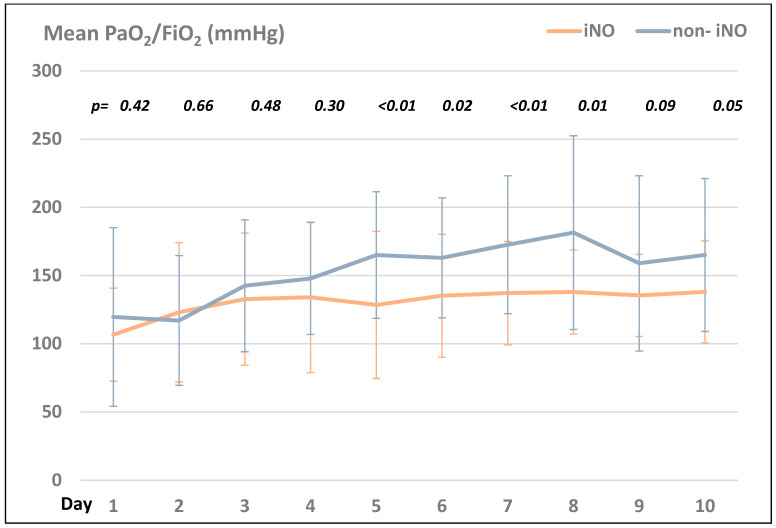
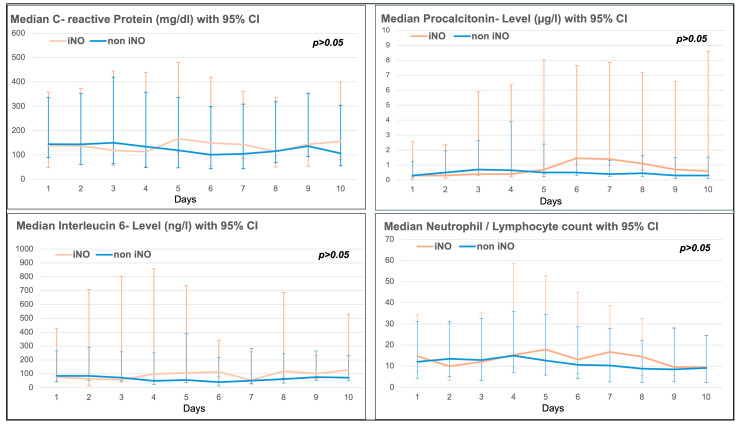
Inhaled nitric oxide (iNO) can improve oxygenation in acute respiratory syndrome (ARDS), has anti-inflammatory and antithrombotic effects, and can inhibit coronavirus- replication. The study aim was to investigate the impact of iNO in COVID-19 associated ARDS (CARDS) on oxygenation, the length of mechanical ventilation (MV), the level of inflammatory markers and the rate of thrombotic events during ICU stay. This was a retrospective, observational, monocentric study analyzing the effect of INO (15 parts per million) vs. non-iNO in adult ventilated CARDS patients on oxygenation, the level of inflammatory markers, and the rate of thrombotic events during ICU stay. Within the iNO group, the impact on gas exchange was assessed by comparing arterial blood gas results obtained at different time points. Overall, 19/56 patients were treated with iNO, with no difference regarding sex, age, body mass index, and SOFA-/APACHE II- score between the iNO and non-iNO groups. iNO improved oxygenation in iNO-responders (7/19) and had no impact on inflammatory markers or the rate of thrombotic events but was associated with an increased MV length. iNO was able to improve oxygenation in CARDS in iNO-responders but did not show an impact on inflammatory markers or the rate of thrombotic events, while it was associated with an increased MV length.
吸入一氧化氮(iNO)可改善急性呼吸窘迫综合征(ARDS)的氧合,具有抗炎和抗血栓作用,并能抑制冠状病毒复制。本研究旨在探讨iNO对新型冠状病毒肺炎相关急性呼吸窘迫综合征(CARDS)患者在重症监护病房(ICU)住院期间氧合、机械通气(MV)时长、炎症标志物水平及血栓形成事件发生率的影响。这是一项回顾性、观察性、单中心研究,分析了在成年接受机械通气的CARDS患者中,吸入百万分之十五的iNO与未吸入iNO对ICU住院期间氧合、炎症标志物水平及血栓形成事件发生率的影响。在iNO组中,通过比较不同时间点获得的动脉血气结果来评估对气体交换的影响。总体而言,56例患者中有19例接受了iNO治疗,iNO组与未使用iNO组在性别、年龄、体重指数以及序贯器官衰竭评估(SOFA)/急性生理与慢性健康状况评分系统(APACHE)II评分方面无差异。iNO可改善iNO反应者(7/19)的氧合,对炎症标志物或血栓形成事件发生率无影响,但与MV时长增加有关。iNO能够改善CARDS中iNO反应者的氧合,但对炎症标志物或血栓形成事件发生率无影响,同时与MV时长增加有关。