School of Public Health, Arba Minch University, Arba Minch, Ethiopia.
Public Health Nutrition Unit, Department of Public Health and Primary Care, Ghent University, Ghent, Belgium.
PLoS One. 2023 Jun 27;18(6):e0287703. doi: 10.1371/journal.pone.0287703. eCollection 2023.
Iron deficiency is negatively associated with children's cognitive development. Evidence showed that iron supplementation improves cognitive development. Nearly 50% of anemia is caused by iron deficiency. Anemia affects more school-age children, at an age where their brain development continues. The aim of this systematic review and meta-analysis is to review the evidence from published randomized controlled trials to evaluate the effects of iron supplementation on cognitive development and function among school-age children.
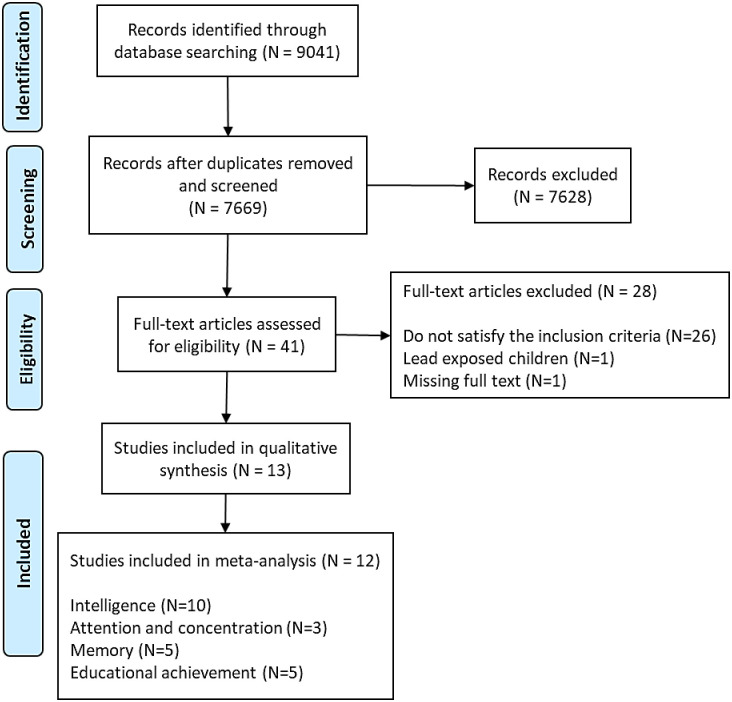
Five databases including MEDLINE, EMBASE, Scopus, Web of Science and CENTRAL were used to search for articles on April 20th, 2021. The search was reconducted on October 13th, 2022 to retrieve new records. Studies were eligible if they included school children 6-12 years of age, were randomized controlled trials, and if they tested iron supplementation and measured cognitive development.
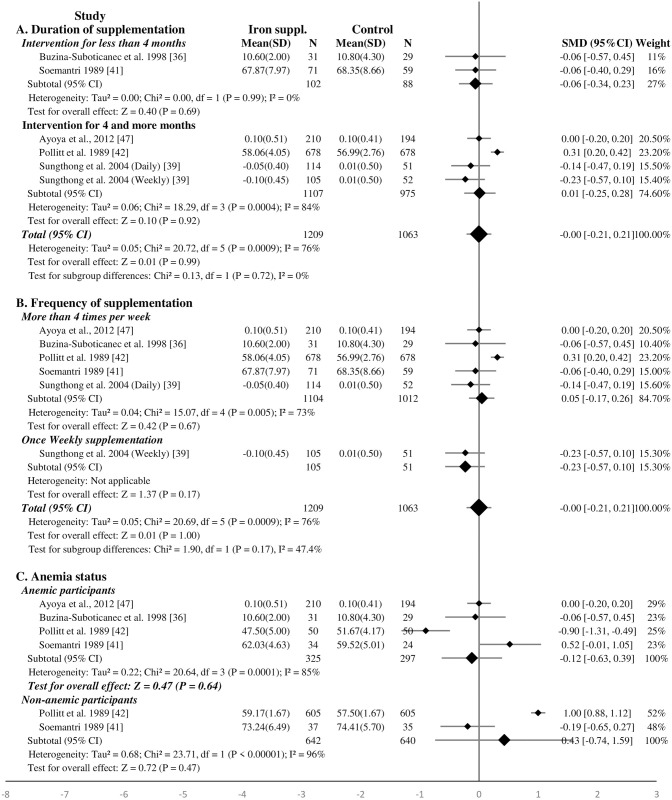
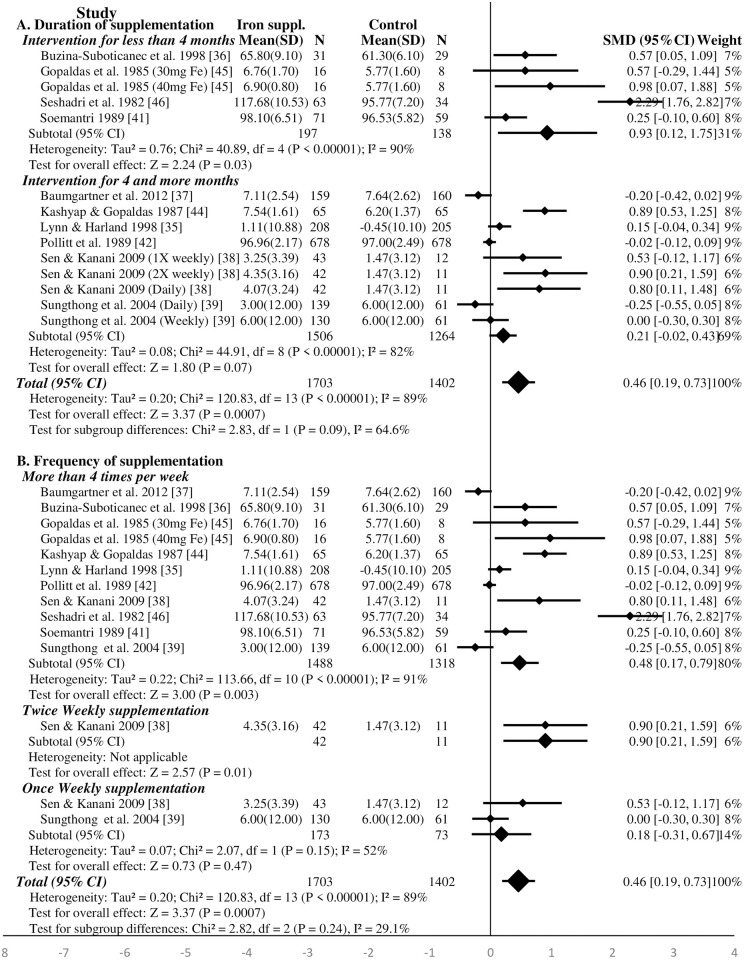
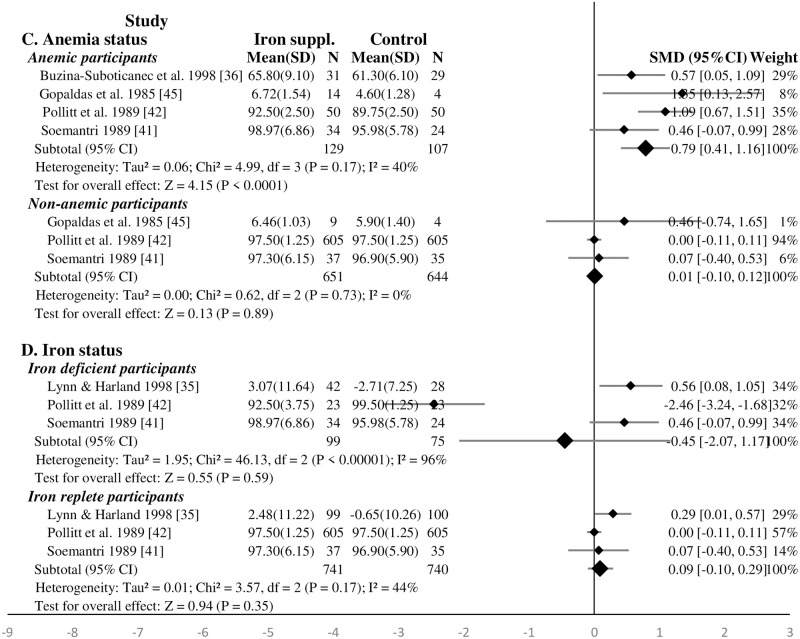
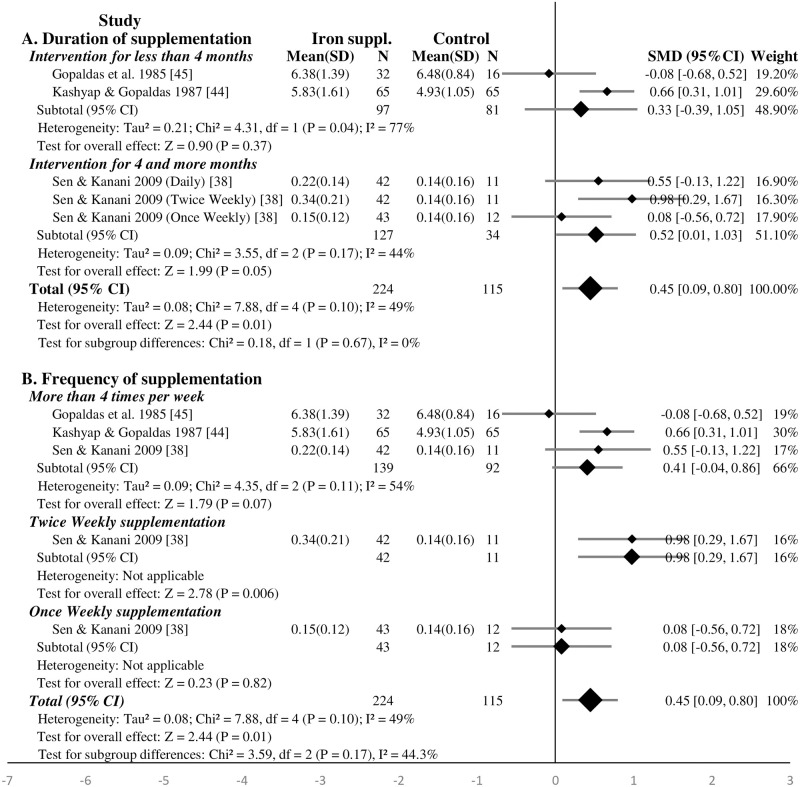
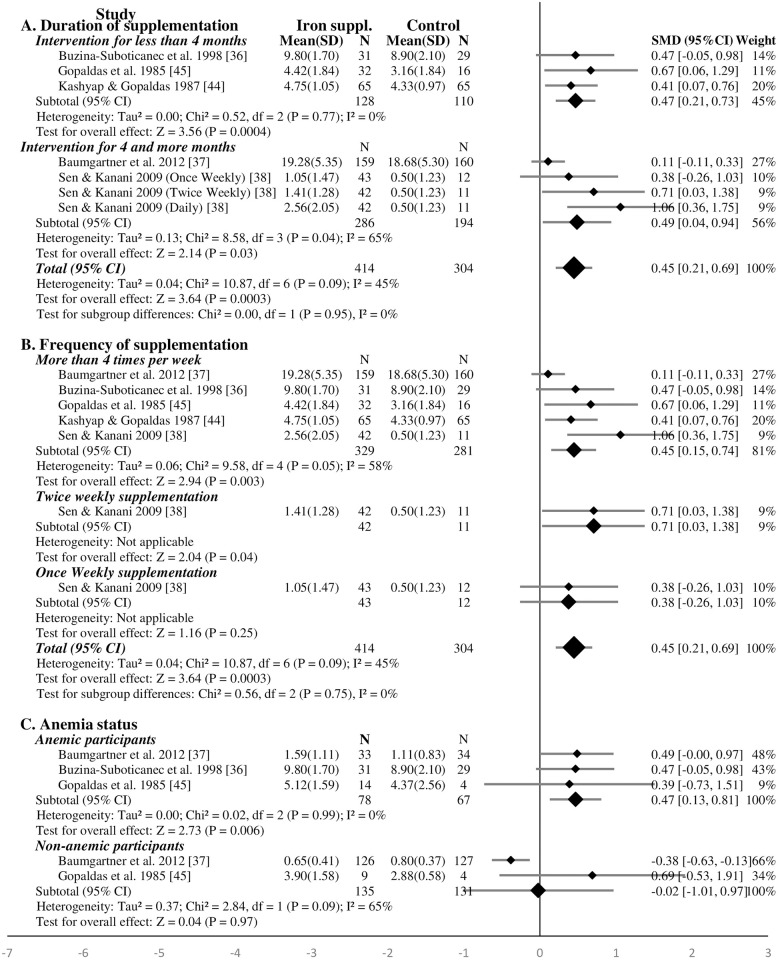
Thirteen articles were included in the systematic review. Overall, iron supplementation significantly improved intelligence (standardized mean difference, 95% confidence interval) (SMD 0.46, 95%CI: 0.19, 0.73, P<0.001), attention and concentration (SMD 0.44, 95%CI: 0.07, 0.81, P = 0.02) and memory (SMD 0.44, 95%CI: 0.21, 0.67, P <0.001) of school-age children. There was no significant effect of iron supplementation on school achievement of school-age children (SMD 0.06, 95%CI: -0.15, 0.26, P = 0.56). In a subgroup analysis, iron-supplemented children who were anemic at baseline had had better outcomes of intelligence (SMD 0.79, 95%CI: 0.41, 1.16, P = 0.001) and memory (SMD 0.47, 95%CI: 0.13, 0.81; P = 0.006).
Iron supplementation has a significant positive effect on the intelligence, attention and concentration, and the memory of school-age children but there was no evidence on the effect of iron supplementation on their school achievement.
铁缺乏与儿童认知发展呈负相关。有证据表明,铁补充剂可改善认知发展。近 50%的贫血是由铁缺乏引起的。贫血影响更多学龄儿童,而此时他们的大脑仍在发育。本系统评价和荟萃分析旨在综述已发表的随机对照试验证据,以评估铁补充剂对学龄儿童认知发展和功能的影响。
我们于 2021 年 4 月 20 日在 MEDLINE、EMBASE、Scopus、Web of Science 和 CENTRAL 这 5 个数据库中检索文献,并于 2022 年 10 月 13 日进行了再次检索以获取新记录。纳入符合以下标准的研究:纳入 6-12 岁学龄儿童的随机对照试验,研究铁补充剂并测量认知发展。
本系统评价纳入了 13 项研究。总体而言,铁补充剂显著改善了儿童智力(标准化均数差,95%置信区间)(SMD 0.46,95%CI:0.19,0.73,P<0.001)、注意力和专注力(SMD 0.44,95%CI:0.07,0.81,P = 0.02)和记忆力(SMD 0.44,95%CI:0.21,0.67,P<0.001)。铁补充剂对学龄儿童的学业成绩没有显著影响(SMD 0.06,95%CI:-0.15,0.26,P = 0.56)。在亚组分析中,基线时贫血的铁补充儿童在智力(SMD 0.79,95%CI:0.41,1.16,P = 0.001)和记忆力(SMD 0.47,95%CI:0.13,0.81;P = 0.006)方面的结果更好。
铁补充剂对学龄儿童的智力、注意力和专注力以及记忆力有显著的积极影响,但没有证据表明铁补充剂对其学业成绩有影响。