Section of Neonatology, Department of Pediatrics, Baylor College of Medicine, Texas Children's Hospital, Houston, Texas, United States.
Divsion of Neonatology, Department of Pediatrics, Children's Hospital of Philadelphia, University of Pennsylvania, Philadelphia, Pennsylvania, United States.
Am J Physiol Lung Cell Mol Physiol. 2023 Sep 1;325(3):L314-L326. doi: 10.1152/ajplung.00086.2023. Epub 2023 Jun 27.
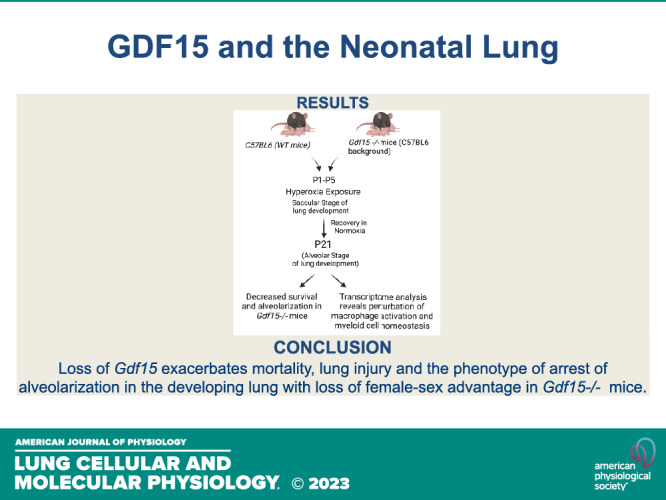
Growth differentiation factor 15 (GDF15) is a divergent member of the transforming growth factor-β (TGF-β) superfamily, and its expression increases under various stress conditions, including inflammation, hyperoxia, and senescence. GDF15 expression is increased in neonatal murine bronchopulmonary dysplasia (BPD) models, and GDF15 loss exacerbates oxidative stress and decreases cellular viability in vitro. Our overall hypothesis is that the loss of GDF15 will exacerbate hyperoxic lung injury in the neonatal lung in vivo. We exposed neonatal mice and wild-type (WT) controls on a similar background to room air or hyperoxia (95% [Formula: see text]) for 5 days after birth. The mice were euthanized on (PND 21). mice had higher mortality and lower body weight than WT mice after exposure to hyperoxia. Hyperoxia exposure adversely impacted alveolarization and lung vascular development, with a greater impact in mice. Interestingly, mice showed lower macrophage count in the lungs compared with WT mice both under room air and after exposure to hyperoxia. Analysis of the lung transcriptome revealed marked divergence in gene expression and enriched biological pathways in WT and mice and differed markedly by biological sex. Notably, pathways related to macrophage activation and myeloid cell homeostasis were negatively enriched in mice. Loss of exacerbates mortality, lung injury, and the phenotype of the arrest of alveolarization in the developing lung with loss of female-sex advantage in mice. We show for the first time that loss of exacerbates mortality, lung injury, and the phenotype of the arrest of alveolarization in the developing lung with loss of female-sex advantage in mice. We also highlight the distinct pulmonary transcriptomic response in the lung including pathways related to macrophage recruitment and activation.
生长分化因子 15(GDF15)是转化生长因子-β(TGF-β)超家族的一个分支成员,其表达在各种应激条件下增加,包括炎症、高氧和衰老。新生鼠支气管肺发育不良(BPD)模型中 GDF15 的表达增加,GDF15 缺失会加剧体外氧化应激并降低细胞活力。我们的总体假设是,GDF15 的缺失会加剧新生鼠肺内的高氧肺损伤。我们使新生小鼠和具有相似背景的野生型(WT)对照在出生后 5 天内分别暴露于空气或高氧(95%[公式:见正文])中。在出生后第 21 天(PND 21)处死小鼠。高氧暴露后,GDF15 缺失的小鼠死亡率高于 WT 小鼠,体重也低于 WT 小鼠。高氧暴露对肺泡化和肺血管发育有不利影响,在 GDF15 缺失的小鼠中影响更大。有趣的是,与 WT 小鼠相比,高氧暴露和空气暴露下 GDF15 缺失的小鼠肺部的巨噬细胞计数都较低。对肺转录组的分析显示,WT 和 GDF15 缺失的小鼠的基因表达和富集的生物学途径存在显著差异,且差异因生物学性别而异。值得注意的是,与巨噬细胞激活和髓样细胞稳态相关的途径在 GDF15 缺失的小鼠中呈负富集。GDF15 缺失会加剧死亡率、肺损伤和肺泡化发育停滞的表型,并且在 GDF15 缺失的雌性小鼠中丧失了性别优势。我们首次表明,GDF15 缺失会加剧死亡率、肺损伤和肺泡化发育停滞的表型,并且在 GDF15 缺失的雌性小鼠中丧失了性别优势。我们还突出了 GDF15 缺失的肺部转录组的独特反应,包括与巨噬细胞募集和激活相关的途径。