Julius Center for Health Sciences and Primary Care, UMC Utrecht, Universiteitsweg 100, 3584 CG, Utrecht, The Netherlands.
Institute for Risk Assessment Sciences, Utrecht University, Yalelaan 2, 3584 CM, Utrecht, the Netherlands.
BMC Public Health. 2023 Jun 27;23(1):1243. doi: 10.1186/s12889-023-16146-0.
Our aim was to gain insight into the effect of COVID-19 measures on SARS-CoV-2 incidence in secondary schools and the association with classroom CO concentration and airborne contamination.
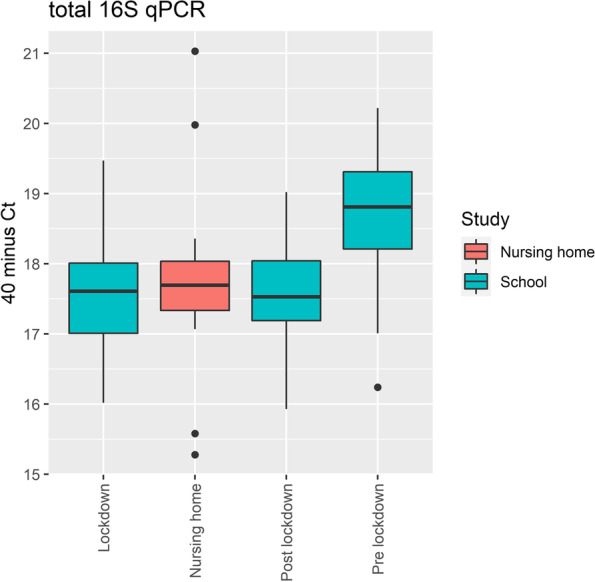
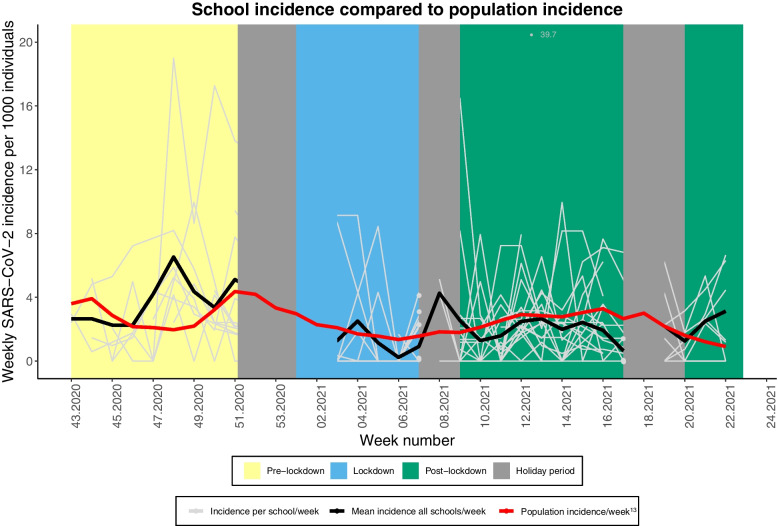
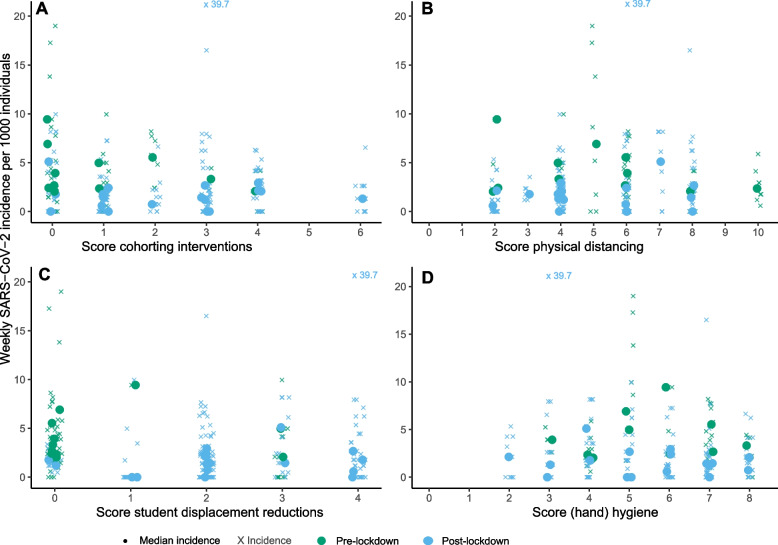
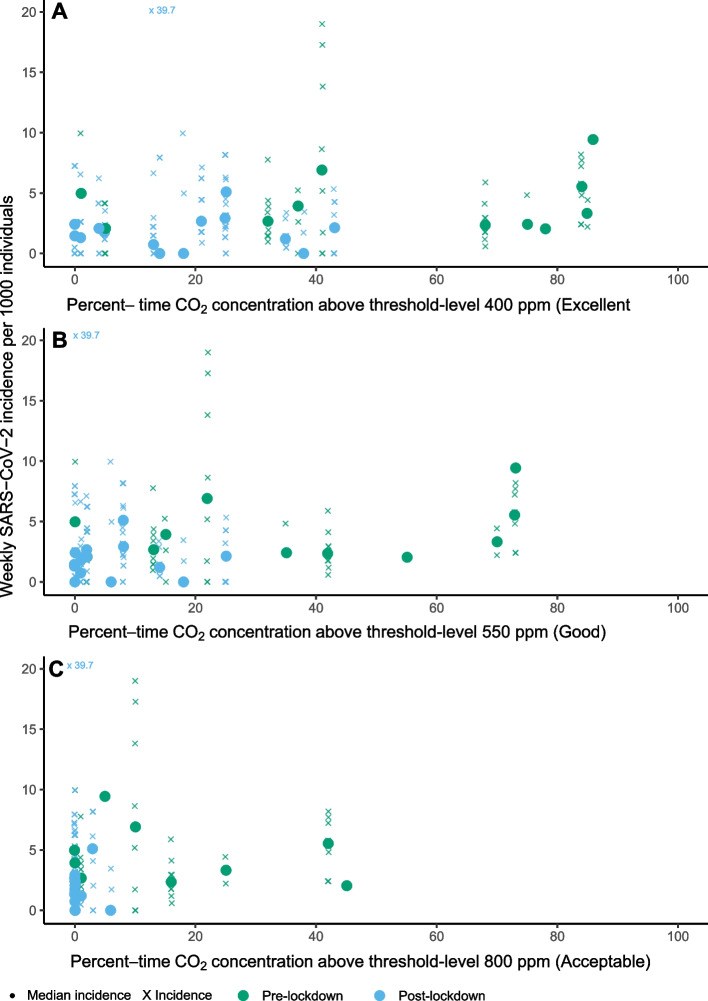
Between October 2020-June 2021, 18 schools weekly reported SARS-CoV-2 incidence and completed surveys on school-initiated COVID-19 measures (e.g. improving hygiene or minimizing contacts). CO was measured in occupied classrooms twice, and SARS-CoV-2 air contamination longitudinally using electrostatic dust collectors (EDC) and analyzed using RT-qPCR. National COVID-19 policy measures varied during pre-lockdown, lockdown and post-lockdown periods. During the entire study, schools were recommended to improve ventilation. SARS-CoV-2 incidence rate ratios (IRR) were estimated by Generalized Estimating Equation (GEE) models.
During 18 weeks follow-up (range: 10-22) SARS-CoV-2 school-incidence decreased during national lockdown (adjusted IRR: 0.41, 95%CI: 0.21-0.80) and post-lockdown (IRR: 0.60, 0.39-0.93) compared to pre-lockdown. School-initiated COVID-19 measures had no additional effect. Pre-lockdown, IRRs per 10% increase in time CO exceeded 400, 550 and 800 ppm above outdoor level respectively, were 1.08 (1.00-1.16), 1.10 (1.02-1.19), and 1.08 (0.95-1.22). Post-lockdown, COconcentrations were considerably lower and not associated with SARS-CoV-2 incidence. No SARS-CoV-2 RNA was detected in any of the EDC samples.
During a period with low SARS-CoV-2 population immunity and increased attention to ventilation, with CO levels most of the time below acceptable thresholds, only the national policy during and post-lockdown of reduced class-occupancy, stringent quarantine, and contact testing reduced SARS-CoV-2 incidence in Dutch secondary schools. Widespread SARS-CoV-2 air contamination could not be demonstrated in schools under the prevailing conditions during the study.
我们的目的是深入了解 COVID-19 措施对中学 SARS-CoV-2 发病率的影响,以及与课堂 CO 浓度和空气污染物的关联。
2020 年 10 月至 2021 年 6 月,18 所学校每周报告 SARS-CoV-2 发病率,并完成了关于学校发起的 COVID-19 措施(例如改善卫生或最大程度减少接触)的调查。两次在有人居住的教室测量 CO,使用静电除尘器(EDC)纵向分析 SARS-CoV-2 空气污染物,并使用 RT-qPCR 进行分析。在封锁前、封锁中和封锁后期间,国家 COVID-19 政策措施各不相同。在整个研究过程中,建议学校改善通风。使用广义估计方程(GEE)模型估计 SARS-CoV-2 发病率比率(IRR)。
在 18 周的随访期间(范围为 10-22 周),与封锁前相比,国家封锁期间(调整后的 IRR:0.41,95%CI:0.21-0.80)和封锁后(IRR:0.60,0.39-0.93)SARS-CoV-2 学校发病率降低。学校发起的 COVID-19 措施没有额外效果。在封锁前,当 CO 浓度超过室外水平的 10%时,IRR 分别超过 400、550 和 800 ppm,分别为 1.08(1.00-1.16)、1.10(1.02-1.19)和 1.08(0.95-1.22)。在封锁后,CO 浓度明显降低,与 SARS-CoV-2 发病率无关。在任何 EDC 样本中均未检测到 SARS-CoV-2 RNA。
在 SARS-CoV-2 人群免疫力低且增加了对通风的关注的时期,CO 水平大多数时间低于可接受的阈值,只有国家在封锁期间和封锁后实施的减少班级占有率、严格检疫和接触测试的政策降低了荷兰中学的 SARS-CoV-2 发病率。在研究期间,在普遍的条件下,没有在学校中证明广泛存在 SARS-CoV-2 空气污染物。