Center for Infectious Disease Modeling and Analysis, Yale School of Public Health, New Haven, CT 06520.
Center for Vaccine Development and Global Health, University of Maryland School of Medicine, Baltimore, MD 21201.
Proc Natl Acad Sci U S A. 2021 Aug 24;118(34). doi: 10.1073/pnas.2109229118.
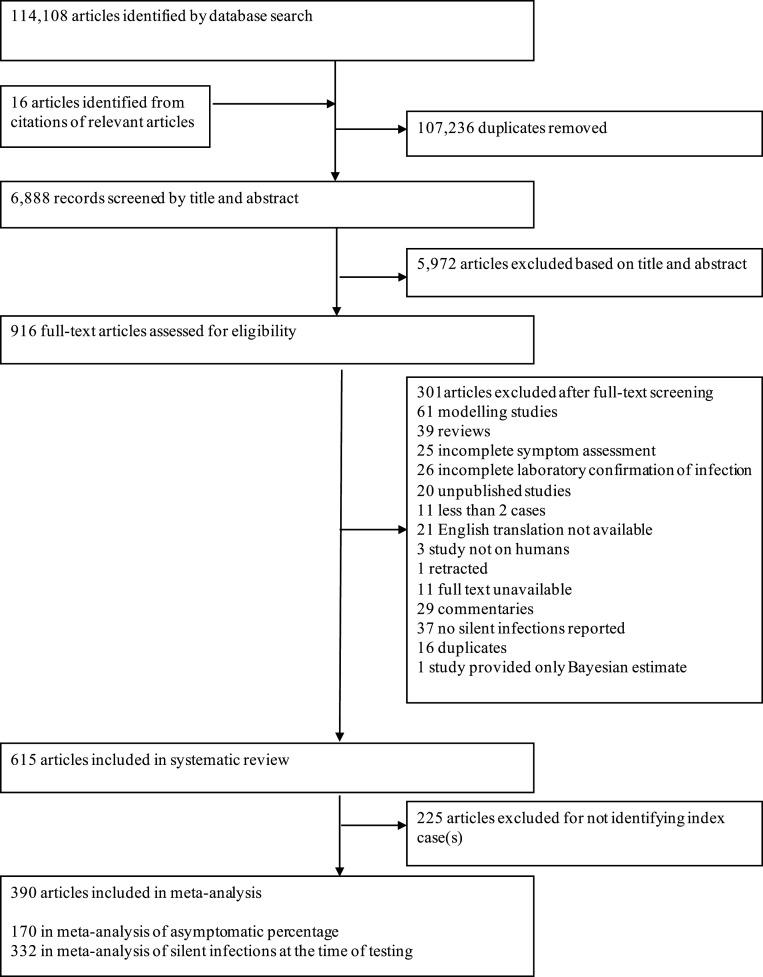
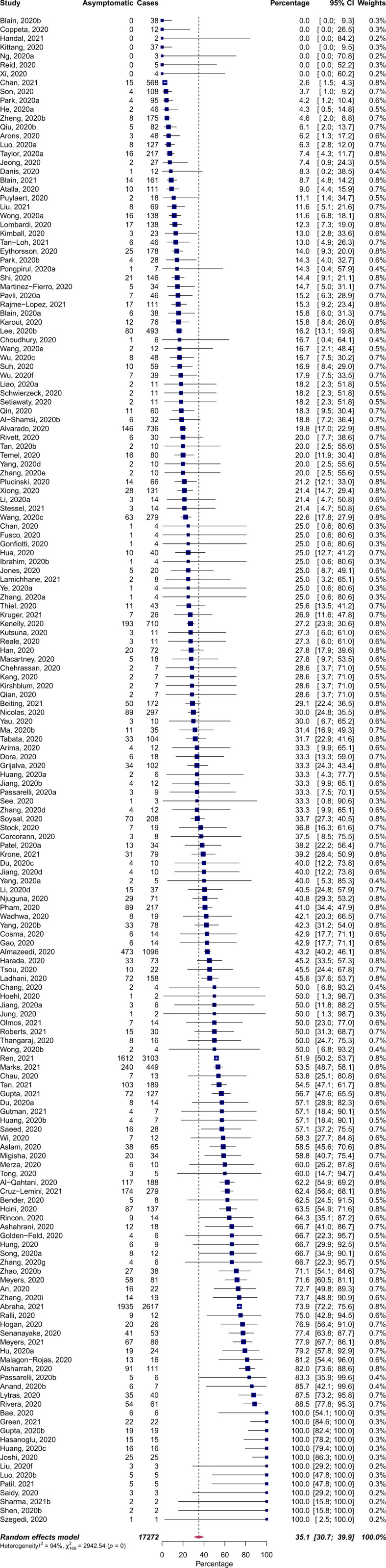
Quantification of asymptomatic infections is fundamental for effective public health responses to the COVID-19 pandemic. Discrepancies regarding the extent of asymptomaticity have arisen from inconsistent terminology as well as conflation of index and secondary cases which biases toward lower asymptomaticity. We searched PubMed, Embase, Web of Science, and World Health Organization Global Research Database on COVID-19 between January 1, 2020 and April 2, 2021 to identify studies that reported silent infections at the time of testing, whether presymptomatic or asymptomatic. Index cases were removed to minimize representational bias that would result in overestimation of symptomaticity. By analyzing over 350 studies, we estimate that the percentage of infections that never developed clinical symptoms, and thus were truly asymptomatic, was 35.1% (95% CI: 30.7 to 39.9%). At the time of testing, 42.8% (95% prediction interval: 5.2 to 91.1%) of cases exhibited no symptoms, a group comprising both asymptomatic and presymptomatic infections. Asymptomaticity was significantly lower among the elderly, at 19.7% (95% CI: 12.7 to 29.4%) compared with children at 46.7% (95% CI: 32.0 to 62.0%). We also found that cases with comorbidities had significantly lower asymptomaticity compared to cases with no underlying medical conditions. Without proactive policies to detect asymptomatic infections, such as rapid contact tracing, prolonged efforts for pandemic control may be needed even in the presence of vaccination.
无症状感染的量化对于有效应对 COVID-19 大流行的公共卫生措施至关重要。由于术语不一致以及将索引病例和次级病例混淆,导致无症状感染的程度存在差异,从而偏向于低估无症状感染的程度。我们检索了 2020 年 1 月 1 日至 2021 年 4 月 2 日期间在 PubMed、Embase、Web of Science 和世界卫生组织 COVID-19 全球研究数据库中报告了在检测时处于潜伏期或无症状期的静默感染的研究。为了尽量减少代表性偏差,我们去除了索引病例,因为这种偏差会导致对症状性感染的高估。通过分析 350 多项研究,我们估计从未出现临床症状的感染比例,即真正无症状的感染比例为 35.1%(95%CI:30.7 至 39.9%)。在检测时,42.8%(95%预测区间:5.2 至 91.1%)的病例没有任何症状,其中包括无症状和潜伏期感染。与儿童(95%CI:32.0 至 62.0%)相比,老年人的无症状感染比例显著较低,为 19.7%(95%CI:12.7 至 29.4%)。我们还发现,与没有潜在疾病的病例相比,患有合并症的病例的无症状感染比例显著降低。如果没有主动检测无症状感染的政策,如快速接触者追踪,即使在接种疫苗的情况下,也可能需要长期努力来控制大流行。