Martins Tanimola, Ukoumunne Obioha C, Lyratzopoulos Georgios, Hamilton Willie, Abel Gary
Department of Health and Community Sciences, Faculty of Health and Life Sciences, College of Medicine and Health, University of Exeter St Luke's Campus, Magdalen Road, Exeter EX1 2LU, UK.
National Institute for Health and Care Research (NIHR) Applied Research Collaboration (ARC) South West Peninsula (PenARC), Department of Health and Community Sciences, Faculty of Health and Life Sciences, University of Exeter, Exeter EX1 2LU, UK.
Cancers (Basel). 2023 Jun 7;15(12):3100. doi: 10.3390/cancers15123100.
We investigated ethnic differences in the presenting features recorded in primary care before cancer diagnosis.
English population-based cancer-registry-linked primary care data were analysed. We identified the coded features of six cancers (breast, lung, prostate, colorectal, oesophagogastric, and myeloma) in the year pre-diagnosis. Logistic regression models investigated ethnic differences in first-incident cancer features, adjusted for age, sex, smoking status, deprivation, and comorbidity.
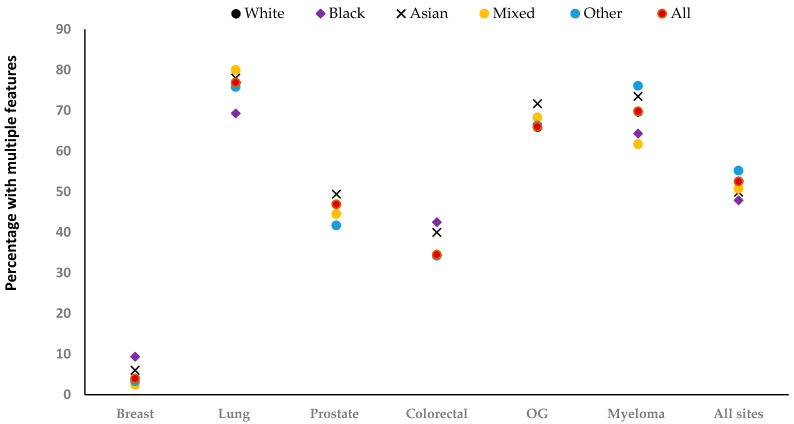
Of 130,944 patients, 92% were White. In total, 188,487 incident features were recorded in the year pre-diagnosis, with 48% (89,531) as sole features. Compared with White patients, Asian and Black patients with breast, colorectal, and prostate cancer were more likely than White patients to have multiple features; the opposite was seen for the Black and Other ethnic groups with lung or prostate cancer. The proportion with relevant recorded features was broadly similar by ethnicity, with notable cancer-specific exceptions. Asian and Black patients were more likely to have low-risk features (e.g., cough, upper abdominal pain) recorded. Non-White patients were less likely to have alarm features.
The degree to which these differences reflect disease, patient or healthcare factors is unclear. Further research examining the predictive value of cancer features in ethnic minority groups and their association with cancer outcomes is needed.
我们调查了癌症诊断前初级保健中记录的呈现特征的种族差异。
分析了与英国人群癌症登记相关的初级保健数据。我们确定了诊断前一年六种癌症(乳腺癌、肺癌、前列腺癌、结直肠癌、食管胃癌和骨髓瘤)的编码特征。逻辑回归模型研究了首次发生癌症特征的种族差异,并对年龄、性别、吸烟状况、贫困程度和合并症进行了调整。
在130,944名患者中,92%为白人。在诊断前一年共记录了188,487个发病特征,其中48%(89,531个)为唯一特征。与白人患者相比,患有乳腺癌、结直肠癌和前列腺癌的亚洲和黑人患者比白人患者更有可能具有多种特征;患有肺癌或前列腺癌的黑人和其他种族群体则情况相反。按种族划分,有相关记录特征的比例大致相似,但有明显的癌症特异性例外情况。亚洲和黑人患者更有可能记录有低风险特征(如咳嗽、上腹部疼痛)。非白人患者出现警示特征的可能性较小。
这些差异在多大程度上反映疾病、患者或医疗保健因素尚不清楚。需要进一步研究少数民族群体中癌症特征的预测价值及其与癌症结局的关联。