Tribst João Paulo Mendes, Werner Arie, Blom Erik J
Department of Reconstructive Oral Care, Academic Centre for Dentistry Amsterdam (ACTA), Universiteit van Amsterdam and Vrije Universiteit, 1081 LA Amsterdam, The Netherlands.
Department of Dental Materials Science, Academic Centre for Dentistry Amsterdam (ACTA), University of Amsterdam and Vrije University Amsterdam, 1081 LA Amsterdam, The Netherlands.
Diagnostics (Basel). 2023 Jun 20;13(12):2123. doi: 10.3390/diagnostics13122123.
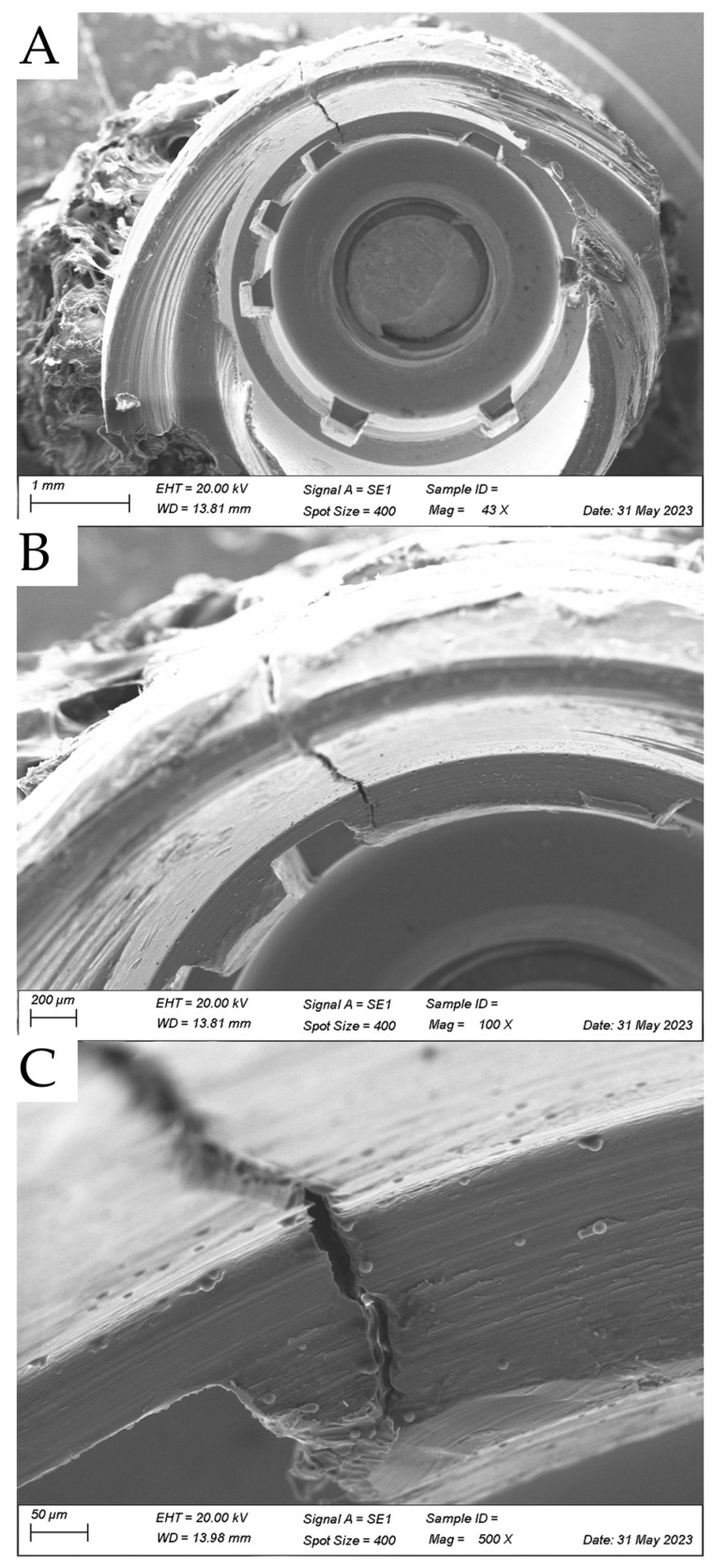
Despite the widespread use of titanium implants in orthopedic and dental surgeries, concerns have recently emerged regarding potential deformations and fractures after osseointegration. In a recent clinical case, a titanium implant fractured after successful osseointegration. This fracture occurred despite the absence of any significant trauma or excessive external force applied to the area. The fracture was attributed to a combination of factors, including abutment design flaws, material fatigue, and biomechanical stress imposed on the implant during functional loading. This raises concerns about the long-term durability and reliability of titanium implants, particularly in high-stress areas such as the posterior region or weight-bearing bones. An image was made with scanning electron microscopy showing the fracture region near the prosthetic platform and highlighting the knowledge that despite their ductility, titanium implants can fracture.
尽管钛植入物在骨科和牙科手术中广泛使用,但最近人们对骨整合后可能出现的变形和骨折产生了担忧。在最近的一个临床病例中,一枚钛植入物在成功骨整合后发生了骨折。尽管该区域没有受到任何重大创伤或施加过大外力,但骨折还是发生了。骨折归因于多种因素的综合作用,包括基台设计缺陷、材料疲劳以及功能加载过程中施加在植入物上的生物力学应力。这引发了人们对钛植入物长期耐用性和可靠性的担忧,尤其是在诸如后部区域或承重骨等高应力区域。通过扫描电子显微镜拍摄了一张图像,显示了假体平台附近的骨折区域,并突出了一个事实,即尽管钛植入物具有延展性,但仍可能发生骨折。