Liu Haichuan, Li Zhenghang, Zhang La, Zhang Mi, Liu Shanshan, Wang Jianwei, Yang Changhong, Peng Qiling, Du Chengyou, Jiang Ning
Department of Hepatobiliary Surgery, The First Affiliated Hospital of Chongqing Medical University, Chongqing 400016, China.
Department of Breast and Thyroid Surgery, The First Affiliated Hospital of Chongqing Medical University, Chongqing 400016, China.
Biomedicines. 2023 Jun 16;11(6):1738. doi: 10.3390/biomedicines11061738.
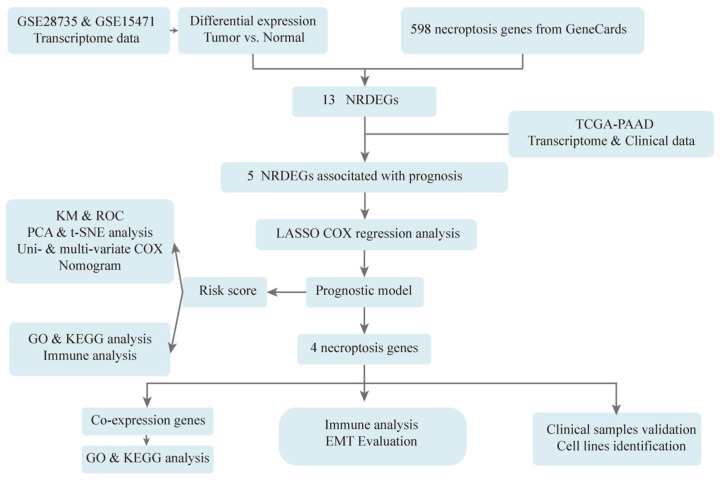
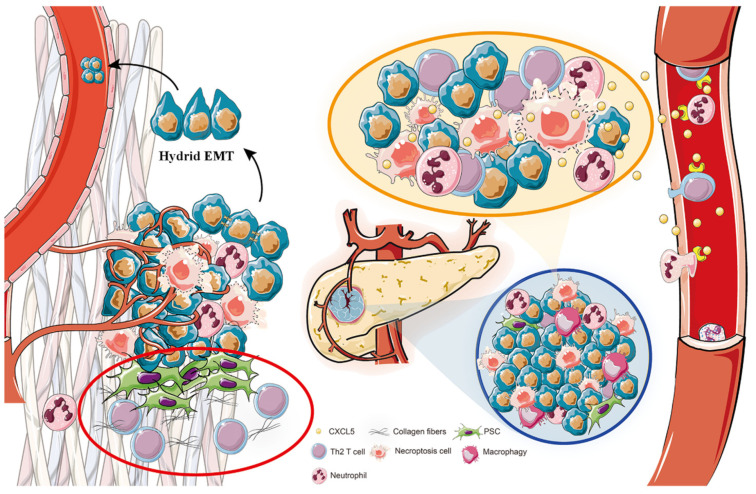
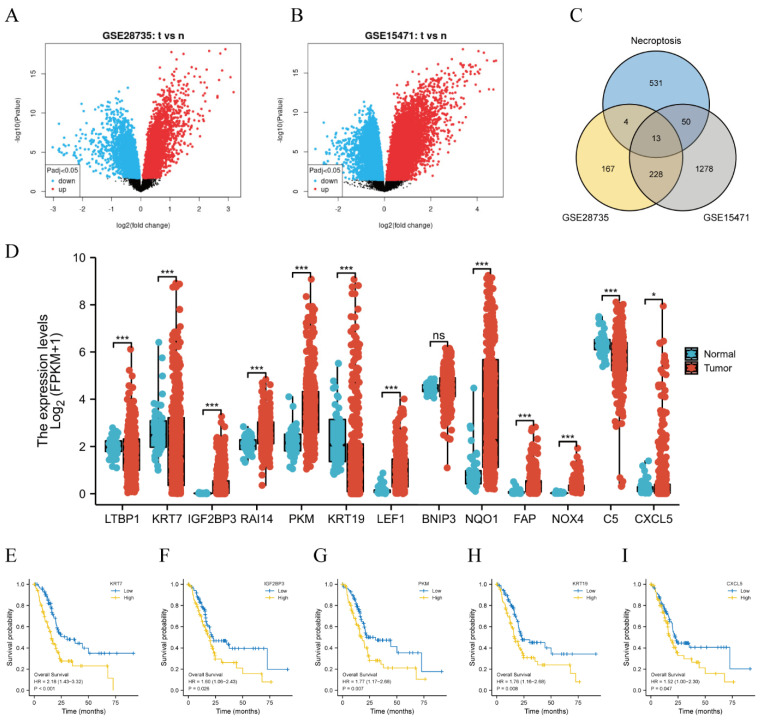
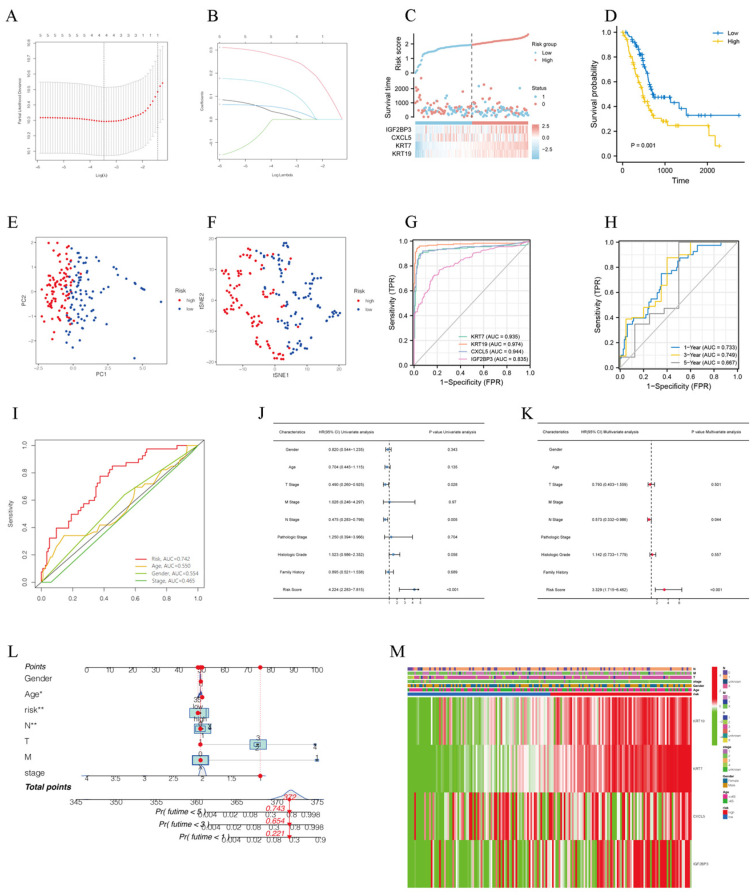
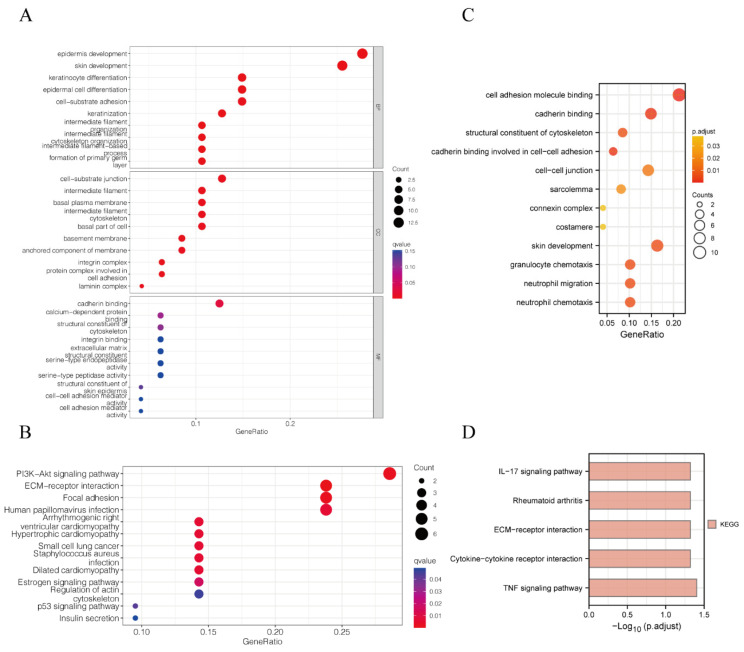
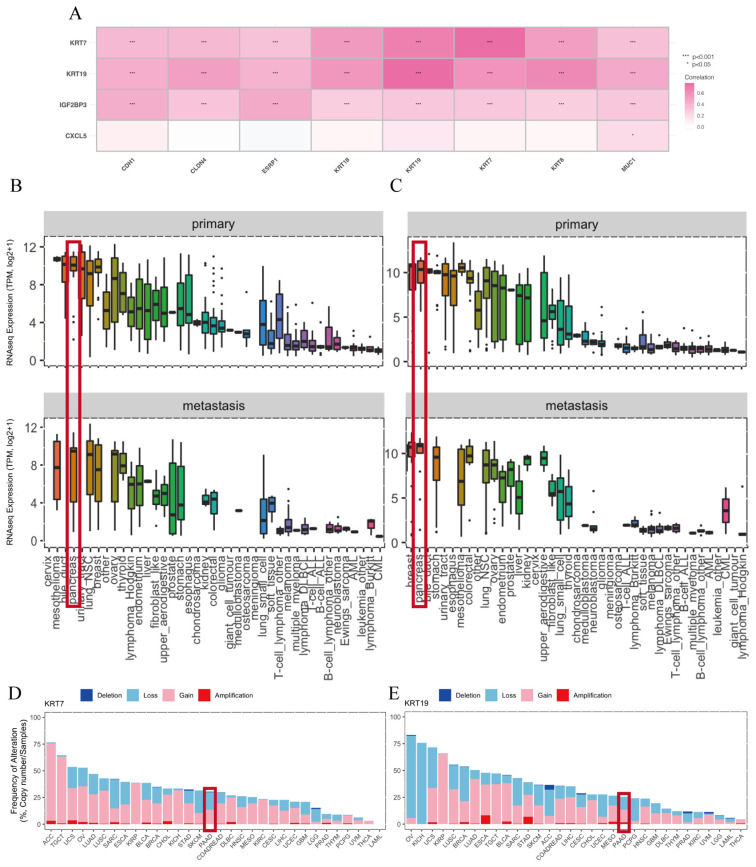
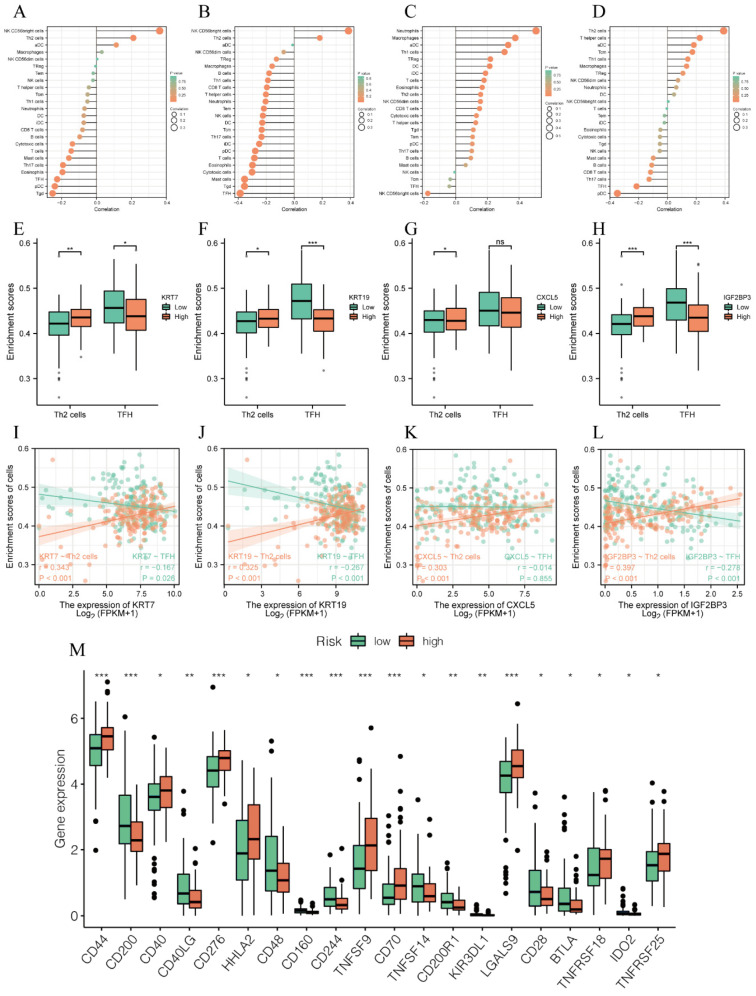
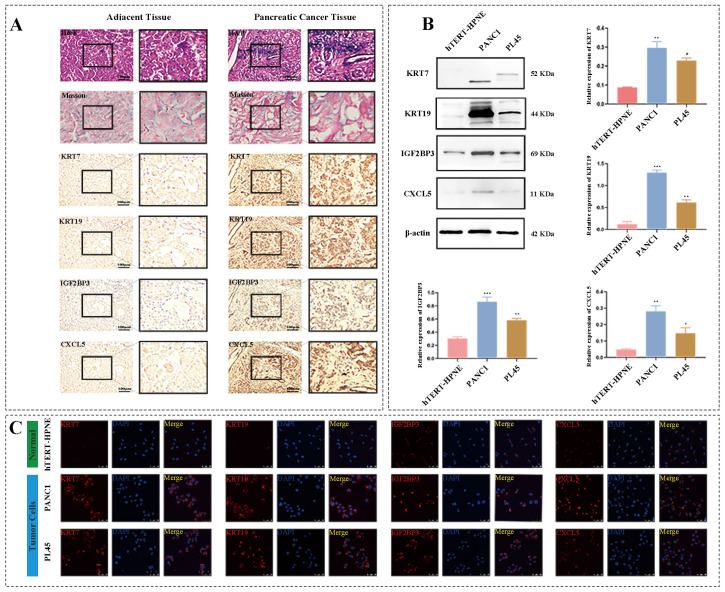
Necroptosis, pro-inflammatory programmed necrosis, has been reported to exert momentous roles in pancreatic cancer (PC). Herein, the objective of this study is to construct a necroptosis-related prognostic model for detecting pancreatic cancer. In this study, the intersection between necroptosis-related genes and differentially expressed genes (DEGs) of pancreatic ductal adenocarcinoma (PDAC) was obtained based on GeneCards database, GEO database (GSE28735 and GSE15471), and verified using The Cancer Genome Atlas (TCGA). Next, a prognostic model with Cox and LASSO regression analysis, and divided the patients into high-risk and low-risk groups. Subsequently, the Kaplan-Meier (KM) survival curve and the receiver operating characteristic (ROC) curves were generated to assess the predictive ability of overall survival (OS) of PC patients. Gene ontology (GO) and Kyoto Encyclopedia of Genes and Genomes (KEGG) analyses were performed to predict the potential biofunction and possible mechanical pathways. The EMTome database and an immune analysis were applied to further explore underlying mechanism. Finally, clinical samples of PDAC patients were utilized to verify the expression of model genes via immunohistochemistry (IHC), and the normal human pancreatic ductal cell line, hTERT-HPNE as well as human pancreatic ductal carcinoma cell lines, PANC-1 and PL45, were used to identify the levels of model genes by Western blot (WB) and immunofluorescence (IF) in vitro. The results showed that 13 necroptosis-related DEGs (NRDEGs) were screened based on GEO database, and finally four of five prognostic genes, including KRT7, KRT19, IGF2BP3, CXCL5, were further identified by TCGA to successfully construct a prognostic model. Univariate and multivariate Cox analysis ultimately confirmed that this prognostic model has independent prognostic significance, KM curve suggested that the OS of low-risk group was longer than high-risk group, and the area under receiver (AUC) of ROC for 1, 3, 5 years was 0.733, 0.749 and 0.667, respectively. A GO analysis illustrated that model genes may participate in cell-cell junction, cadherin binding, cell adhesion molecule binding, and neutrophil migration and chemotaxis, while KEGG showed involvement in PI3K-Akt signaling pathway, ECMreceptor interaction, IL-17 signaling pathway, TNF signaling pathway, etc. Moreover, our results showed KRT7 and KRT19 were closely related to EMT markers, and EMTome database manifested that KRT7 and KRT19 are highly expressed in both primary and metastatic pancreatic cancer, declaring that model genes promoted invasion and metastasis potential through EMT. In addition, four model genes were positively correlated with Th2, which has been reported to take part in promoting immune escape, while model genes except CXCL5 were negatively correlated with TFH cells, indicating that model genes may participate in immunity. Additionally, IHC results showed that model genes were higher expressed in PC tissues than that in adjacent tumor tissues, and WB and IF also suggested that model genes were more highly expressed in PANC-1 and PL45 than in hTERT-HPNE. Tracing of a necroptosis-related prognostic model for pancreatic carcinoma reveals its invasion and metastasis potential through EMT and immunity. The construction of this model and the possible mechanism of necroptosis in PDAC was preliminarily explored to provide reliable new biomarkers for the early diagnosis, treatment, and prognosis for pancreatic cancer patients.
坏死性凋亡,即促炎性程序性坏死,据报道在胰腺癌(PC)中发挥着重要作用。在此,本研究的目的是构建一个用于检测胰腺癌的坏死性凋亡相关预后模型。在本研究中,基于基因卡片数据库、基因表达综合数据库(GSE28735和GSE15471)获得坏死性凋亡相关基因与胰腺导管腺癌(PDAC)差异表达基因(DEGs)的交集,并使用癌症基因组图谱(TCGA)进行验证。接下来,通过Cox和LASSO回归分析构建一个预后模型,并将患者分为高风险组和低风险组。随后,生成Kaplan-Meier(KM)生存曲线和受试者工作特征(ROC)曲线,以评估PC患者总生存期(OS)的预测能力。进行基因本体(GO)和京都基因与基因组百科全书(KEGG)分析,以预测潜在的生物功能和可能的作用机制。应用EMTome数据库和免疫分析进一步探索潜在机制。最后,利用PDAC患者的临床样本通过免疫组织化学(IHC)验证模型基因的表达,并使用正常人胰腺导管细胞系hTERT-HPNE以及人胰腺导管癌细胞系PANC-1和PL45,通过蛋白质免疫印迹(WB)和免疫荧光(IF)在体外鉴定模型基因的水平。结果显示,基于基因表达综合数据库筛选出13个坏死性凋亡相关差异表达基因(NRDEGs),最终通过TCGA进一步鉴定出5个预后基因中的4个,包括角蛋白7(KRT7)、角蛋白19(KRT19)、胰岛素样生长因子2结合蛋白3(IGF2BP3)、趋化因子配体5(CXCL5),成功构建了一个预后模型。单因素和多因素Cox分析最终证实该预后模型具有独立的预后意义,KM曲线表明低风险组的OS长于高风险组,1年、3年、5年ROC曲线下面积(AUC)分别为0.733、0.749和0.667。GO分析表明,模型基因可能参与细胞间连接、钙黏蛋白结合、细胞黏附分子结合以及中性粒细胞迁移和趋化作用,而KEGG显示其参与磷脂酰肌醇-3激酶-蛋白激酶B(PI3K-Akt)信号通路、细胞外基质受体相互作用、白细胞介素-17(IL-17)信号通路、肿瘤坏死因子(TNF)信号通路等。此外,我们的结果显示KRT7和KRT19与上皮-间质转化(EMT)标志物密切相关,EMTome数据库表明KRT7和KRT19在原发性和转移性胰腺癌中均高表达,表明模型基因通过EMT促进侵袭和转移潜能。此外,4个模型基因与辅助性T细胞2(Th2)呈正相关,Th2据报道参与促进免疫逃逸,而除CXCL5外的模型基因与滤泡辅助性T细胞(TFH)呈负相关,表明模型基因可能参与免疫过程。此外,IHC结果显示模型基因在PC组织中的表达高于相邻肿瘤组织,WB和IF也表明模型基因在PANC-1和PL45中的表达高于hTERT-HPNE。追踪胰腺癌坏死性凋亡相关预后模型揭示其通过EMT和免疫的侵袭和转移潜能。初步探索了该模型的构建以及坏死性凋亡在PDAC中的可能机制,为胰腺癌患者的早期诊断、治疗和预后提供可靠的新生物标志物。