Lu Hongxia, Zheng Jianwei, Wang Yun
Department of Pharmaceutical Economics and Policy, School of Pharmacy, Chapman University, Irvine, CA 92618, USA.
School of Medicine, University of North Carolina at Chapel Hill, Chapel Hill, NC 27599, USA.
Healthcare (Basel). 2023 Jun 13;11(12):1732. doi: 10.3390/healthcare11121732.
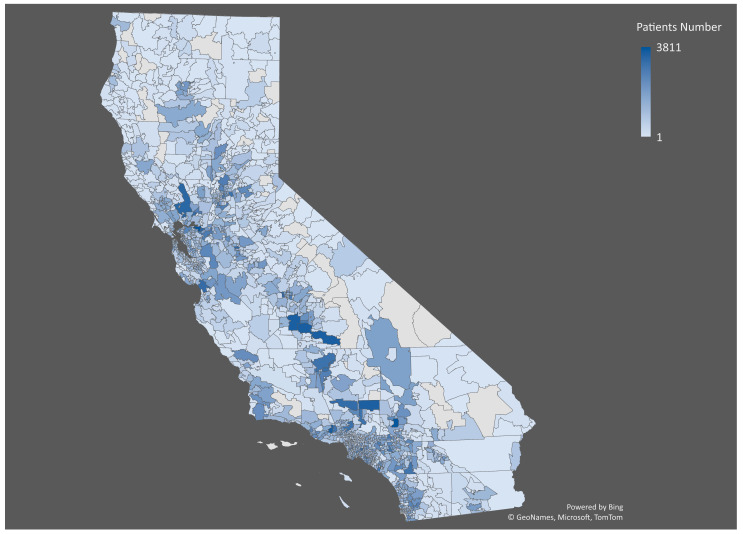
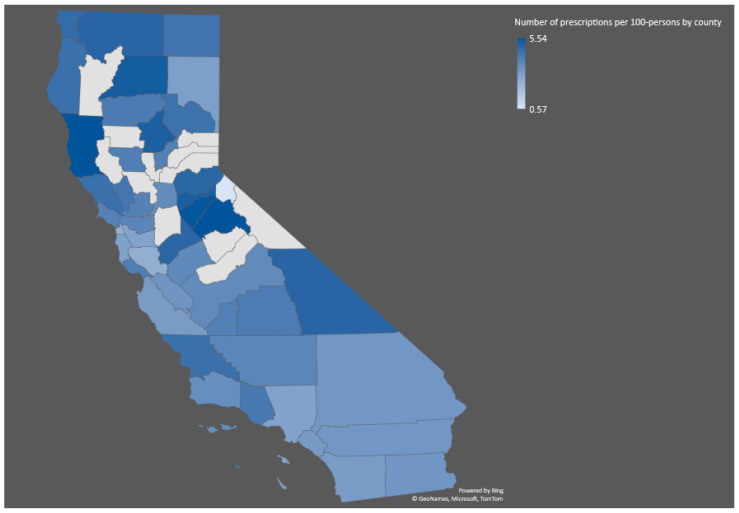
The misuse and abuse of opioids has become a serious public health threat in the United States. The state of California has been hit particularly hard by the opioid epidemic, with a noticeable increase in opioid-related fatalities and hospitalizations. This brief report paper aims to contribute to the growing literature by conducting a geospatial analysis of opioid dispensing patterns in California in 2021. The primary objective was to identify areas characterized by high-risk opioid dispending patterns and explore possible contributing factors. This retrospective study analyzed data from over 7 million records of opioid and benzodiazepine prescriptions dispensed by outpatient pharmacies in California in 2021. A series of generalized linear regression models was employed to assess the impact of neighborhood characteristics on opioid recipients and high-risk opioid dispensing. The study defined high-risk opioid dispensing behavior as: (1) multiple provider episodes, (2) overlapping opioid prescriptions for seven or more days, (3) overlapping opioid and benzodiazepine prescriptions for seven or more days, and (4) a high standardized dosage of opioid prescriptions per month. The study identified variables associated with high-risk opioid dispensing behaviors, including age, population density, income, and housing-related variables, as well as marital status and family-related variables. The study uncovered that there are noticeable disparities in opioid dispensing among different racial and ethnic groups within California. The findings indicated a correlation of high-risk dispensing indicators with certain demographic and socioeconomic factors. There was a substantial regional variation in opioid dispensing practices, with certain rural areas having higher rates of opioid prescriptions than urban areas.
阿片类药物的滥用在美国已成为严重的公共卫生威胁。加利福尼亚州受阿片类药物流行的影响尤为严重,与阿片类药物相关的死亡人数和住院人数显著增加。本简要报告旨在通过对2021年加利福尼亚州阿片类药物配药模式进行地理空间分析,为不断增加的文献做出贡献。主要目标是确定以高风险阿片类药物配药模式为特征的区域,并探索可能的促成因素。这项回顾性研究分析了2021年加利福尼亚州门诊药房超过700万份阿片类药物和苯二氮䓬类药物处方记录的数据。采用一系列广义线性回归模型来评估社区特征对阿片类药物接受者和高风险阿片类药物配药的影响。该研究将高风险阿片类药物配药行为定义为:(1)多次由不同提供者开具处方;(2)阿片类药物处方重叠七天或更长时间;(3)阿片类药物和苯二氮䓬类药物处方重叠七天或更长时间;(4)每月阿片类药物处方的标准化剂量较高。该研究确定了与高风险阿片类药物配药行为相关的变量,包括年龄、人口密度、收入和与住房相关的变量,以及婚姻状况和与家庭相关的变量。该研究发现,加利福尼亚州不同种族和族裔群体在阿片类药物配药方面存在明显差异。研究结果表明高风险配药指标与某些人口统计学和社会经济因素之间存在相关性。阿片类药物配药做法存在很大的区域差异,某些农村地区的阿片类药物处方率高于城市地区。