Heshmatipour Matthew, Quan Ng Ding, Yi-Wen Truong Emily, Zheng Jianwei, Chan Alexandre, Wang Yun
University of California Irvine, School of Pharmacy and Pharmaceutical Sciences, Irvine, California.
University of California Irvine, Donald Bren School of Information and Computer Sciences, Irvine, California.
West J Emerg Med. 2024 Nov;25(6):883-889. doi: 10.5811/westjem.18468.
Coronavirus 2019 (COVID-19) has had a devastating impact on mental health and access to addiction treatment in the United States, including in California, which resulted in the highest rates of emergency department visits (ED) for opioid poisoning in 2020. As California slowly returns to pre-pandemic normalcy, it remains uncertain whether the rates of opioid-related events have slowed down over time. We hypothesized that the number of opioid-related ED visits were exacerbated after the period of the COVID-19 pandemic and continue at a high rate in the present.
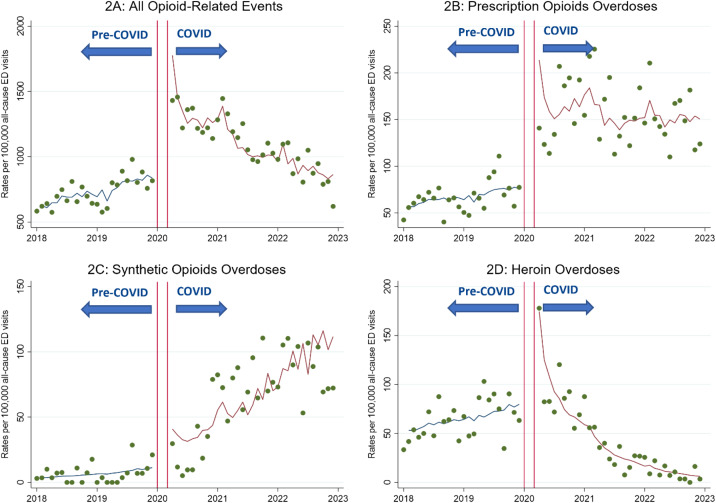
In this analysis we searched the University of California (UC) Health Data Warehouse-a database of electronic health records from six academic medical centers-for opioid related ED visits, identifiying using the following International Classification of Diseases, 10 Ed, Clinical Modification codes: F11 codes, and T40.0*, T40.1*, T40.2*, T40.3*, T40.4*, T40.6*. Opioid overdose-associated visits were classified by types of opioids involved: heroin (T40.1*); prescription opioids (T40.2* or T40.3*); and synthetic opioids (T40.4*). We performed interrupted time analysis to estimate the immediate (level) change and change-in-time trend (trend change), from before (January 2018-October 2019) and during the pandemic (April 2020-December 2022). Monthly visit rates were evaluated with negative binomial regression adjusted for first-order autoregression and using all-cause ED counts as the offset. We present effect sizes as rate ratios (RR) and 95% confidence intervals (CI), tested at α = .05.
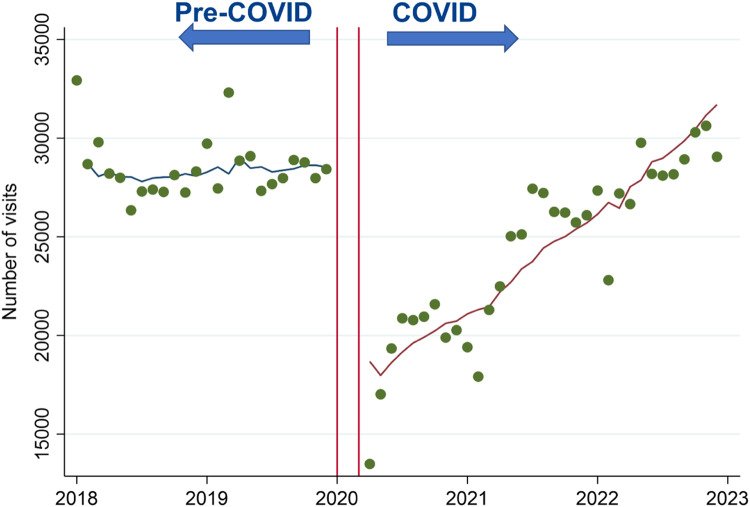
We observed a decrease in overall ED visits from 28,426 to 25,121 visits in December 2019 and June 2021, respectively across all six UC Health Centers. Before COVID-19, we found that ED visit rates steadily increased for all outcomes ( < 0.05) except synthetic opioids. Total opioid-related ED visit rates increased by 15% (RR 1.15, 95% CI 1.02-1.29, = 0.20) immediately after March 2020 before decreasing by 0.5% every month, albeit without statistical significance (RR .995, 95% CI .991-1.00, = 0.06). Opioid-related events across the six academic medical centers increase from 232 in December 2019, representing a single month's total, and peaked at 315 in June 2021. Similar trends were observed with prescription opioid overdoses, with a step increase of 44% (RR 1.44, 95% CI 1.10-1.89, = .008) before plateauing after March 2020 (RR 1.01, 95% CI .998-1.02, = 0.12). Specifically, the total number of prescription opioid-related ED visits more than doubled between December 2019 (22 visits) and June 2021 (49 visits). After March 2020, ED visit rates for synthetic opioid overdoses were increasing steadily by 4% every month (RR 1.04, 95% CI 1.02-1.06, = .001), unlike with heroin, which was observed with an 8% monthly reduction (RR .92, 95% CI .90-.93, < .001). No immediate increase in visit rates was observed for either opioid.
While opioid-related ED admissions among the UC health centers showed an overall decrease, prescription and synthetic opioid overdoses remained significantly higher than pre-pandemic trends as of December 2022. A multilevel approach to improve awareness of new opioid health policies could ameliorate these alarming rises in the post-pandemic era.
2019年冠状病毒病(COVID-19)对美国的心理健康和成瘾治疗可及性产生了毁灭性影响,在加利福尼亚州亦是如此,该州在2020年因阿片类药物中毒导致的急诊就诊率最高。随着加利福尼亚州慢慢恢复到大流行前的正常状态,阿片类药物相关事件的发生率是否随时间推移而放缓仍不确定。我们推测,在COVID-19大流行期间之后,与阿片类药物相关的急诊就诊数量有所增加,且目前仍维持在较高水平。
在本分析中,我们在加利福尼亚大学(UC)健康数据仓库中进行搜索,该仓库是一个来自六个学术医疗中心的电子健康记录数据库,以查找与阿片类药物相关的急诊就诊情况,使用以下《国际疾病分类》第10版临床修订版代码进行识别:F11代码,以及T40.0*、T40.1*、T40.2*、T40.3*、T40.4*、T40.6*。与阿片类药物过量相关的就诊情况按所涉及的阿片类药物类型进行分类:海洛因(T40.1*);处方阿片类药物(T40.2或T40.3);以及合成阿片类药物(T40.4*)。我们进行了中断时间分析,以估计2018年1月至2019年10月(大流行前)和2020年4月至2022年12月(大流行期间)之间的即时(水平)变化和时间趋势变化(趋势变化)。每月就诊率通过负二项回归进行评估,并对一阶自回归进行调整,以所有原因导致的急诊就诊次数作为偏移量。我们将效应量表示为率比(RR)和95%置信区间(CI),在α = 0.05的水平上进行检验。
我们观察到,在2019年12月和2021年6月,六个UC健康中心的急诊就诊总数分别从28,426次降至25,121次。在COVID-19之前,我们发现除合成阿片类药物外,所有结果的急诊就诊率均稳步上升(P < 0.05)。在2020年3月之后,与阿片类药物相关的急诊就诊总率立即上升了15%(RR 1.15,95% CI 1.02 - 1.29,P = 0.20),随后每月下降0.5%,尽管无统计学意义(RR 0.995,95% CI 0.991 - 1.00,P = 0.06)。六个学术医疗中心的阿片类药物相关事件从2019年12月的232例(代表一个月的总数)增加到2021年6月的峰值315例。处方阿片类药物过量也观察到类似趋势,在2020年3月后出现44%的跃升(RR 1.44,95% CI 1.10 - 1.89,P = 0.008),之后趋于平稳(RR 1.01,95% CI 0.998 - 1.02,P = 0.12)。具体而言,与处方阿片类药物相关的急诊就诊总数在2019年12月(22次就诊)至2021年6月(49次就诊)之间增加了一倍多。在2020年3月之后,合成阿片类药物过量的急诊就诊率每月稳步上升4%(RR 1.04,95% CI 1.02 - 1.06,P = 0.001),与海洛因不同,海洛因的急诊就诊率每月下降8%(RR 0.92,95% CI 0.90 - 0.93,P < 0.001)。两种阿片类药物的就诊率均未立即上升。
虽然UC健康中心中与阿片类药物相关的急诊入院总体有所下降,但截至2022年12月,处方和合成阿片类药物过量仍显著高于大流行前的趋势。采用多层次方法提高对新阿片类药物健康政策的认识,可能会改善大流行后时代这些令人担忧的上升情况。