Tanase Bogdan Cosmin, Burlacu Alin Ionut, Nistor Claudiu Eduard, Horvat Teodor, Oancea Cristian, Marc Monica, Tudorache Emanuela, Mateescu Tudor, Manolescu Diana
Department of Thoracic Surgery, Oncology Institute "Alexandru Trestioreanu" of Bucharest, Fundeni Street 252, 022328 Bucharest, Romania.
Center for Research and Innovation in Precision Medicine of Respiratory Diseases, "Victor Babes" University of Medicine and Pharmacy, Eftimie Murgu Square 2, 300041 Timisoara, Romania.
Healthcare (Basel). 2023 Jun 14;11(12):1745. doi: 10.3390/healthcare11121745.
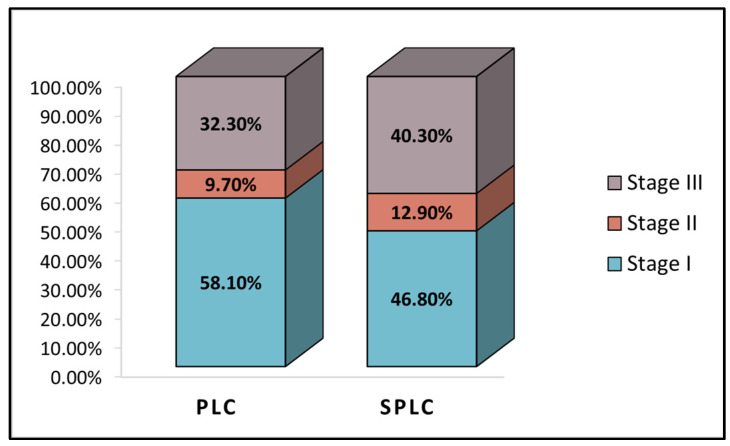
This study aimed to compare the outcomes and cost differences between primary lung cancer (PLC) and second primary lung cancer (SPLC) patients who underwent video-assisted thoracoscopic surgery (VATS). This was a retrospective analysis of 124 patients with lung cancer stages I, II, and III who underwent VATS between January 2018 and January 2023. The patients were divided into two groups based on their cancer status that was matched by age and gender: the PLC group ( = 62) and the SPLC group ( = 62). The results showed that there was no significant difference in the clinical characteristics between the 2 groups, except for the Charlson Comorbidity Index (CCI), with a score above 3 in 62.9% of PLC patients and 80.6% among SPLC patients ( = 0.028). Regarding the surgical outcomes, the operative time for the VATS intervention was significantly higher in the SPLC group, with a median of 300 min, compared with 260 min in the PLC group ( = 0.001), varying by the cancer staging as well. The average duration of hospitalization was significantly longer before and after surgery among patients with SPLC (6.1 days after surgery), compared with 4.2 days after surgery in the PLC group (0.006). Regarding the cost analysis, the total hospitalization cost was significantly higher in the SPLC group (15,400 RON vs. 12,800 RON; = 0.007). Lastly, there was a significant difference in the survival probability between the two patient groups (log-rank -value = 0.038). The 2-year survival was 41.9% among PLC patients and only 24.2% among those with SPLC. At the 5-year follow-up, there were only 1.6% survivors in the SPLC group, compared with 11.3% in the PLC group (-value = 0.028). In conclusion, this study found that VATS is a safe and effective surgical approach for both PLC and SPLC patients. However, SPLC patients have a higher VATS operating time and require more healthcare resources than PLC patients, resulting in higher hospitalization costs. These findings suggest that careful pre-operative evaluation and individualized surgical planning are necessary to optimize the outcomes and cost-effectiveness of VATS for lung cancer patients. Nevertheless, the 5-year survival remains very low and concerning.
本研究旨在比较接受电视辅助胸腔镜手术(VATS)的原发性肺癌(PLC)患者和第二原发性肺癌(SPLC)患者的手术结果及成本差异。这是一项对2018年1月至2023年1月期间接受VATS的124例I、II和III期肺癌患者的回顾性分析。根据年龄和性别匹配的癌症状态将患者分为两组:PLC组(n = 62)和SPLC组(n = 62)。结果显示,两组患者的临床特征无显著差异,但Charlson合并症指数(CCI)除外,PLC组62.9%的患者CCI评分高于3分,SPLC组为80.6%(P = 0.028)。关于手术结果,SPLC组VATS干预的手术时间显著更长,中位数为300分钟,而PLC组为260分钟(P = 0.001),且因癌症分期而异。SPLC患者术前和术后的平均住院时间显著更长(术后6.1天),而PLC组术后为4.2天(P = 0.006)。关于成本分析,SPLC组的总住院费用显著更高(15400罗马尼亚列伊对12800罗马尼亚列伊;P = 0.007)。最后,两组患者的生存概率存在显著差异(对数秩P值 = 0.038)。PLC患者的2年生存率为41.9%,而SPLC患者仅为24.2%。在5年随访时,SPLC组仅有1.6%的幸存者,而PLC组为11.3%(P值 = 0.028)。总之,本研究发现VATS对PLC和SPLC患者都是一种安全有效的手术方法。然而,SPLC患者的VATS手术时间更长,比PLC患者需要更多的医疗资源,导致住院费用更高。这些发现表明,仔细的术前评估和个体化的手术规划对于优化肺癌患者VATS的手术结果和成本效益是必要的。尽管如此,5年生存率仍然非常低且令人担忧。