Department of Pathology, Carol Davila University of Medicine and Pharmacy, 020021 Bucharest, Romania.
Department of Pathology, University Emergency Hospital, 050098 Bucharest, Romania.
Int J Mol Sci. 2023 Jun 10;24(12):9985. doi: 10.3390/ijms24129985.
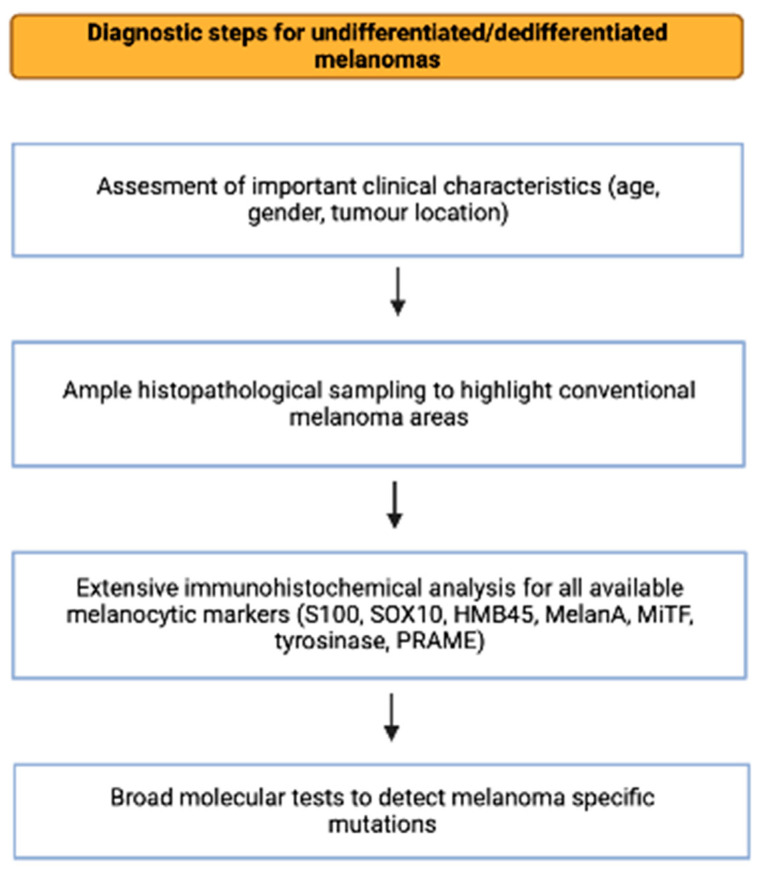
Diagnosing cutaneous melanoma is usually straightforward based on these malignancies' histopathological and immunohistochemical features. Nevertheless, melanomas can imitate various other neoplasms, sometimes lacking the expression of conventional melanocytic markers and expressing non-melanocytic ones. Furthermore, divergent differentiation is more often encountered in metastatic melanomas and is still poorly described in primary cutaneous melanomas, and little is known about these patients' prognosis and therapeutic approach. Therefore, we reviewed the literature on undifferentiated/dedifferentiated cutaneous melanomas, and we discuss the histological, immunohistochemical, and molecular profiles of undifferentiated/dedifferentiated cutaneous melanomas to understand these peculiar lesions better and improve their diagnostic algorithm. In addition to this, we also discuss how different genetic mutations may influence prognosis and become potential therapeutic targets.
诊断皮肤黑色素瘤通常基于这些恶性肿瘤的组织病理学和免疫组织化学特征。然而,黑色素瘤可能模仿各种其他肿瘤,有时缺乏常规黑色素细胞标志物的表达,而表达非黑色素细胞标志物。此外,在转移性黑色素瘤中更常遇到分化趋异,在原发性皮肤黑色素瘤中仍描述甚少,关于这些患者的预后和治疗方法知之甚少。因此,我们复习了关于未分化/去分化皮肤黑色素瘤的文献,并讨论了未分化/去分化皮肤黑色素瘤的组织学、免疫组织化学和分子特征,以更好地了解这些特殊病变并改进其诊断算法。此外,我们还讨论了不同的遗传突变如何影响预后并成为潜在的治疗靶点。