Matthews Jerusha, Secka Arss, McVey D Scott, Dodd Kimberly A, Faburay Bonto
Foreign Animal Disease Diagnostic Laboratory, National Veterinary Services Laboratories, Animal and Plant Health Inspection Services, United States Department of Agriculture, Greenport, NY 11944, USA.
West Africa Livestock Innovation Center, Banjul PMB 14, The Gambia.
Pathogens. 2023 May 23;12(6):749. doi: 10.3390/pathogens12060749.
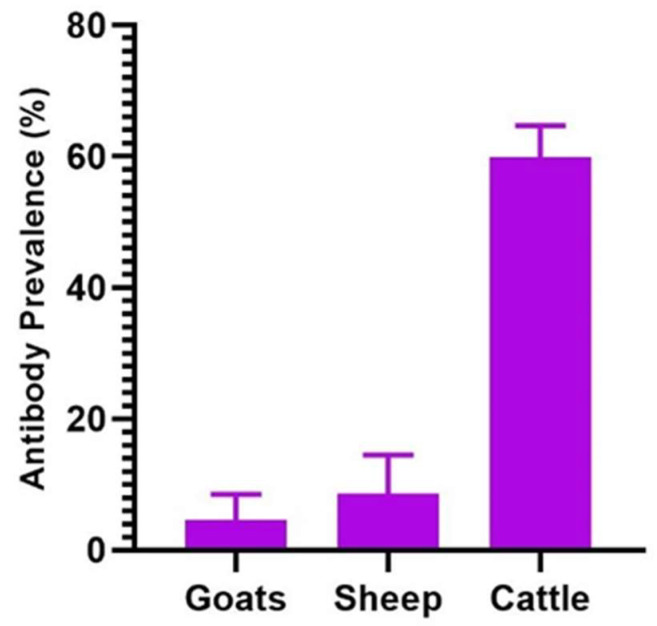
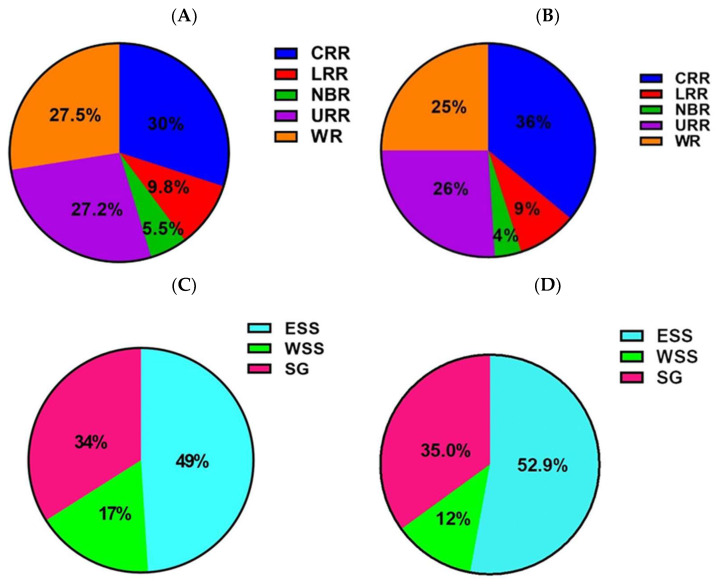
Crimean-Congo hemorrhagic fever virus (CCHFV) is a widely distributed tickborne zoonotic agent that infects a variety of host species. There is a lack of information on the true geographic distribution of the prevalence and risk of CCHFV in West Africa. A countrywide cross-sectional study involving 1413 extensively managed indigenous small ruminants and cattle at livestock sales markets and in village herds, respectively, was carried out in The Gambia. In sheep, an overall anti-CCHFV antibody prevalence of 18.9% (95% CI: 15.5-22.8%), goats 9.0% (95% CI: 6.7-11.7%), and cattle 59.9% (95% CI: 54.9-64.7%) was detected. Significant variation ( < 0.05) in the prevalence of anti-CCHFV antibodies at sites in the five administrative regions (sheep: 4.8-25.9%; goats: 1.8-17.1%) and three agroecological zones (sheep: 8.9-32.9%; goats: 4.1-18.0%) was also observed. Comparatively, higher anti-CCHFV antibody prevalence was detected in cattle (33.3-84.0%) compared to small ruminants (1.8-8.1%). This study represents the first countrywide investigation of the seroprevalence of CCHFV in The Gambia, and the results suggest potential circulation and endemicity of the virus in the country. These data provide critical information vital to the development of informed policies for the surveillance, diagnosis, and control of CCFHV infection in The Gambia and the region.
克里米亚-刚果出血热病毒(CCHFV)是一种广泛传播的蜱传人畜共患病原体,可感染多种宿主物种。关于西非CCHFV流行率和风险的真实地理分布,目前缺乏相关信息。在冈比亚开展了一项全国性横断面研究,分别在牲畜销售市场和村庄畜群中对1413只粗放管理的本地小型反刍动物和牛进行了调查。在绵羊中,检测到抗CCHFV抗体的总体流行率为18.9%(95%置信区间:15.5 - 22.8%),山羊为9.0%(95%置信区间:6.7 - 11.7%),牛为59.9%(95%置信区间:54.9 - 64.7%)。在五个行政区的各地点(绵羊:4.8 - 25.9%;山羊:1.8 - 17.1%)和三个农业生态区(绵羊:8.9 - 32.9%;山羊:4.1 - 18.0%),抗CCHFV抗体流行率也存在显著差异(<0.05)。相比之下,牛的抗CCHFV抗体流行率(33.3 - 84.0%)高于小型反刍动物(1.8 - 8.1%)。本研究是冈比亚首次全国范围内对CCHFV血清流行率的调查,结果表明该病毒在该国可能存在传播和地方性流行。这些数据为制定冈比亚及该地区CCFHV感染监测、诊断和控制的明智政策提供了至关重要的信息。