Webb Mason J, Sener Ugur, Vile Richard G
Department of Hematology, Mayo Clinic, 200 1st Street SW, Rochester, MN 55905, USA.
Department of Medical Oncology, Mayo Clinic, 200 1st Street SW, Rochester, MN 55905, USA.
Pharmaceuticals (Basel). 2023 May 26;16(6):793. doi: 10.3390/ph16060793.
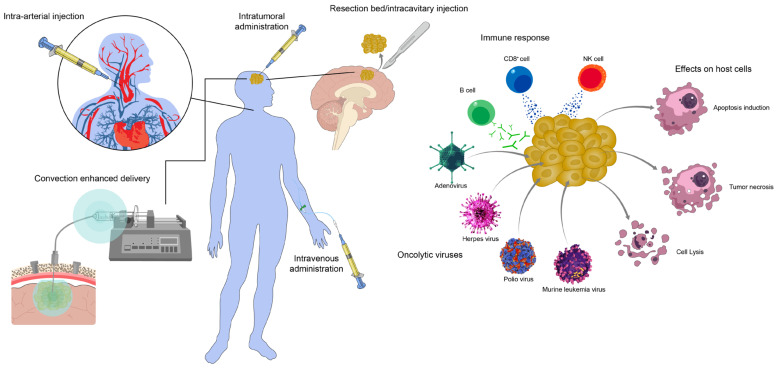
Despite decades of research and numerous clinical trials, the prognosis of patients diagnosed with glioblastoma (GBM) remains dire with median observed survival at 8 months. There is a critical need for novel treatments for GBM, which is the most common malignant primary brain tumor. Major advances in cancer therapeutics such as immune checkpoint inhibitors and chimeric antigen receptor (CAR) T-cell therapy have not yet led to improved outcomes for GBM. Conventional therapy of surgery followed by chemoradiation with or without tumor treating fields remains the standard of care. One of the many approaches to GBM therapy currently being explored is viral therapies. These typically work by selectively lysing target neoplastic cells, called oncolysis, or by the targeted delivery of a therapeutic transgene via a viral vector. In this review, we discuss the underlying mechanisms of action and describe both recent and current human clinical trials using these viruses with an emphasis on promising viral therapeutics that may ultimately break the field's current stagnant paradigm.
尽管经过了数十年的研究和无数次临床试验,但被诊断为胶质母细胞瘤(GBM)的患者预后仍然很差,中位观察生存期为8个月。对于GBM这种最常见的原发性恶性脑肿瘤,迫切需要新的治疗方法。癌症治疗领域的重大进展,如免疫检查点抑制剂和嵌合抗原受体(CAR)T细胞疗法,尚未改善GBM的治疗效果。传统的治疗方法是手术,然后进行有或没有肿瘤治疗电场的放化疗,这仍然是标准的治疗方案。目前正在探索的GBM治疗方法之一是病毒疗法。这些疗法通常通过选择性地裂解靶肿瘤细胞(称为溶瘤作用),或通过病毒载体靶向递送治疗性转基因来发挥作用。在这篇综述中,我们讨论了其潜在的作用机制,并描述了使用这些病毒的近期和当前人类临床试验,重点介绍了可能最终打破该领域当前停滞模式的有前景的病毒疗法。