Obadi Abdullah, Alharbi Abdulaziz, Alomran Abdulrasoul, Alghamdi Abdulaziz G, Louki Ibrahim, Alkhasha Arafat
Plant Production Department, King Saud University, Riyadh 11451, Saudi Arabia.
Soil Science Department, King Saud University, Riyadh 11451, Saudi Arabia.
Plants (Basel). 2023 Jun 17;12(12):2355. doi: 10.3390/plants12122355.
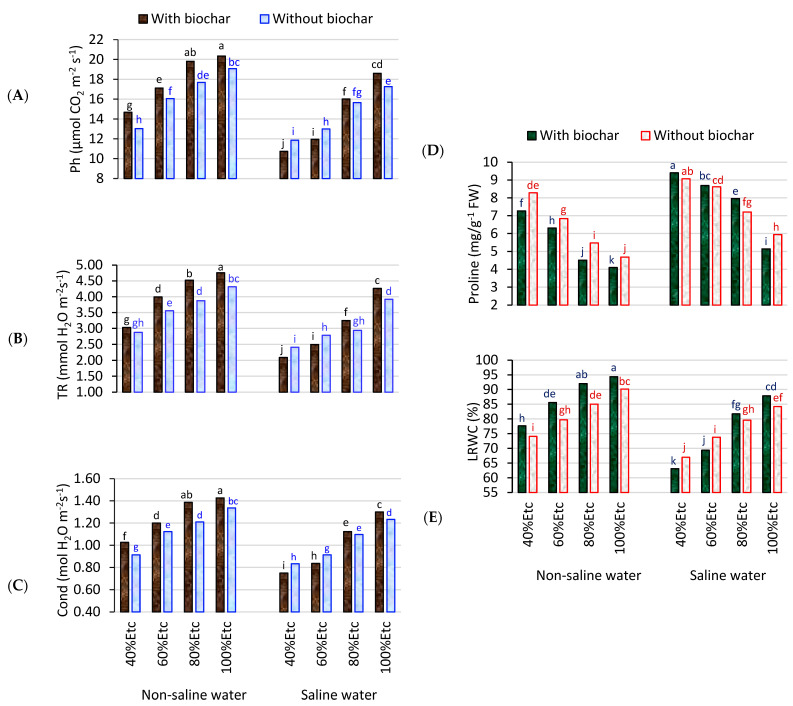
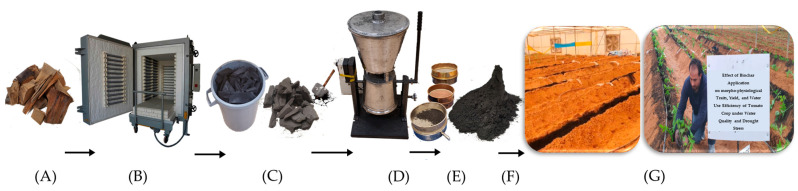
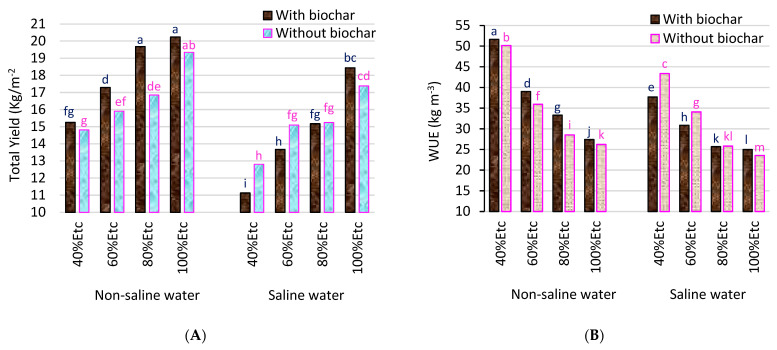
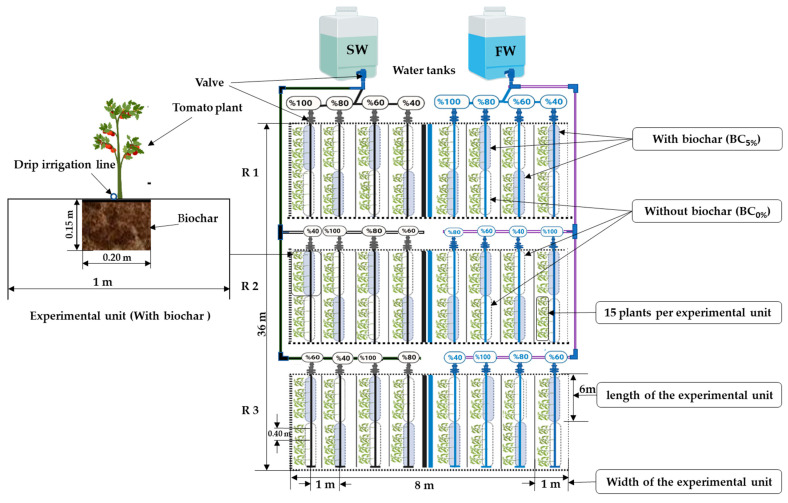
The use of saline water under drought conditions is critical for sustainable agricultural development in arid regions. Biochar is used as a soil amendment to enhance soil properties such as water-holding capacity and the source of nutrition elements of plants. Therefore, the experiment was conducted to evaluate the effects of biochar application on the morpho-physiological traits and yield of tomatoes under combined salinity and drought stress in greenhouses. There were 16 treatments consist two water quality fresh and saline (0.9 and 2.3 dS m), three deficit irrigation levels (DI) 80, 60, and 40% addition 100% of Evapotranspiration (ETc), and biochar application by rate 5% (BC) (/) and untreated soil (BC). The results indicated that the salinity and water deficit negatively affected morphological, physiological, and yield traits. In contrast, the application of biochar improved all traits. The interaction between biochar and saline water leads to decreased vegetative growth indices, leaf gas exchange, the relative water content of leaves (LRWC), photosynthetic pigments, and yield, especially with the water supply deficit (60 and 40% ETc), where the yield decreased by 42.48% under the highest water deficit at 40% ETc compared to the control. The addition of biochar with freshwater led to a significantly increased vegetative growth, physiological traits, yield, water use efficiency (WUE), and less proline content under all various water treatments compared to untreated soil. In general, biochar combined with DI and freshwater could improve morpho-physiological attributes, sustain the growth of tomato plants, and increase productivity in arid and semi-arid regions.
在干旱条件下使用盐水对于干旱地区的可持续农业发展至关重要。生物炭被用作土壤改良剂,以增强土壤特性,如持水能力和植物营养元素来源。因此,本试验旨在评估在温室中盐分和干旱胁迫联合作用下,施用生物炭对番茄形态生理性状和产量的影响。试验共有16种处理,包括两种水质(淡水和盐水,电导率分别为0.9和2.3 dS m)、三个亏缺灌溉水平(分别为蒸发散量ETc的80%、60%和40%),以及按5%比例施用生物炭(BC)(/)和未处理土壤(BC)。结果表明,盐分和水分亏缺对形态、生理和产量性状产生负面影响。相比之下,施用生物炭改善了所有性状。生物炭与盐水的相互作用导致营养生长指标、叶片气体交换、叶片相对含水量(LRWC)、光合色素和产量下降,尤其是在水分供应亏缺(60%和40% ETc)时,在40% ETc的最高水分亏缺条件下,产量比对照降低了42.48%。与未处理土壤相比,在所有不同水分处理下,添加淡水生物炭均显著提高了营养生长、生理性状、产量、水分利用效率(WUE),且脯氨酸含量更低。总体而言,生物炭与亏缺灌溉和淡水相结合可以改善形态生理属性,维持番茄植株生长,并提高干旱和半干旱地区的生产力。