Phillies George David Joseph
Department of Physics, Worcester Polytechnic Institute, Worcester, MA 01609-2280, USA.
Polymers (Basel). 2023 Jun 8;15(12):2615. doi: 10.3390/polym15122615.
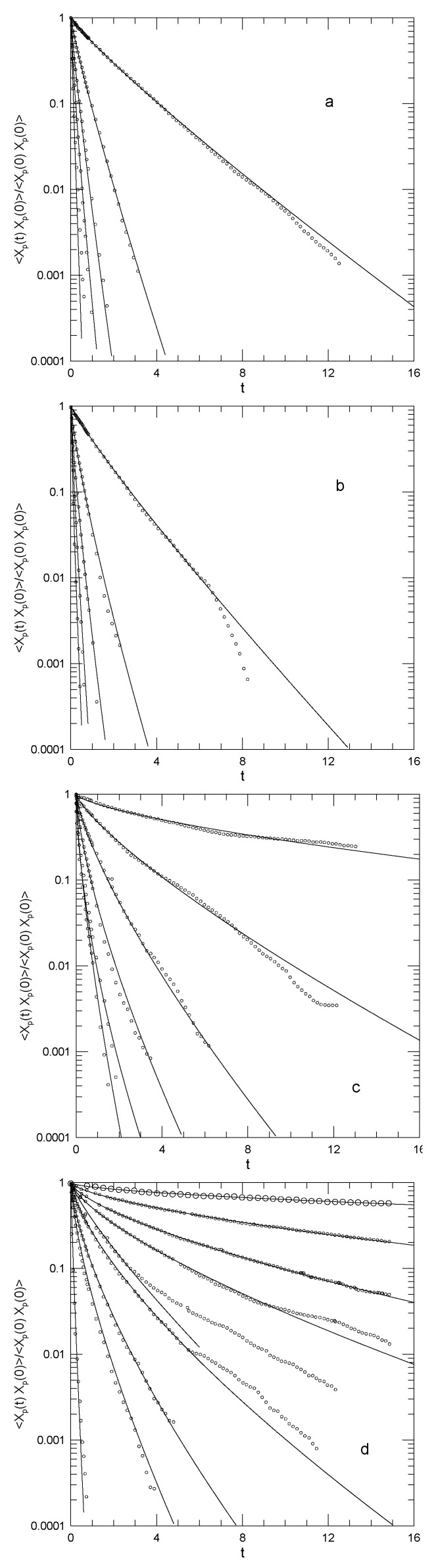
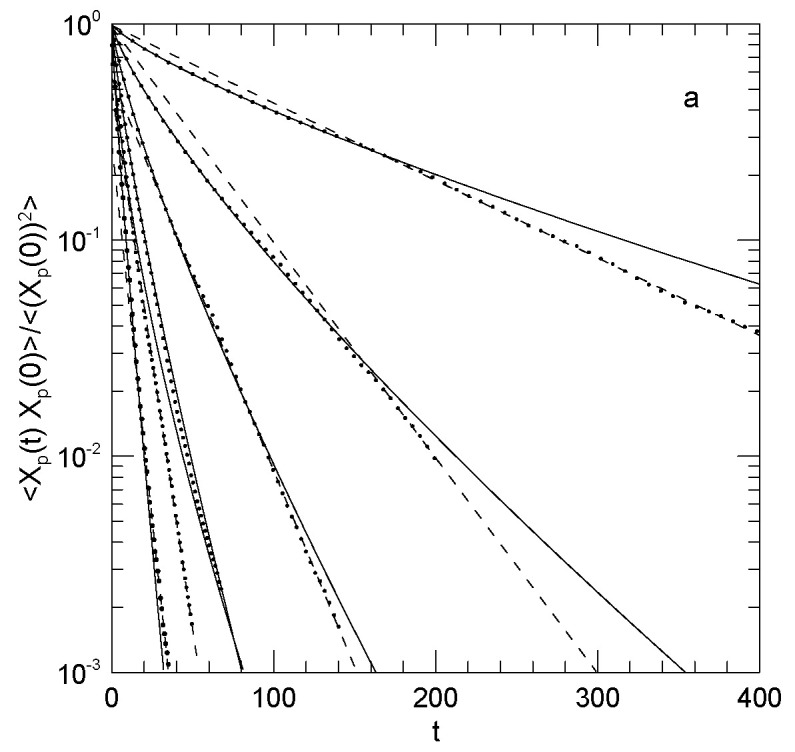
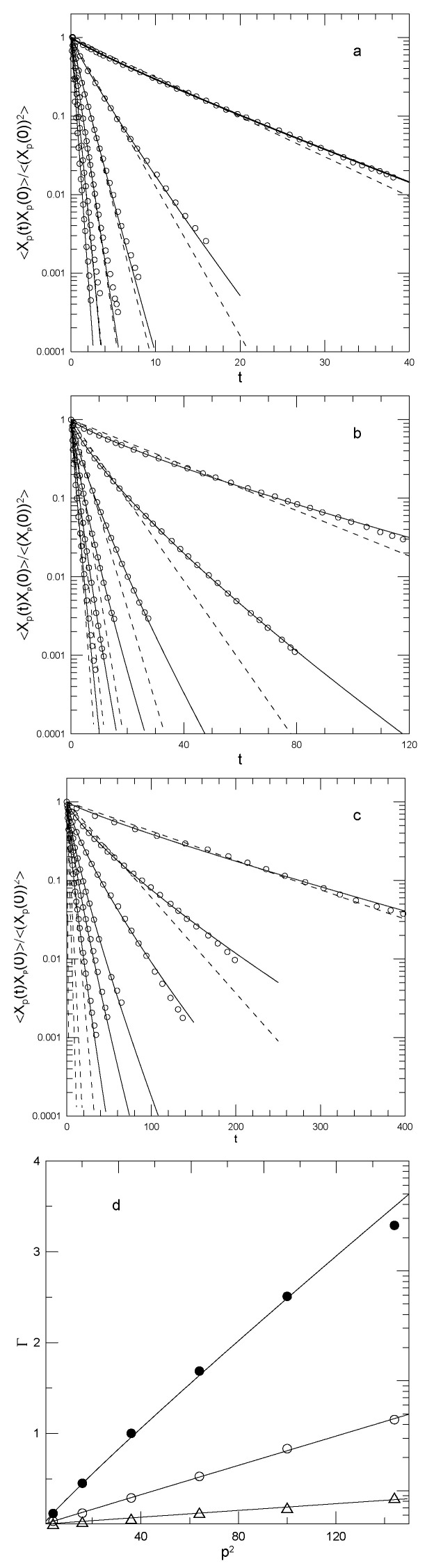
An extensive review of literature simulations of quiescent polymer melts is given, considering results that test aspects of the Rouse model in the melt. We focus on Rouse model predictions for the mean-square amplitudes ⟨(Xp(0))2⟩ and time correlation functions ⟨Xp(0)Xp(t)⟩ of the Rouse mode Xp(t). The simulations conclusively demonstrate that the Rouse model is invalid in polymer melts. In particular, and contrary to the Rouse model, (i) mean-square Rouse mode amplitudes ⟨(Xp(0))2⟩ do not scale as sin-2(pπ/2N), being the number of beads in the polymer. For small (say, p≤3) ⟨(Xp(0))2⟩ scales with as p-2; for larger , it scales as p-3. (ii) Rouse mode time correlation functions ⟨Xp(t)Xp(0)⟩ do not decay with time as exponentials; they instead decay as stretched exponentials exp(-αtβ). β depends on , typically with a minimum near N/2 or N/4. (iii) Polymer bead displacements are not described by independent Gaussian random processes. (iv) For p≠q, ⟨Xp(t)Xq(0)⟩ is sometimes non-zero. (v) The response of a polymer coil to a shear flow is a rotation, not the affine deformation predicted by Rouse. We also briefly consider the Kirkwood-Riseman polymer model.
本文对静态聚合物熔体的文献模拟进行了广泛综述,考虑了测试熔体中劳斯模型各方面的结果。我们关注劳斯模型对劳斯模式(X_p(t))的均方振幅(\langle(X_p(0))^2\rangle)和时间相关函数(\langle X_p(0)X_p(t)\rangle)的预测。模拟结果确凿地表明,劳斯模型在聚合物熔体中是无效的。特别是,与劳斯模型相反,(i)均方劳斯模式振幅(\langle(X_p(0))^2\rangle)并不按(\sin^{-2}(p\pi/2N))缩放,(N)为聚合物中的珠子数。对于较小的(p)(例如,(p\leq3)),(\langle(X_p(0))^2\rangle)与(p)的关系为(p^{-2});对于较大的(p),它按(p^{-3})缩放。(ii)劳斯模式时间相关函数(\langle X_p(t)X_p(0)\rangle)并不随时间呈指数衰减;相反,它们以拉伸指数(\exp(-\alpha t^{\beta}))衰减。(\beta)取决于(N),通常在(N/2)或(N/4)附近有最小值。(iii)聚合物珠子的位移不是由独立的高斯随机过程描述的。(iv)对于(p\neq q),(\langle X_p(t)X_q(0)\rangle)有时不为零。(v)聚合物线团对剪切流的响应是旋转,而不是劳斯预测的仿射变形。我们还简要考虑了柯克伍德 - 里斯曼聚合物模型。