
生物刺激剂红海藻(var.liui)提取物喷雾可提高大豆的产量和耐旱性。
Biostimulant red seaweed ( var. liui) extracts spray improves yield and drought tolerance in soybean.
机构信息
Department of Agronomy, Bangabandhu Sheikh Mujibur Rahman Agricultural University, Gazipur, Bangladesh.
Genetics and Plant breeding, Bangabandhu Sheikh Mujibur Rahman Agricultural University, Gazipur, Bangladesh.
出版信息
PeerJ. 2023 Jun 23;11:e15588. doi: 10.7717/peerj.15588. eCollection 2023.
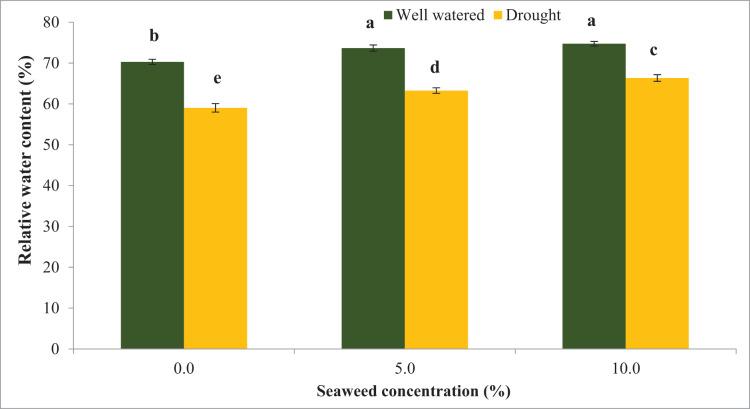
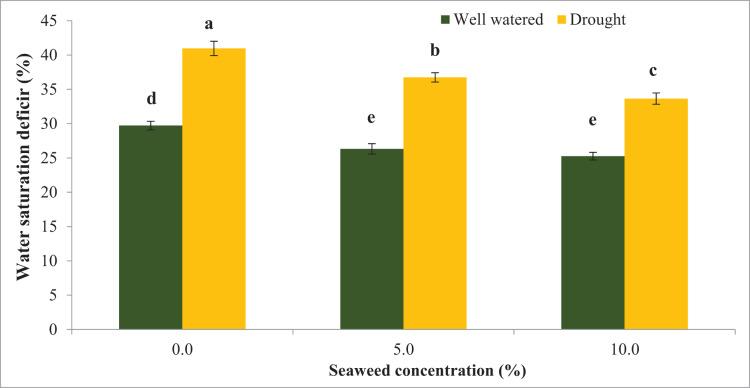
Drought has a deleterious impact on the growth, physiology, and yield of various plants, including soybean. Seaweed extracts are rich in various bioactive compounds, including antioxidants, and can be used as biostimulants for improving yield and alleviating the adverse effect of drought stress. The purpose of this study was to evaluate the effect of soybean growth and yield with different concentrations (0.0%, 5.0%, and 10.0% v/v) of water extracts of the red seaweed var. under well-watered (80% of field capacity (FC) and drought (40% of FC)) conditions. Drought stress decreased soybean grain yield by 45.58% compared to well-watered circumstances but increased the water saturation deficit by 37.87%. It also decreased leaf water, chlorophyll content, plant height, and the fresh weight of the leaf, stem, and petiole. Drought stress decreased soybean grain yield by 45.58% compared to well-watered circumstances but increased the water saturation deficit by 37.87%. It also decreased leaf water, chlorophyll content, plant height, and the fresh weight of the leaf, stem, and petiole. Under both drought and well-watered situations, foliar application of seaweed extracts dramatically improved soybean growth and production. Under drought and well-watered situations, 10.0% seaweed extract increased grain yield by 54.87% and 23.97%, respectively in comparison to untreated plants. The results of this study suggest that red seaweed extracts from var. may be used as a biostimulant to improve soybean yield and drought tolerance in the presence of insufficient water. However, the actual mechanisms behind these improvements need to be further investigated in field conditions.
干旱对包括大豆在内的各种植物的生长、生理和产量都有有害影响。海藻提取物富含各种生物活性化合物,包括抗氧化剂,可以用作生物刺激剂,以提高产量并缓解干旱胁迫的不利影响。本研究的目的是评估不同浓度(0.0%、5.0%和 10.0%v/v)的红海藻 var. 水提取物对大豆生长和产量的影响,在充分浇水(田间持水量的 80%)和干旱(田间持水量的 40%)条件下。与充分浇水的情况相比,干旱胁迫使大豆籽粒产量降低了 45.58%,但使水分饱和亏缺增加了 37.87%。它还降低了叶片水、叶绿素含量、株高以及叶片、茎和叶柄的鲜重。与充分浇水的情况相比,干旱胁迫使大豆籽粒产量降低了 45.58%,但使水分饱和亏缺增加了 37.87%。它还降低了叶片水、叶绿素含量、株高以及叶片、茎和叶柄的鲜重。在干旱和充分浇水的情况下,叶面喷施海藻提取物都显著提高了大豆的生长和产量。在干旱和充分浇水的情况下,与未处理的植株相比,10.0%的海藻提取物分别使籽粒产量增加了 54.87%和 23.97%。本研究结果表明,var. 的红海藻提取物可用作生物刺激剂,以在水分不足的情况下提高大豆的产量和耐旱性。然而,这些改进背后的实际机制需要在田间条件下进一步研究。

 Zotero 插件