• 文献检索
  • 文档翻译
  • 深度研究
  • 学术资讯
  • Suppr Zotero 插件Zotero 插件
  • 邀请有礼
  • 套餐&价格
  • 历史记录
应用&插件
Suppr Zotero 插件Zotero 插件浏览器插件Mac 客户端Windows 客户端微信小程序
定价
高级版会员购买积分包购买API积分包
服务
文献检索文档翻译深度研究API 文档MCP 服务
关于我们
关于 Suppr公司介绍联系我们用户协议隐私条款
关注我们

Suppr 超能文献

核心技术专利:CN118964589B侵权必究
粤ICP备2023148730 号-1Suppr @ 2026

文献检索

告别复杂PubMed语法,用中文像聊天一样搜索,搜遍4000万医学文献。AI智能推荐,让科研检索更轻松。

立即免费搜索

文件翻译

保留排版,准确专业,支持PDF/Word/PPT等文件格式,支持 12+语言互译。

免费翻译文档

深度研究

AI帮你快速写综述,25分钟生成高质量综述,智能提取关键信息,辅助科研写作。

立即免费体验

使用Lu-PLGA(RGF)-CXCR4L进行化疗放疗以靶向治疗结直肠癌。

Chemo-radiotherapy with Lu-PLGA(RGF)-CXCR4L for the targeted treatment of colorectal cancer.

作者信息

Cruz-Nova Pedro, Gibbens-Bandala Brenda, Ancira-Cortez Alejandra, Ramírez-Nava Gerardo, Santos-Cuevas Clara, Luna-Gutiérrez Myrna, Ocampo-García Blanca

机构信息

Departamento de Materiales Radiactivos, Instituto Nacional de Investigaciones Nucleares, Ocoyoacac, Estado de México, Mexico.

Institute of Advanced Materials for Sustainable Manufacturing, Tecnológico de Monterrey, Mexico City, Mexico.

出版信息

Front Med (Lausanne). 2023 Jun 12;10:1191315. doi: 10.3389/fmed.2023.1191315. eCollection 2023.

DOI:10.3389/fmed.2023.1191315
PMID:37378300
原文链接:https://pmc.ncbi.nlm.nih.gov/articles/PMC10292846/
Abstract

INTRODUCTION

More than 1.9 million new cases of colorectal cancer and 935,000 deaths were estimated to have occurred worldwide in 2020. Therapies for metastatic colorectal cancer include cytotoxic chemotherapy and targeted therapies in multiple lines of treatment. Nevertheless, the optimal use of these agents has not yet been resolved. Regorafenib (RGF) is an Food and Drug Administration (FDA)-authorized multikinase inhibitor indicated for patients with metastatic colorectal cancer, non-responding to priority lines of chemotherapy and immunotherapy. Nanoparticles have been used in specific applications, such as site-specific drug delivery systems, cancer therapy, and clinical bioanalytical diagnostics. C-X-C Chemokine receptor type 4 (CXCR4) is the most widely-expressed chemokine receptor in more than 23 human cancer types, including colorectal cancer. This research aimed to synthesize and preclinically evaluate a targeted nanosystem for colorectal cancer chemo-radiotherapy using RGF encapsulated in Poly(D,L-lactic-co-glycolic acid) (PLGA) nanoparticles coated with a CXCR4 ligand (CXCR4L) and Lu as a therapeutic β-emitter.

METHODS

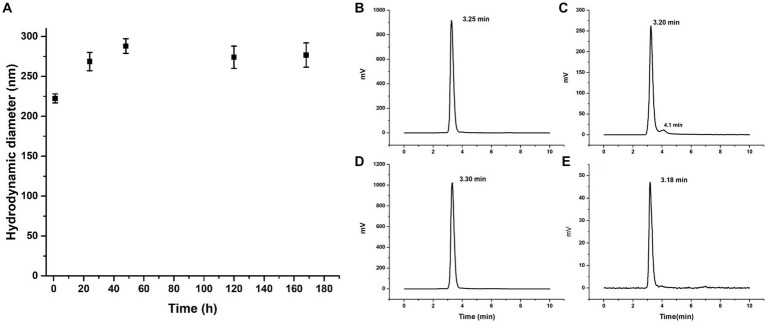
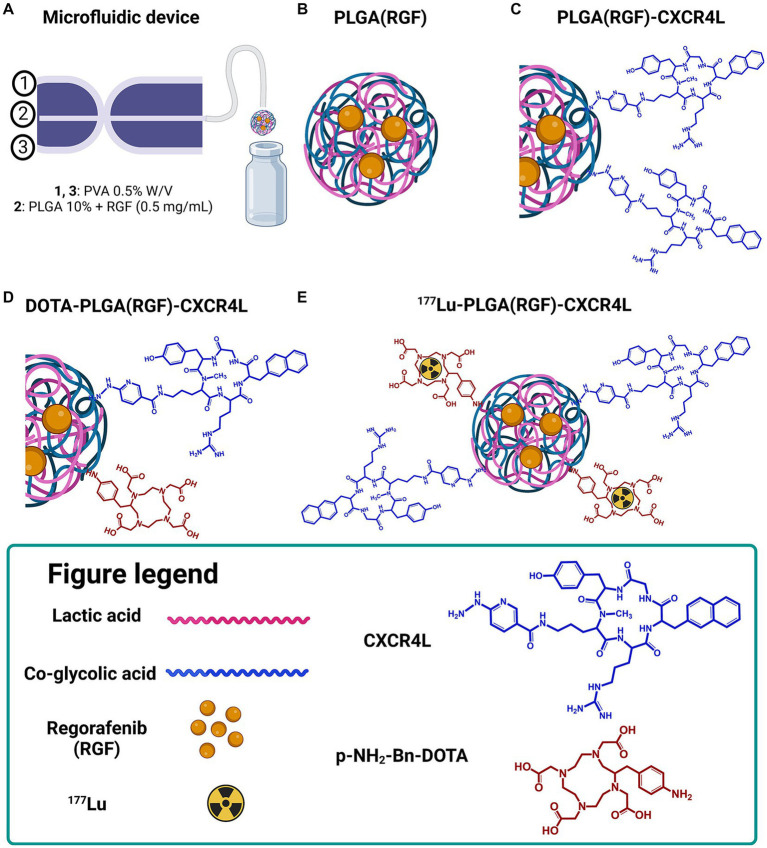
Empty PLGA and PLGA(RGF) nanoparticles were prepared using the microfluidic method, followed by the DOTA and CXCR4L functionalization and nanoparticle radiolabeling with Lu. The final nanosystem gave a particle size of 280 nm with a polydispersity index of 0.347. and toxicity effects were assessed using the HCT116 colorectal cancer cell line.

RESULTS

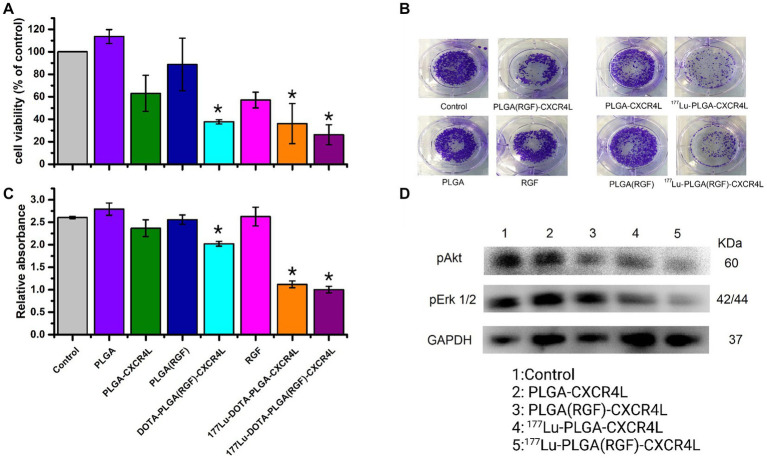
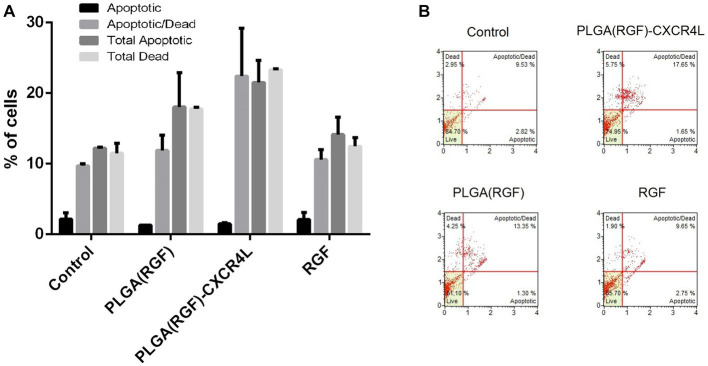
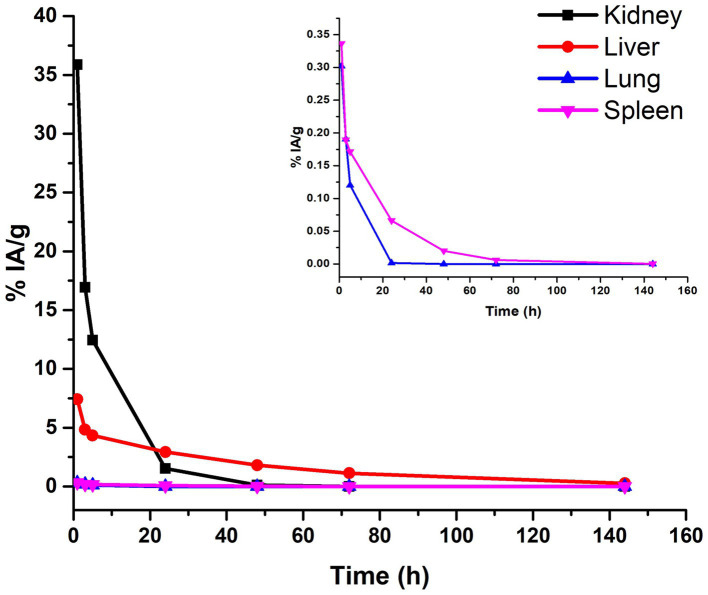
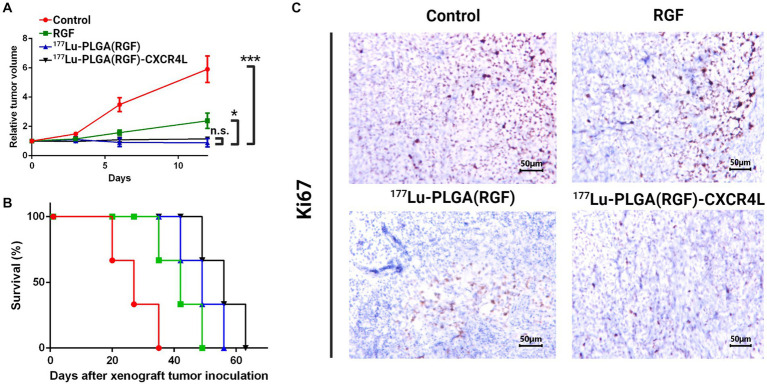
Lu-PLGA(RGF)-CXCR4L nanoparticles decreased cell viability and proliferation by inhibiting Erk and Akt phosphorylation and promoting apoptosis. Moreover, administration of Lu-PLGA(RGF)-CXCR4L significantly reduced tumor growth in an HCT116 colorectal cancer xenograft model. The biokinetic profile showed hepatic and renal elimination.

DISCUSSION

Data obtained in this research justify additional preclinical safety trials and the clinical evaluation of Lu-PLGA(RGF)-CXCR4L as a potential combined treatment of colorectal cancer.

摘要

引言

2020年全球估计有超过190万例新发结直肠癌病例和93.5万例死亡。转移性结直肠癌的治疗方法包括多线治疗中的细胞毒性化疗和靶向治疗。然而,这些药物的最佳使用方法尚未确定。瑞戈非尼(RGF)是一种美国食品药品监督管理局(FDA)批准的多激酶抑制剂,适用于对一线化疗和免疫治疗无反应的转移性结直肠癌患者。纳米颗粒已用于特定应用,如位点特异性药物递送系统、癌症治疗和临床生物分析诊断。C-X-C趋化因子受体4(CXCR4)是在包括结直肠癌在内的23种以上人类癌症类型中表达最广泛的趋化因子受体。本研究旨在合成并在临床前评估一种靶向纳米系统,用于结直肠癌的化学放疗,该系统使用包裹在聚(D,L-乳酸-共-乙醇酸)(PLGA)纳米颗粒中的RGF,该纳米颗粒涂有CXCR4配体(CXCR4L),并使用镥作为治疗性β发射体。

方法

采用微流控法制备空白PLGA和PLGA(RGF)纳米颗粒,然后进行DOTA和CXCR4L功能化以及纳米颗粒用镥进行放射性标记。最终的纳米系统粒径为280nm,多分散指数为0.347。使用HCT116结直肠癌细胞系评估其毒性作用。

结果

镥-PLGA(RGF)-CXCR4L纳米颗粒通过抑制Erk和Akt磷酸化并促进凋亡来降低细胞活力和增殖。此外,给予镥-PLGA(RGF)-CXCR4L可显著降低HCT116结直肠癌异种移植模型中的肿瘤生长。生物动力学曲线显示有肝脏和肾脏清除。

讨论

本研究获得的数据证明有必要进行额外的临床前安全性试验以及对镥-PLGA(RGF)-CXCR4L作为结直肠癌潜在联合治疗方法的临床评估。
https://cdn.ncbi.nlm.nih.gov/pmc/blobs/8a61/10292846/54293bc94d16/fmed-10-1191315-g014.jpg
https://cdn.ncbi.nlm.nih.gov/pmc/blobs/8a61/10292846/7cb3494ff2ae/fmed-10-1191315-g001.jpg
https://cdn.ncbi.nlm.nih.gov/pmc/blobs/8a61/10292846/dc833250046d/fmed-10-1191315-g002.jpg
https://cdn.ncbi.nlm.nih.gov/pmc/blobs/8a61/10292846/9b04d99e5157/fmed-10-1191315-g003.jpg
https://cdn.ncbi.nlm.nih.gov/pmc/blobs/8a61/10292846/c79c517fe611/fmed-10-1191315-g004.jpg
https://cdn.ncbi.nlm.nih.gov/pmc/blobs/8a61/10292846/581d2831ebaf/fmed-10-1191315-g005.jpg
https://cdn.ncbi.nlm.nih.gov/pmc/blobs/8a61/10292846/10f02cf1cf1e/fmed-10-1191315-g006.jpg
https://cdn.ncbi.nlm.nih.gov/pmc/blobs/8a61/10292846/0c2a7517d376/fmed-10-1191315-g007.jpg
https://cdn.ncbi.nlm.nih.gov/pmc/blobs/8a61/10292846/b543bfa4fd89/fmed-10-1191315-g008.jpg
https://cdn.ncbi.nlm.nih.gov/pmc/blobs/8a61/10292846/aa4e5290040d/fmed-10-1191315-g009.jpg
https://cdn.ncbi.nlm.nih.gov/pmc/blobs/8a61/10292846/aa3825953adb/fmed-10-1191315-g010.jpg
https://cdn.ncbi.nlm.nih.gov/pmc/blobs/8a61/10292846/7eba92dbe268/fmed-10-1191315-g011.jpg
https://cdn.ncbi.nlm.nih.gov/pmc/blobs/8a61/10292846/9e7b8096d687/fmed-10-1191315-g012.jpg
https://cdn.ncbi.nlm.nih.gov/pmc/blobs/8a61/10292846/d28aa1e3af69/fmed-10-1191315-g013.jpg
https://cdn.ncbi.nlm.nih.gov/pmc/blobs/8a61/10292846/54293bc94d16/fmed-10-1191315-g014.jpg
https://cdn.ncbi.nlm.nih.gov/pmc/blobs/8a61/10292846/7cb3494ff2ae/fmed-10-1191315-g001.jpg
https://cdn.ncbi.nlm.nih.gov/pmc/blobs/8a61/10292846/dc833250046d/fmed-10-1191315-g002.jpg
https://cdn.ncbi.nlm.nih.gov/pmc/blobs/8a61/10292846/9b04d99e5157/fmed-10-1191315-g003.jpg
https://cdn.ncbi.nlm.nih.gov/pmc/blobs/8a61/10292846/c79c517fe611/fmed-10-1191315-g004.jpg
https://cdn.ncbi.nlm.nih.gov/pmc/blobs/8a61/10292846/581d2831ebaf/fmed-10-1191315-g005.jpg
https://cdn.ncbi.nlm.nih.gov/pmc/blobs/8a61/10292846/10f02cf1cf1e/fmed-10-1191315-g006.jpg
https://cdn.ncbi.nlm.nih.gov/pmc/blobs/8a61/10292846/0c2a7517d376/fmed-10-1191315-g007.jpg
https://cdn.ncbi.nlm.nih.gov/pmc/blobs/8a61/10292846/b543bfa4fd89/fmed-10-1191315-g008.jpg
https://cdn.ncbi.nlm.nih.gov/pmc/blobs/8a61/10292846/aa4e5290040d/fmed-10-1191315-g009.jpg
https://cdn.ncbi.nlm.nih.gov/pmc/blobs/8a61/10292846/aa3825953adb/fmed-10-1191315-g010.jpg
https://cdn.ncbi.nlm.nih.gov/pmc/blobs/8a61/10292846/7eba92dbe268/fmed-10-1191315-g011.jpg
https://cdn.ncbi.nlm.nih.gov/pmc/blobs/8a61/10292846/9e7b8096d687/fmed-10-1191315-g012.jpg
https://cdn.ncbi.nlm.nih.gov/pmc/blobs/8a61/10292846/d28aa1e3af69/fmed-10-1191315-g013.jpg
https://cdn.ncbi.nlm.nih.gov/pmc/blobs/8a61/10292846/54293bc94d16/fmed-10-1191315-g014.jpg

相似文献

1
Chemo-radiotherapy with Lu-PLGA(RGF)-CXCR4L for the targeted treatment of colorectal cancer.使用Lu-PLGA(RGF)-CXCR4L进行化疗放疗以靶向治疗结直肠癌。
Front Med (Lausanne). 2023 Jun 12;10:1191315. doi: 10.3389/fmed.2023.1191315. eCollection 2023.
2
Development of Lu-DN(C19)-CXCR4 Ligand Nanosystem for Combinatorial Therapy in Pancreatic Cancer.Lu-DN(C19)-CXCR4 配体纳米系统的开发用于胰腺癌的联合治疗。
J Biomed Nanotechnol. 2021 Feb 28;17(2):263-278. doi: 10.1166/jbn.2021.3016.
3
Lu-Bombesin-PLGA (paclitaxel): A targeted controlled-release nanomedicine for bimodal therapy of breast cancer.鲁脑啡肽-PLGA(紫杉醇):一种用于乳腺癌双模式治疗的靶向控释纳米药物。
Mater Sci Eng C Mater Biol Appl. 2019 Dec;105:110043. doi: 10.1016/j.msec.2019.110043. Epub 2019 Aug 1.
4
Preparation and in vitro evaluation of radiolabeled HA-PLGA nanoparticles as novel MTX delivery system for local treatment of rheumatoid arthritis.放射性标记的 HA-PLGA 纳米粒作为新型 MTX 给药系统用于类风湿关节炎局部治疗的制备及体外评价。
Mater Sci Eng C Mater Biol Appl. 2019 Oct;103:109766. doi: 10.1016/j.msec.2019.109766. Epub 2019 May 19.
5
Development, Characterization, and Investigation of In Vivo Targeted Delivery Efficacy of Luteolin-Loaded, Eudragit S100-Coated mPEG-PLGA Nanoparticles.芦丁载药、Eudragit S100 包衣 mPEG-PLGA 纳米粒的制备、表征及体内靶向递药效果研究。
AAPS PharmSciTech. 2022 Mar 29;23(4):100. doi: 10.1208/s12249-022-02255-3.
6
Co-delivery of sorafenib and metapristone encapsulated by CXCR4-targeted PLGA-PEG nanoparticles overcomes hepatocellular carcinoma resistance to sorafenib.载sorafenib 和米非司酮的 CXCR4 靶向 PLGA-PEG 纳米粒共递送克服了肝细胞癌对 sorafenib 的耐药性。
J Exp Clin Cancer Res. 2019 May 31;38(1):232. doi: 10.1186/s13046-019-1216-x.
7
Anti-EGFR-mAb and 5-Fluorouracil Conjugated Polymeric Nanoparticles for Colorectal Cancer.抗 EGFR-mAb 和 5-氟尿嘧啶偶联聚合物纳米粒用于结直肠癌。
Recent Pat Anticancer Drug Discov. 2021;16(1):84-100. doi: 10.2174/1574892815666201221121859.
8
Poly (lactic-co-glycolic acid)-encapsulated iodine-131 nanoparticles fabricated with rhTSH induce apoptosis and immobilization of thyroid cancer cells.用重组人促甲状腺激素制备的聚(乳酸-乙醇酸)包裹的碘-131纳米颗粒可诱导甲状腺癌细胞凋亡并使其固定。
Front Oncol. 2023 Jan 27;13:1030105. doi: 10.3389/fonc.2023.1030105. eCollection 2023.
9
Evaluation of cytotoxic and tumor targeting capability of (177)Lu-DOTATATE-nanoparticles: a trailblazing strategy in peptide receptor radionuclide therapy.(177)镥-奥曲肽纳米颗粒的细胞毒性和肿瘤靶向能力评估:肽受体放射性核素治疗中的开创性策略
Ann Nucl Med. 2016 Jun;30(5):334-45. doi: 10.1007/s12149-016-1067-x. Epub 2016 Feb 20.
10
Characterization of Lu-DOTA-M5A Anti-Carcinoembryonic Antigen Humanized Antibody and HSP90 Inhibition for Potentiated Radioimmunotherapy of Colorectal Cancer.镥-多胺多羧基大环配体- M5A抗癌胚抗原人源化抗体的表征及HSP90抑制用于增强结直肠癌的放射免疫治疗
Front Oncol. 2022 Mar 31;12:849338. doi: 10.3389/fonc.2022.849338. eCollection 2022.

引用本文的文献

1
Enhancing Colorectal Cancer Treatment Through VEGF/VEGFR Inhibitors and Immunotherapy.通过VEGF/VEGFR抑制剂和免疫疗法增强结直肠癌治疗
Curr Treat Options Oncol. 2025 Mar;26(3):213-225. doi: 10.1007/s11864-025-01306-8. Epub 2025 Mar 6.
2
Exploring treatment options in cancer: Tumor treatment strategies.探索癌症的治疗选择:肿瘤治疗策略。
Signal Transduct Target Ther. 2024 Jul 17;9(1):175. doi: 10.1038/s41392-024-01856-7.
3
Nanoparticles and Mesenchymal Stem Cell (MSC) Therapy for Cancer Treatment: Focus on Nanocarriers and a si-RNA CXCR4 Chemokine Blocker as Strategies for Tumor Eradication In Vitro and In Vivo.

本文引用的文献

1
Toxicity Assessment of [Lu]Lu-iFAP/iPSMA Nanoparticles Prepared under GMP-Compliant Radiopharmaceutical Processes.在符合药品生产质量管理规范(GMP)的放射性药物制备工艺下制备的[镥]镥-iFAP/iPSMA纳米颗粒的毒性评估
Nanomaterials (Basel). 2022 Nov 25;12(23):4181. doi: 10.3390/nano12234181.
2
Targeted Endoradiotherapy with LuO-iPSMA/-iFAP Nanoparticles Activated by Neutron Irradiation: Preclinical Evaluation and First Patient Image.中子辐照激活的LuO-iPSMA/-iFAP纳米颗粒靶向内放射治疗:临床前评估及首例患者成像
Pharmaceutics. 2022 Mar 27;14(4):720. doi: 10.3390/pharmaceutics14040720.
3
Cytotoxicity of targeted PLGA nanoparticles: a systematic review.
纳米颗粒与间充质干细胞(MSC)疗法用于癌症治疗:聚焦纳米载体以及作为体内外根除肿瘤策略的si-RNA CXCR4趋化因子阻断剂
Micromachines (Basel). 2023 Nov 7;14(11):2068. doi: 10.3390/mi14112068.
靶向聚乳酸-羟基乙酸共聚物纳米颗粒的细胞毒性:一项系统评价
RSC Adv. 2021 Mar 3;11(16):9433-9449. doi: 10.1039/d1ra00074h. eCollection 2021 Mar 1.
4
Folate targeted hybrid lipo-polymeric nanoplexes containing docetaxel and miRNA-34a for breast cancer treatment.载多西他赛和 miRNA-34a 的叶酸靶向杂化脂质聚合物纳米复合物用于乳腺癌治疗。
Mater Sci Eng C Mater Biol Appl. 2021 Sep;128:112305. doi: 10.1016/j.msec.2021.112305. Epub 2021 Jul 10.
5
CXCL12-CXCR4/CXCR7 Axis in Colorectal Cancer: Therapeutic Target in Preclinical and Clinical Studies.CXCL12-CXCR4/CXCR7 轴在结直肠癌中的作用:临床前和临床研究中的治疗靶点。
Int J Mol Sci. 2021 Jul 9;22(14):7371. doi: 10.3390/ijms22147371.
6
Formulation of tunable size PLGA-PEG nanoparticles for drug delivery using microfluidic technology.采用微流控技术制备可调节粒径的 PLGA-PEG 纳米粒用于药物传递。
PLoS One. 2021 Jun 18;16(6):e0251821. doi: 10.1371/journal.pone.0251821. eCollection 2021.
7
Apoptosis induction by siRNA targeting integrin-β1 and regorafenib/DDAB-mPEG-PCL hybrid nanoparticles in regorafenib-resistant colon cancer cells.靶向整合素β1的小干扰RNA及瑞戈非尼/二油酰基磷脂酰胆碱-甲氧基聚乙二醇-聚己内酯杂合纳米粒诱导瑞戈非尼耐药结肠癌细胞凋亡的研究
Am J Cancer Res. 2021 Apr 15;11(4):1170-1184. eCollection 2021.
8
Development of Lu-DN(C19)-CXCR4 Ligand Nanosystem for Combinatorial Therapy in Pancreatic Cancer.Lu-DN(C19)-CXCR4 配体纳米系统的开发用于胰腺癌的联合治疗。
J Biomed Nanotechnol. 2021 Feb 28;17(2):263-278. doi: 10.1166/jbn.2021.3016.
9
Cyclodextrin-based host-guest complexes loaded with regorafenib for colorectal cancer treatment.载有regorafenib 的环糊精主体-客体配合物用于结直肠癌治疗。
Nat Commun. 2021 Feb 3;12(1):759. doi: 10.1038/s41467-021-21071-0.
10
Artificial intelligence application for rapid fabrication of size-tunable PLGA microparticles in microfluidics.人工智能在微流控中快速制备尺寸可调的 PLGA 微球中的应用。
Sci Rep. 2020 Nov 11;10(1):19517. doi: 10.1038/s41598-020-76477-5.