Suzhou Center for Disease Control and Prevention, Suzhou, 215004, China.
Jiangsu Provincial Center for Disease Control and Prevention, Nanjing, 210003, China.
AIDS Res Ther. 2023 Jun 28;20(1):41. doi: 10.1186/s12981-023-00540-0.
This retrospective study aimed to characterize the distribution of HIV-1 genotypes and the prevalence of drug resistance mutations in people with antiretroviral treatment (ART) failure in Suzhou City, China.
Pol gene of HIV-1 viruses in blood samples of EDTA anticoagulants from 398 patients with failed antiviral treatment was successfully amplified by using an in-house assay. Drug resistance mutations were analyzed by using the Stanford HIV Drug Resistance Database system ( https://hivdb.stanford.edu/hivdb/by-mutations/ ). HIV-1 genotypes were determined by the REGA HIV subtyping tool (version 3.46, https://www.genomedetective.com/app/typingtool/hiv ). Near full-length genomes (NFLG) of HIV-1 viruses were obtained by next generation sequencing method.
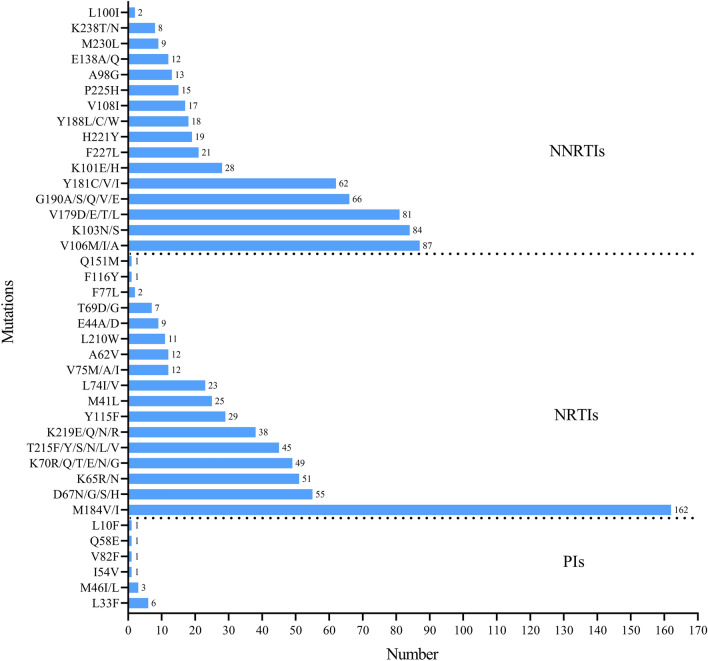
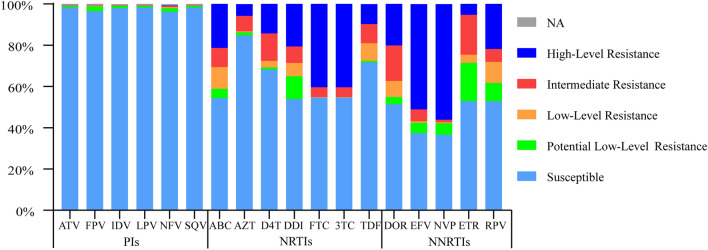
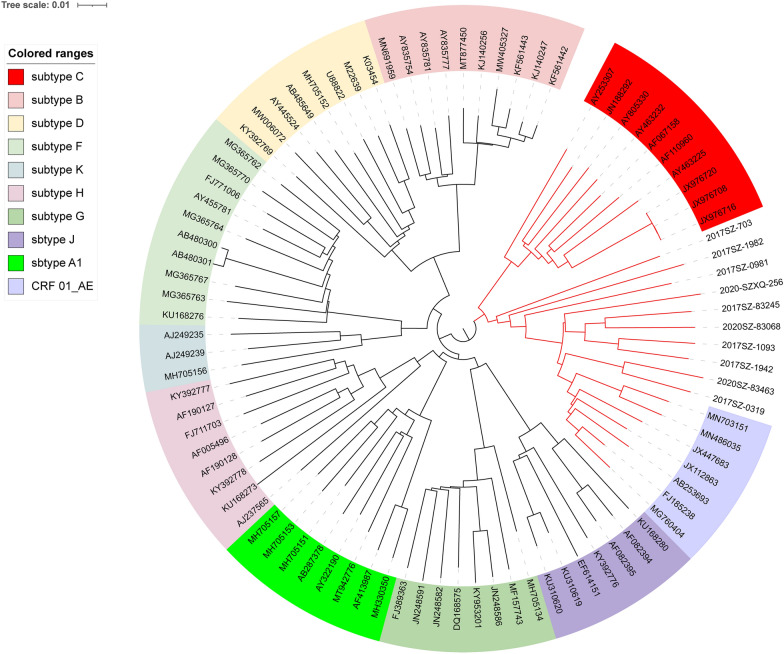
Sequences analysis of the pol gene revealed that CRF 01_AE (57.29%, 228/398) was the dominant subtype circulating in Suzhou City, followed by CRF 07_BC (17.34%, 69/398), subtype B (7.54%, 30/398), CRF 08_BC (6.53%, 26/398), CRF 67_01B (3.02%, 12/398) and CRF55_01B (2.51%, 10/398). The overall prevalence of drug-resistant mutations in cases with ART failure was 64.57% (257/398), including 45.48% (181/398) for nucleotide reverse transcriptase inhibitors (NRTIs) mutations, 63.32% (252/398) for non-nucleoside reverse transcriptase inhibitors (NNRTIs) mutations, and 3.02% (12/398) for protease inhibitors (PIs) mutations. Ten near full-length genomes (NFLG) of HIV-1 viruses were identified, including six recombinants of CRF 01_AE and subtype B, two recombinants of CRF 01_AE, subtype B and subtype C sequences, one recombinant of CRF 01_AE and subtype C and one recombinant of CRF 01_AE, subtype A1 and subtype C.
The high prevalence of drug-resistant HIV-1 viruses was a serious challenge for HIV prevention and treatment of people with HIV infection. Treatment regimens for ART failure patients should be adjusted over time based on the outcome of drug resistance tests. NFLG sequencing facilitates the identification of new recombinants of HIV-1.
本回顾性研究旨在描述中国苏州市接受抗逆转录病毒治疗(ART)失败的人群中 HIV-1 基因型的分布和耐药突变的流行情况。
采用自制检测方法,成功扩增了 398 名抗病毒治疗失败患者 EDTA 抗凝全血样本中的 HIV-1 pol 基因。采用斯坦福 HIV 耐药数据库系统(https://hivdb.stanford.edu/hivdb/by-mutations/)分析耐药突变。采用 REGA HIV 亚型测定工具(版本 3.46,https://www.genomedetective.com/app/typingtool/hiv)确定 HIV-1 基因型。通过下一代测序方法获得 HIV-1 病毒的近全长基因组(NFLG)。
pol 基因序列分析显示,CRF 01_AE(57.29%,228/398)是苏州市流行的主要亚型,其次是 CRF 07_BC(17.34%,69/398)、B 亚型(7.54%,30/398)、CRF 08_BC(6.53%,26/398)、CRF 67_01B(3.02%,12/398)和 CRF55_01B(2.51%,10/398)。ART 失败患者耐药突变的总发生率为 64.57%(257/398),包括核苷酸逆转录酶抑制剂(NRTIs)突变 45.48%(181/398),非核苷酸逆转录酶抑制剂(NNRTIs)突变 63.32%(252/398),蛋白酶抑制剂(PIs)突变 3.02%(12/398)。鉴定了 10 株 HIV-1 病毒的近全长基因组(NFLG),包括 6 株 CRF 01_AE 和 B 亚型的重组、2 株 CRF 01_AE、B 和 C 序列的重组、1 株 CRF 01_AE 和 C 亚型的重组、1 株 CRF 01_AE、A1 和 C 亚型的重组。
耐药 HIV-1 病毒的高流行率对 HIV 感染者的预防和治疗构成了严重挑战。ART 失败患者的治疗方案应根据耐药检测结果进行调整。NFLG 测序有助于发现新的 HIV-1 重组。