Department of Epidemiology and public health, Sciensano, Brussels, Belgium.
Euro Surveill. 2023 Jun;28(26). doi: 10.2807/1560-7917.ES.2023.28.26.2200768.
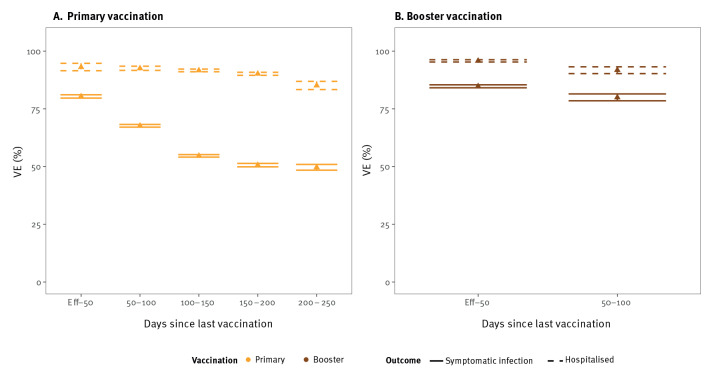
BackgroundThe Belgian COVID-19 vaccination campaign aimed to reduce disease spread and severity.AimWe estimated SARS-CoV-2 variant-specific vaccine effectiveness against symptomatic infection (VEi) and hospitalisation (VEh), given time since vaccination and prior infection.MethodsNationwide healthcare records from July 2021 to May 2022 on testing and vaccination were combined with a clinical hospital survey. We used a test-negative design and proportional hazard regression to estimate VEi and VEh, controlling for prior infection, time since vaccination, age, sex, residence and calendar week of sampling.ResultsWe included 1,932,546 symptomatic individuals, of whom 734,115 tested positive. VEi against Delta waned from an initial estimate of 80% (95% confidence interval (CI): 80-81) to 55% (95% CI: 54-55) 100-150 days after the primary vaccination course. Booster vaccination increased initial VEi to 85% (95% CI: 84-85). Against Omicron, an initial VEi of 33% (95% CI: 30-36) waned to 17% (95% CI: 15-18), while booster vaccination increased VEi to 50% (95% CI: 49-50), which waned to 20% (95% CI: 19-21) 100-150 days after vaccination. Initial VEh for booster vaccination decreased from 96% (95% CI: 95-96) against Delta to 87% (95% CI: 86-89) against Omicron. VEh against Omicron waned to 73% (95% CI: 71-75) 100-150 days after booster vaccination. While recent prior infections conferred higher protection, infections occurring before 2021 remained associated with significant risk reduction against symptomatic infection. Vaccination and prior infection outperformed vaccination or prior infection only.ConclusionWe report waning and a significant decrease in VEi and VEh from Delta to Omicron-dominant periods. Booster vaccination and prior infection attenuated these effects.
比利时的 COVID-19 疫苗接种活动旨在减少疾病传播和严重程度。
我们评估了 SARS-CoV-2 变异特异性疫苗对有症状感染(VEi)和住院(VEh)的有效性,考虑了接种疫苗后的时间和既往感染情况。
我们结合临床医院调查,将 2021 年 7 月至 2022 年 5 月期间的全国性医疗记录中的检测和疫苗接种情况进行了合并。我们使用了阴性检测设计和比例风险回归来估计 VEi 和 VEh,同时控制了既往感染、接种疫苗后的时间、年龄、性别、居住地和采样周。
我们纳入了 1932546 例有症状个体,其中 734115 例检测结果为阳性。Delta 变异株的 VEi 从初始估计的 80%(95%置信区间(CI):80-81)下降到 100-150 天后的 55%(95%CI:54-55)。加强针接种将初始 VEi 提高到 85%(95%CI:84-85)。对于 Omicron 变异株,初始 VEi 为 33%(95%CI:30-36),下降到 17%(95%CI:15-18),而加强针接种将 VEi 提高到 50%(95%CI:49-50),下降到 100-150 天后的 20%(95%CI:19-21)。加强针接种对 Omicron 的初始 VEh 从 Delta 的 96%(95%CI:95-96)下降到 87%(95%CI:86-89)。加强针接种后 100-150 天,Omicron 的 VEh 下降到 73%(95%CI:71-75)。虽然最近的既往感染提供了更高的保护,但 2021 年之前的感染仍然与有症状感染的显著风险降低相关。接种疫苗和既往感染的效果优于仅接种疫苗或既往感染。
我们报告了从 Delta 到 Omicron 主导时期的 VEi 和 VEh 的下降和显著下降。加强针接种和既往感染减轻了这些影响。