Allwright Michael, Mundell Hamish D, McCorkindale Andrew N, Lindley Richard I, Austin Paul J, Guennewig Boris, Sutherland Greg T
Brain and Mind Centre and School of Medical Sciences, Faculty of Medicine and Health, The University of Sydney, Camperdown, NSW 2006, Australia.
Charles Perkins Centre and School of Medical Sciences, Faculty of Medicine and Health, University of Sydney, Camperdown, NSW 2006, Australia.
Aging Brain. 2023 Jun 17;3:100081. doi: 10.1016/j.nbas.2023.100081. eCollection 2023.
The cause of the most common form of dementia, sporadic Alzheimer's disease (AD), remains unknown. This may reflect insufficiently powered studies to date for this multi-factorial disorder. The UK Biobank dataset presents a unique opportunity to rank known risk factors and determine novel variables.
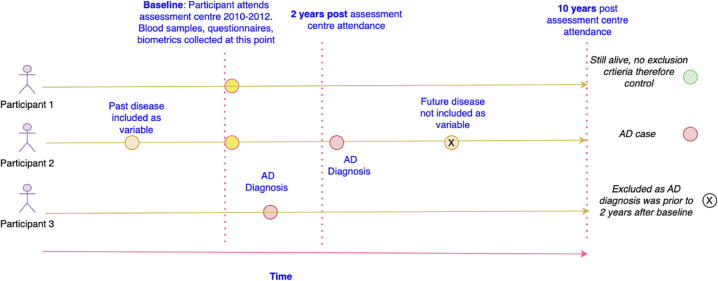
A custom machine learning approach for high dimensionality data was applied to explore prospectively associations between AD in a sub-cohort of 156,209 UK Biobank participants aged 60-70 including more than 2,090 who were subsequently diagnosed with AD.
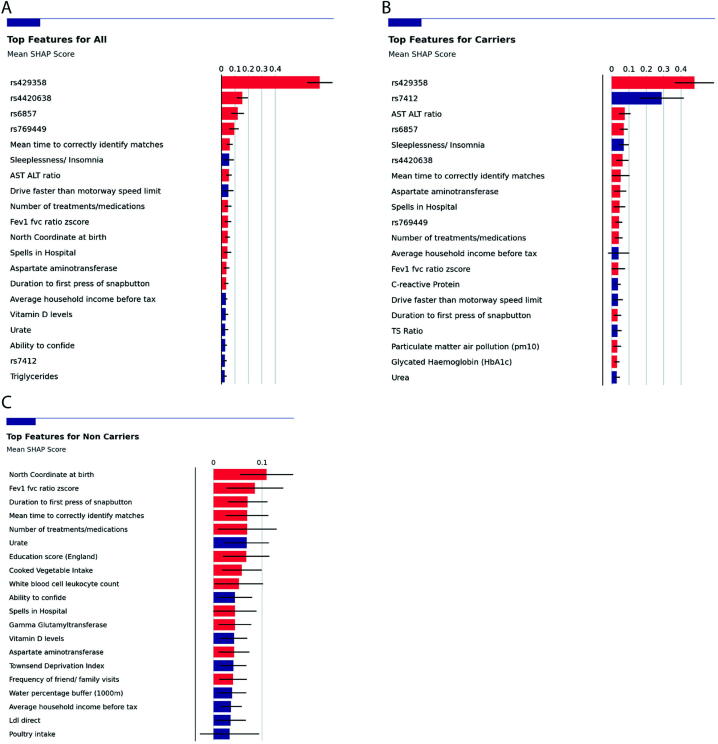
After the possession of the APOE4 allele, the next highest ranked risk factors were other genetic variants within the TOMM40-APOE-APOC1 locus. When stratified by their apolipoprotein 4 (APOE4) carrier status, the most prominent risk factors in carriers were AST:ALT ratio, the "number of treatments/ medications" taken as well as "time spent in hospital" while protection was conferred by "Sleeplessness/Insomnia". In non-APOE carriers, lower socioeconomic status and fewer years of education were highly ranked but effect sizes were small relative to APOE4 carriers.
Possession of the APOE4 allele was confirmed as the most important risk factor in AD. Other TOMM40-APOE-APOC1 locus variants further moderate the risk of AD in APOE4 carriers. Liver pathology is a novel risk factor in APOE4 carriers while "Sleeplessness/Insomnia" is protective in AD irrespective of APOE4 status. Other factors such as "Number of treatments/ medications" suggest that multimorbidity is an important risk factor for AD. Future treatments aimed at co-morbidities, including liver disease, may concomitantly lower the risk of sporadic AD.
最常见的痴呆形式——散发性阿尔茨海默病(AD)的病因仍然不明。这可能反映出迄今为止针对这种多因素疾病的研究力度不足。英国生物银行数据集提供了一个独特的机会来对已知风险因素进行排序并确定新的变量。
应用一种针对高维数据的定制机器学习方法,前瞻性地探索英国生物银行中156209名60至70岁参与者亚组中的AD之间的关联,其中包括2090多名随后被诊断为AD的参与者。
在拥有APOE4等位基因之后,排名第二高的风险因素是TOMM40 - APOE - APOC1基因座内的其他遗传变异。按载脂蛋白4(APOE4)携带者状态分层时,携带者中最突出的风险因素是AST:ALT比值、服用的“治疗/药物数量”以及“住院时间”,而“失眠/睡眠不足”具有保护作用。在非APOE携带者中,社会经济地位较低和受教育年限较少排名靠前,但相对于APOE4携带者,效应量较小。
APOE4等位基因的携带被确认为AD中最重要的风险因素。其他TOMM40 - APOE - APOC1基因座变异进一步调节了APOE4携带者患AD的风险。肝脏病理是APOE4携带者中的一个新风险因素,而“失眠/睡眠不足”在AD中具有保护作用,与APOE4状态无关。其他因素如“治疗/药物数量”表明合并症是AD的一个重要风险因素。针对包括肝脏疾病在内的合并症的未来治疗可能会同时降低散发性AD的风险。