École de santé publique de l'Université de Montréal, Canada.
Center for Advanced Research in Sleep Medicine, Centre Intégré Universitaire de Santé et de Services Sociaux Du Nord-de-l'île-de-Montréal, Canada.
Scand J Public Health. 2023 Dec;51(8):1122-1135. doi: 10.1177/14034948221110019. Epub 2022 Jul 10.
The association between belonging to a disadvantaged socio-economic status or social class and health outcomes has been consistently documented during recent decades. However, a meta-analysis quantifying the association between belonging to a lower social class and the risk of dementia has yet to be performed. In the present work, we sought to summarise the results of prospective, longitudinal studies on this topic.
We conducted a systematic review and meta-analysis of prospective, longitudinal studies measuring the association between indicators of social class and the risk of all-cause/Alzheimer's dementia. The search was conducted in four databases (Medline, Embase, Web of Science and PsychInfo). Inclusion criteria for this systematic review and meta-analysis were: (a) longitudinal prospective study, (b) aged ⩾60 years at baseline, (c) issued from the general population, (d) no dementia at baseline and (e) mention of social class as exposure. Exclusion criteria were: (a) study of rare dementia types (e.g. frontotemporal dementia), (b) abstract-only papers and (c) articles without full text available. The Newcastle-Ottawa scale was used to assess the risk of bias in individual studies. We calculated the overall pooled relative risk of dementia for different social class indicators, both crude and adjusted for sex, age and the year of the cohort start.
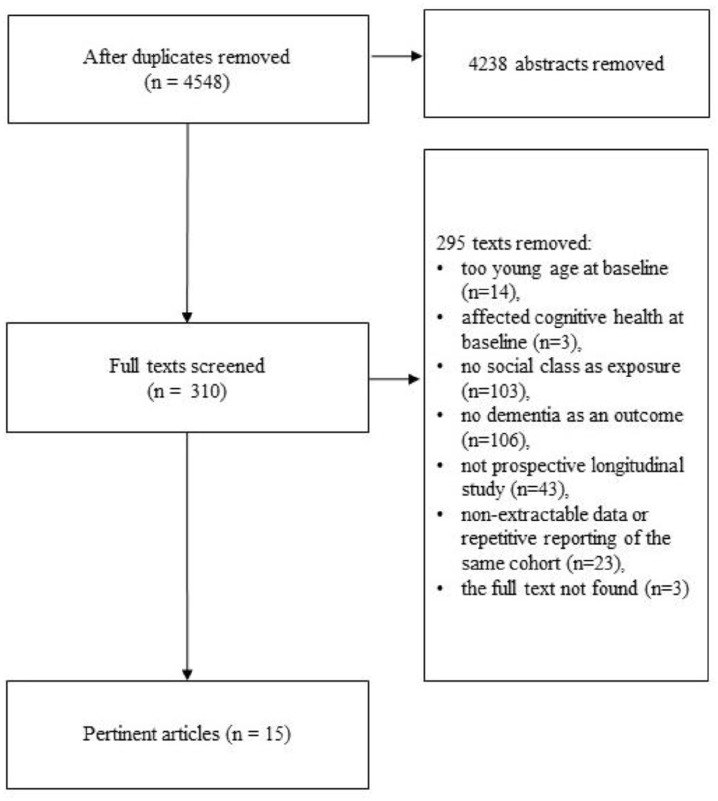
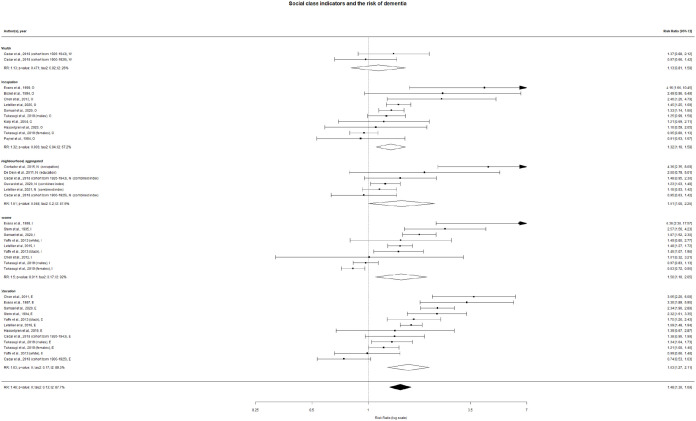
Out of 4548 screened abstracts, 15 were included in the final analysis (76,561 participants, mean follow-up 6.7 years (2.4-25 years), mean age at baseline 75.1 years (70.6-82.1 years), mean percentage of women 58%). Social class was operationalised as levels of education, occupational class, income level, neighbourhood disadvantage and wealth. Education (relative risk (RR)=2.48; confidence interval (CI) 1.71-3.59) and occupational class (RR=2.09; CI 1.18-3.69) but not income (RR=1.28; CI 0.81-2.04) were significantly associated with the risk of dementia in the adjusted model. Some of the limitations of this study are the inclusion of studies predominantly conducted in high-income countries and the exclusion of social mobility in our analysis.
近几十年来,人们一直发现,属于社会经济地位或社会阶层较低的人与健康结果之间存在关联。然而,尚未进行过将社会阶层较低与痴呆风险之间的关联进行量化的荟萃分析。在本项工作中,我们试图总结有关这一主题的前瞻性纵向研究的结果。
我们对前瞻性纵向研究进行了系统回顾和荟萃分析,这些研究衡量了社会阶层指标与全因/阿尔茨海默病痴呆风险之间的关联。检索工作在四个数据库(Medline、Embase、Web of Science 和 PsychInfo)中进行。本系统评价和荟萃分析的纳入标准为:(a)纵向前瞻性研究;(b)基线时年龄 ⩾60 岁;(c)来自普通人群;(d)基线时无痴呆;(e)将社会阶层作为暴露因素。排除标准为:(a)罕见痴呆类型的研究(例如额颞叶痴呆);(b)仅摘要论文;(c)无全文可用的文章。使用纽卡斯尔-渥太华量表评估了个体研究的偏倚风险。我们计算了不同社会阶层指标的痴呆总合并相对风险,包括未调整性别、年龄和队列起始年份的风险和调整后的风险。
在筛选的 4548 篇摘要中,有 15 篇被纳入最终分析(76561 名参与者,平均随访时间为 6.7 年(2.4-25 年),基线时平均年龄为 75.1 岁(70.6-82.1 岁),平均女性比例为 58%)。社会阶层的定义是教育水平、职业阶层、收入水平、邻里劣势和财富。在调整后的模型中,教育(相对风险(RR)=2.48;置信区间(CI)1.71-3.59)和职业阶层(RR=2.09;CI 1.18-3.69)与痴呆风险显著相关,但收入(RR=1.28;CI 0.81-2.04)无显著相关性。本研究的一些局限性在于纳入的研究主要在高收入国家进行,以及我们的分析中未考虑社会流动性。