Department of Respiratory and Critical Care Medicine, Fifth People's Hospital of Shanghai, Fudan University, 801 Heqing Road, Shanghai, 200240, China.
Center of Community-Based Health Research, Fudan University, Shanghai, China.
BMC Infect Dis. 2023 Jun 29;23(1):440. doi: 10.1186/s12879-023-08424-4.
Hydrogen/oxygen therapy contribute to ameliorate dyspnea and disease progression in patients with respiratory diseases. Therefore, we hypothesized that hydrogen/oxygen therapy for ordinary coronavirus disease 2019 (COVID-19) patients might reduce the length of hospitalization and increase hospital discharge rates.
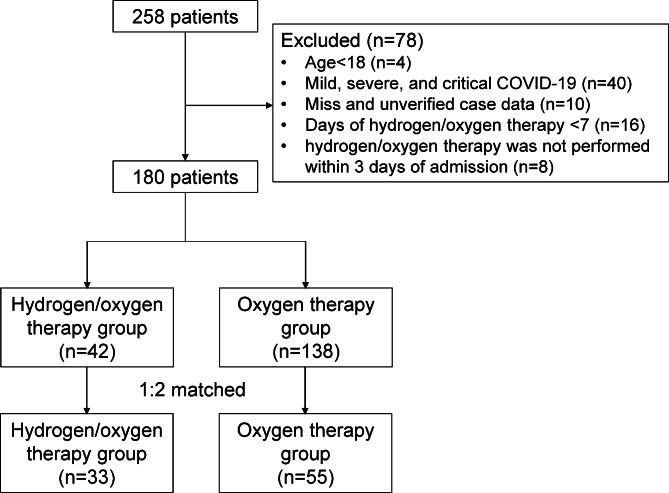
This retrospective, propensity-score matched (PSM) case-control study included 180 patients hospitalized with COVID-19 from 3 centers. After assigned in 1:2 ratios by PSM, 33 patients received hydrogen/oxygen therapy and 55 patients received oxygen therapy included in this study. Primary endpoint was the length of hospitalization. Secondary endpoints were hospital discharge rates and oxygen saturation (SpO). Vital signs and respiratory symptoms were also observed.
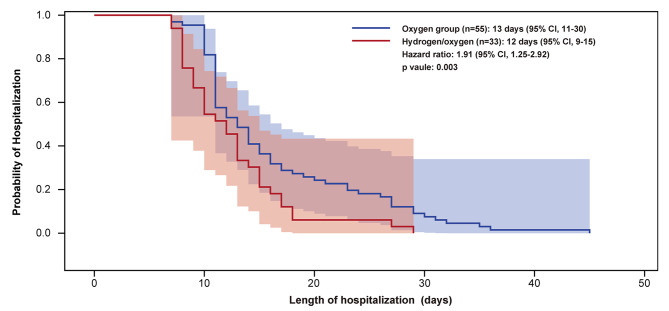
Findings confirmed a significantly lower median length of hospitalization (HR = 1.91; 95% CIs, 1.25-2.92; p < 0.05) in the hydrogen/oxygen group (12 days; 95% CI, 9-15) versus the oxygen group (13 days; 95% CI, 11-20). The higher hospital discharge rates were observed in the hydrogen/oxygen group at 21 days (93.9% vs. 74.5%; p < 0.05) and 28 days (97.0% vs. 85.5%; p < 0.05) compared with the oxygen group, except for 14 days (69.7% vs. 56.4%). After 5-day therapy, patients in hydrogen/oxygen group exhibited a higher level of SpO compared with that in the oxygen group (98.5%±0.56% vs. 97.8%±1.0%; p < 0.001). In subgroup analysis of patients received hydrogen/oxygen, patients aged < 55 years (p = 0.028) and without comorbidities (p = 0.002) exhibited a shorter hospitalization (median 10 days).
This study indicated that hydrogen/oxygen might be a useful therapeutic medical gas to enhance SpO and shorten length of hospitalization in patients with ordinary COVID-19. Younger patients or those without comorbidities are likely to benefit more from hydrogen/oxygen therapy.
氢气/氧气疗法有助于改善呼吸系统疾病患者的呼吸困难和疾病进展。因此,我们假设对普通新型冠状病毒病 2019(COVID-19)患者进行氢气/氧气疗法可能会缩短住院时间并增加出院率。
本回顾性、倾向评分匹配(PSM)病例对照研究纳入了来自 3 个中心的 180 例 COVID-19 住院患者。通过 PSM 按 1:2 的比例分配后,33 例患者接受氢气/氧气治疗,55 例患者接受氧气治疗纳入本研究。主要终点是住院时间。次要终点是出院率和血氧饱和度(SpO2)。还观察了生命体征和呼吸症状。
研究结果证实,与氧气组(12 天;95%CI,9-15)相比,氢气/氧气组(12 天;95%CI,9-15)的中位住院时间明显缩短(HR=1.91;95%CI,1.25-2.92;p<0.05)。氢气/氧气组在第 21 天(93.9%vs.74.5%;p<0.05)和第 28 天(97.0%vs.85.5%;p<0.05)的出院率更高,而氧气组在第 14 天(69.7%vs.56.4%)除外。经过 5 天的治疗,与氧气组相比,氢气/氧气组患者的 SpO2 水平更高(98.5%±0.56%vs.97.8%±1.0%;p<0.001)。在接受氢气/氧气治疗的患者亚组分析中,年龄<55 岁的患者(p=0.028)和无合并症的患者(p=0.002)住院时间更短(中位 10 天)。
本研究表明,氢气/氧气可能是一种有用的治疗性医用气体,可提高 SpO2 并缩短普通 COVID-19 患者的住院时间。年龄较小的患者或无合并症的患者可能更受益于氢气/氧气治疗。