Ki H, Gu J, Cha Y, Lee K W, Ihee H
Struct Dyn. 2023 Jun 27;10(3):034103. doi: 10.1063/4.0000189. eCollection 2023 May.
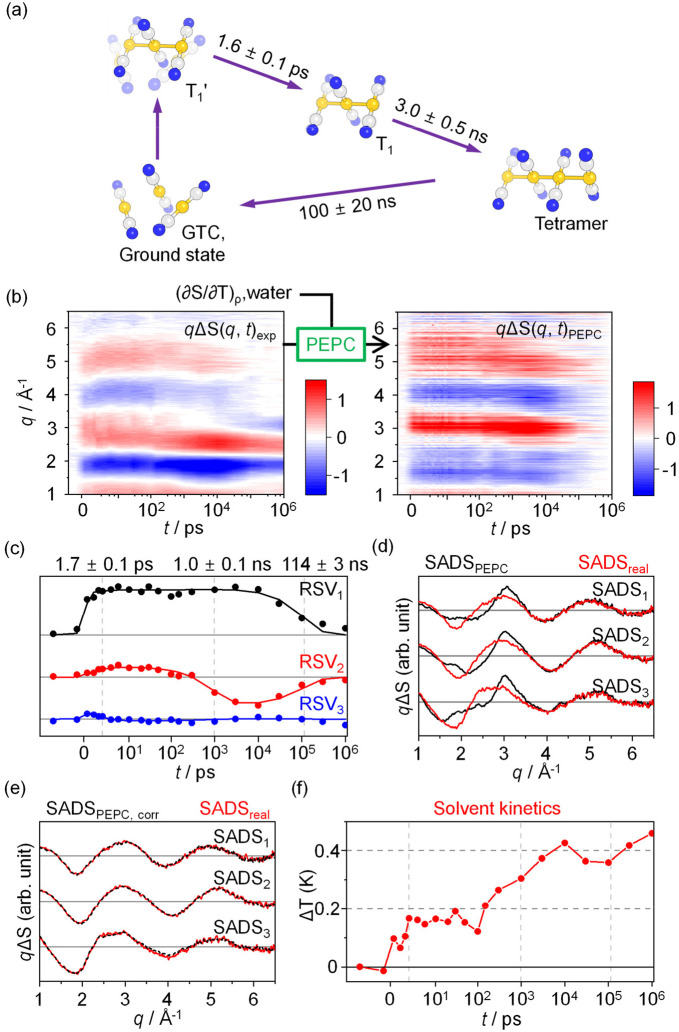
Time-resolved x-ray liquidography (TRXL) is a potent method for investigating the structural dynamics of chemical and biological reactions in the liquid phase. It has enabled the extraction of detailed structural aspects of various dynamic processes, the molecular structures of intermediates, and kinetics of reactions across a wide range of systems, from small molecules to proteins and nanoparticles. Proper data analysis is key to extracting the information of the kinetics and structural dynamics of the studied system encrypted in the TRXL data. In typical TRXL data, the signals from solute scattering, solvent scattering, and solute-solvent cross scattering are mixed in the -space, and the solute kinetics and solvent hydrodynamics are mixed in the time domain, thus complicating the data analysis. Various methods developed so far generally require prior knowledge of the molecular structures of candidate species involved in the reaction. Because such information is often unavailable, a typical data analysis often involves tedious trial and error. To remedy this situation, we have developed a method named projection to extract the perpendicular component (PEPC), capable of removing the contribution of solvent kinetics from TRXL data. The resulting data then contain only the solute kinetics, and, thus, the solute kinetics can be easily determined. Once the solute kinetics is determined, the subsequent data analysis to extract the structural information can be performed with drastically improved convenience. The application of the PEPC method is demonstrated with TRXL data from the photochemistry of two molecular systems: [Au(CN)] in water and CHI in cyclohexane.
时间分辨X射线液体成像(TRXL)是研究液相中化学和生物反应结构动力学的一种有效方法。它能够提取各种动态过程的详细结构信息、中间体的分子结构以及从小分子到蛋白质和纳米颗粒等广泛体系中反应的动力学信息。正确的数据分析是从TRXL数据中提取所研究系统的动力学和结构动力学信息的关键。在典型的TRXL数据中,溶质散射、溶剂散射和溶质 - 溶剂交叉散射的信号在空间中混合,溶质动力学和溶剂流体动力学在时域中混合,从而使数据分析变得复杂。到目前为止开发的各种方法通常需要有关反应中候选物种分子结构的先验知识。由于此类信息往往不可得,典型的数据分析通常涉及繁琐的反复试验。为了改善这种情况,我们开发了一种名为投影提取垂直分量(PEPC)的方法,该方法能够从TRXL数据中去除溶剂动力学的贡献。所得数据随后仅包含溶质动力学,因此可以轻松确定溶质动力学。一旦确定了溶质动力学,随后提取结构信息的数据分析就可以在极大提高便利性的情况下进行。通过来自两个分子体系光化学的TRXL数据展示了PEPC方法的应用:水中的[Au(CN)]和环己烷中的CHI。