Tian Zhikui, Fan Yadong, Sun Xuan, Wang Dongjun, Guan Yuanyuan, Zhang Ying, Zhang Zhaohui, Guo Jing, Bu Huaien, Wu Zhongming, Wang Hongwu
School of Health Sciences and Engineering, Tianjin University of Traditional Chinese Medicine, Tianjin, 301617, China.
Nanjing University of Chinese Medicine, Nanjing, 210023, China.
Heliyon. 2023 Jun 16;9(6):e17339. doi: 10.1016/j.heliyon.2023.e17339. eCollection 2023 Jun.
The objectives of this study were to identify clinical predictors of the Traditional Chinese medicine (TCM) clinical index for diabetic peripheral neuropathy (DPN) in type 2 diabetes mellitus (T2DM) patients, develop a clinical prediction model, and construct a nomogram.
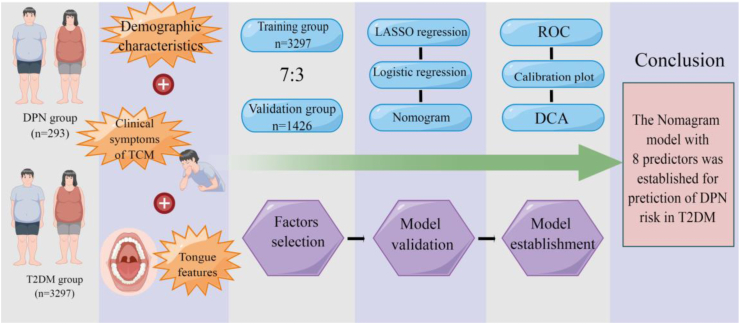
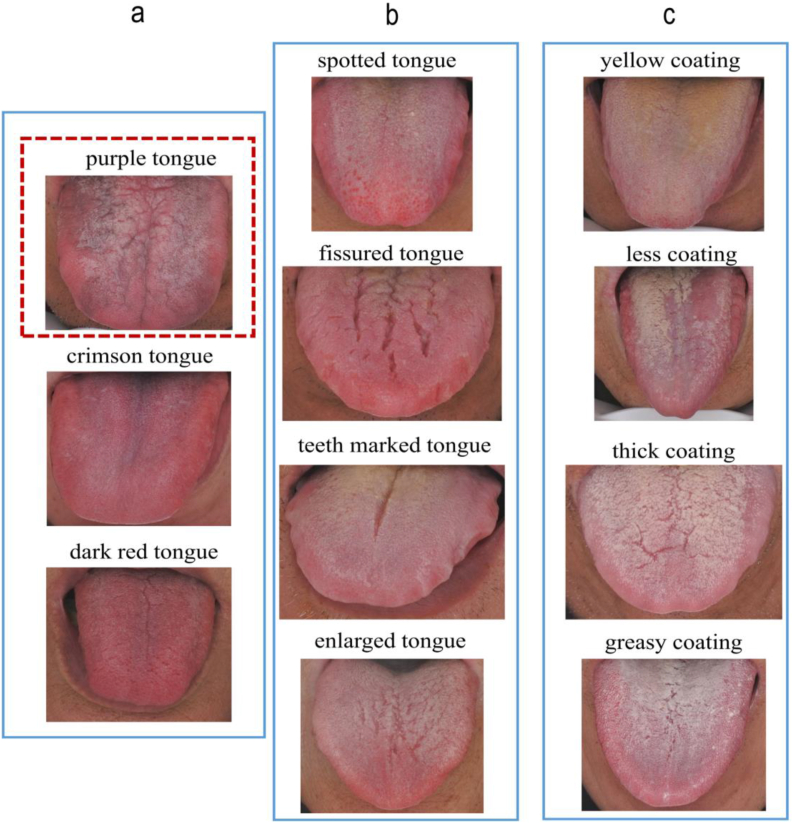
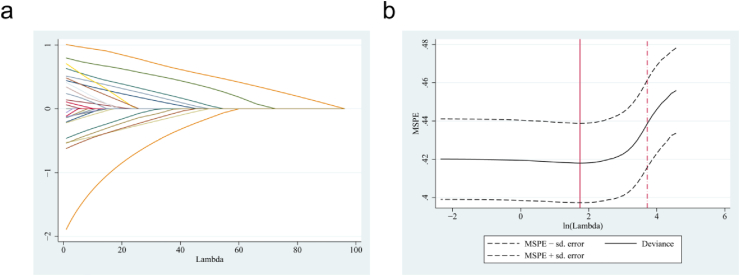
We collected the TCM clinical index from 3590 T2DM recruited at the Second Affiliated Hospital of Tianjin University of Traditional Chinese Medicine from January 2019 to October 2020. The participants were randomly assigned to either the training group (n = 3297) or the validation group (n = 1426). TCM symptoms and tongue characteristics were used to assess the risk of developing DPN in T2DM patients. Through 5-fold cross-validation in the training group, the least absolute shrinkage and selection operator (LASSO) regression analysis method was used to optimize variable selection. In addition, using multifactor logistic regression analysis, a predictive model and nomogram were developed.
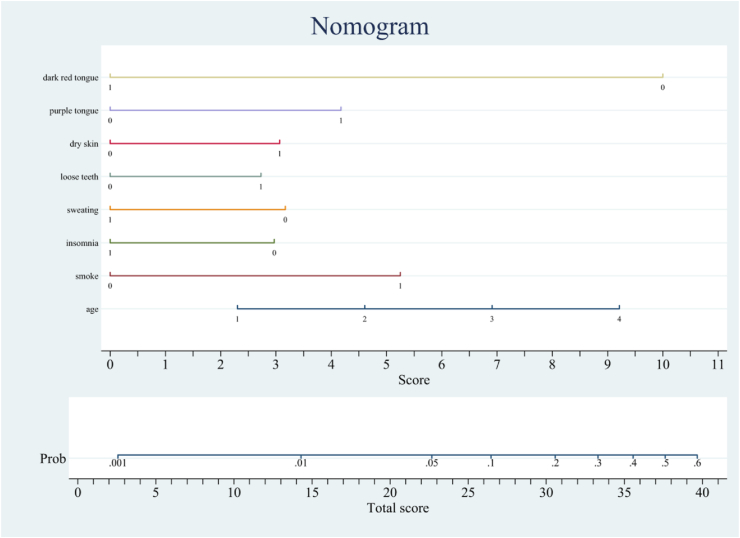
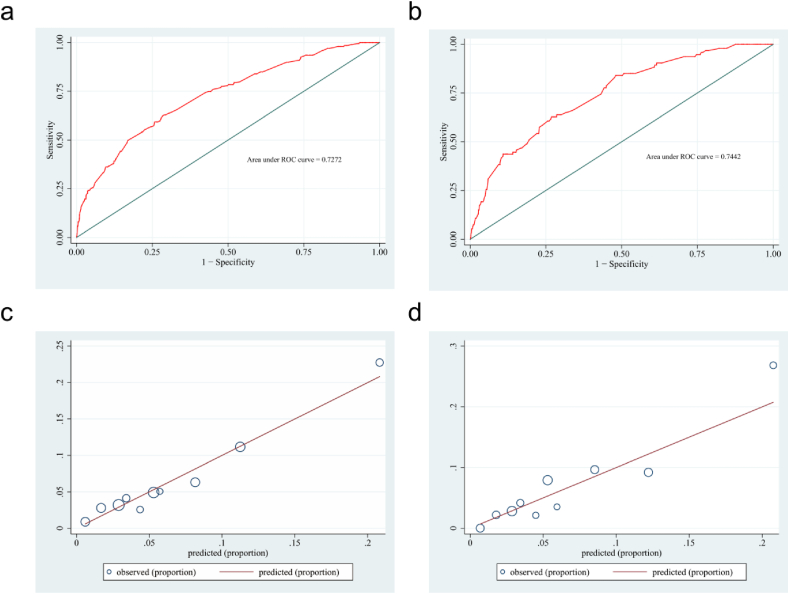
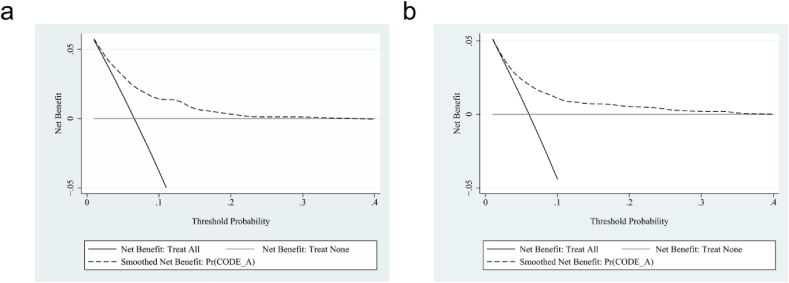
A total of eight independent predictors were found to be associated with the DPN in multivariate logistic regression analyses: advanced age of grading (odds ratio/OR 1.575), smoke (OR 2.815), insomnia (OR 0.557), sweating (OR 0.535), loose teeth (OR 1.713), dry skin (OR 1.831), purple tongue (OR 2.278). And dark red tongue (OR 0.139). The model was constructed using these eight predictor's medium discriminative capabilities. The area under the curve (AUC) of the training set is 0.727, and the AUC of the validation set is 0.744 on the ROC curve. The calibration plot revealed that the model's goodness-of-fit is satisfactory.
We established a TCM prediction model for DPN in patients with T2DM based on the TCM clinical index.
本研究旨在确定2型糖尿病(T2DM)患者糖尿病周围神经病变(DPN)的中医临床指标的临床预测因素,建立临床预测模型并构建列线图。
我们收集了2019年1月至2020年10月在天津中医药大学第二附属医院招募的3590例T2DM患者的中医临床指标。参与者被随机分配到训练组(n = 3297)或验证组(n = 1426)。采用中医症状和舌象特征评估T2DM患者发生DPN的风险。在训练组中通过5折交叉验证,使用最小绝对收缩和选择算子(LASSO)回归分析方法优化变量选择。此外,采用多因素逻辑回归分析,建立预测模型和列线图。
在多因素逻辑回归分析中,共发现8个独立预测因素与DPN相关:分级年龄较大(比值比/OR 1.575)、吸烟(OR 2.815)、失眠(OR 0.557)、多汗(OR 0.535)、牙齿松动(OR 1.713)、皮肤干燥(OR 1.831)、紫舌(OR 2.278)和暗红舌(OR 0.139)。利用这8个预测因素的中等判别能力构建模型。在ROC曲线上,训练集的曲线下面积(AUC)为0.727,验证集的AUC为0.744。校准图显示模型的拟合优度令人满意。
我们基于中医临床指标建立了T2DM患者DPN的中医预测模型。