Department of Pediatric Nephrology, Aichi Children's Health and Medical Center, 4267-Chome, Morioka-cho, Obu, Aichi, 474-8710, Japan.
Medical Support Center for Japan Environment and Children's Study, National Center for Child Health and Development, 2-10-1 Okura, Setagaya-ku, Tokyo, 157-8535, Japan.
Clin Exp Nephrol. 2023 Oct;27(10):857-864. doi: 10.1007/s10157-023-02370-w. Epub 2023 Jun 30.
Reference blood pressure (BP) values for Japanese children based on a large number of measurements by auscultation have not yet been established.
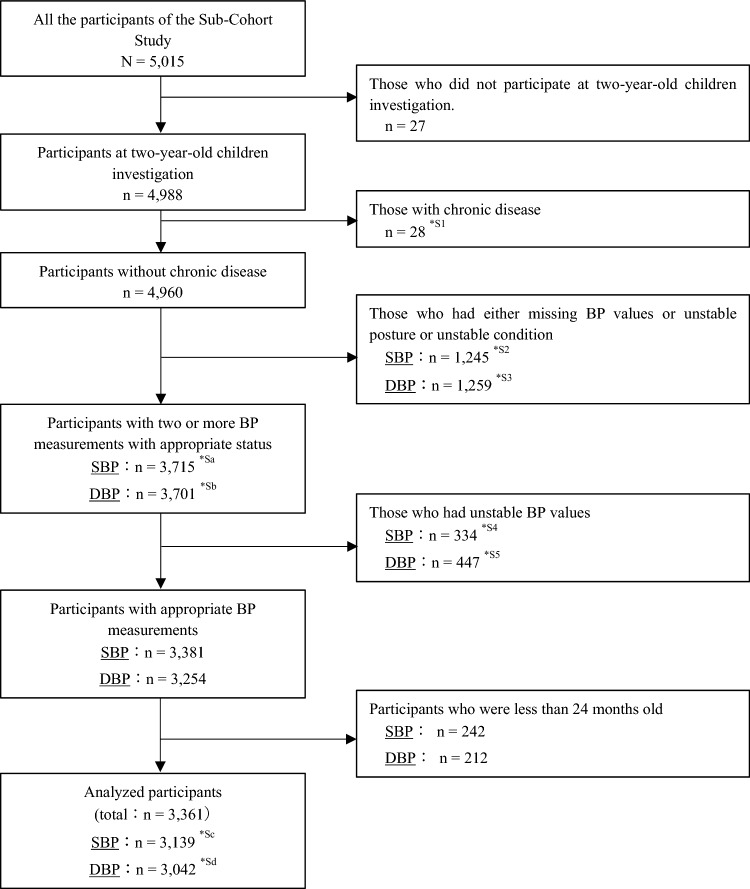
This was a cross-sectional analysis of data from a birth-cohort study. The data from the sub-cohort study conducted for children at the age of 2 years in the Japan Environment and Children's Study from April 2015 to January 2017 were analyzed. BP was measured via auscultation using an aneroid sphygmomanometer. Each participant was measured in triplicate, and the average value of two consecutive measurements with a difference of less than 5 mmHg was recorded. The reference BP values were estimated using the lambda-mu-sigma (LMS) method and compared with those obtained via the polynomial regression model.
Data from 3361 participants were analyzed. Although the difference between the estimated BP values by the LMS and the polynomial regression model was small, the LMS model was more valid based on the results of the fit curve of the observed values and regression models for each model. For 2-year-old children with heights in the 50th percentile, the 50th, 90th, 95th, and 99th percentile reference values of systolic BP (mmHg) for boys were 91, 102, 106, and 112, and that for girls were 90, 101, 103, and 109, respectively, and those of diastolic BP for boys were 52, 62, 65, and 71, and that for girls were 52, 62, 65, and 71, respectively.
The reference BP values for 2-year-old Japanese children were determined based on auscultation and were made available.
尚未建立基于听诊法大量测量的日本儿童参考血压(BP)值。
这是对日本环境与儿童研究中的子队列研究数据的横断面分析。分析了 2015 年 4 月至 2017 年 1 月期间在日本环境与儿童研究中进行的 2 岁儿童亚队列研究的数据。使用无液血压计进行听诊法测量 BP。对每位参与者进行三次测量,记录两次连续测量值之间差值小于 5mmHg 的平均值。使用 lambda-mu-sigma(LMS)方法估计参考 BP 值,并将其与通过多项式回归模型获得的值进行比较。
分析了 3361 名参与者的数据。虽然 LMS 法和多项式回归模型估计的 BP 值之间的差异较小,但基于观察值和每个模型回归模型拟合曲线的结果,LMS 模型更有效。对于身高处于第 50 百分位数的 2 岁儿童,男孩收缩压(mmHg)第 50、90、95 和 99 百分位参考值分别为 91、102、106 和 112,女孩分别为 90、101、103 和 109,男孩舒张压分别为 52、62、65 和 71,女孩分别为 52、62、65 和 71。
根据听诊法确定了 2 岁日本儿童的参考 BP 值,并提供了这些值。