Medical-Surgical Dentistry Research Group (OMEQUI), Health Research Institute of Santiago de Compostela (IDIS), University of Santiago de Compostela (USC), 15782 A, Santiago de Compostela, Coruña, Spain.
School of Medicine and Dentistry, C/ Entrerríos S/N, 15782, Santiago de Compostela, Spain.
Clin Oral Investig. 2023 Aug;27(8):4855-4860. doi: 10.1007/s00784-023-05106-y. Epub 2023 Jun 30.
To assess the efficacy of a new toothbrush (Balene) for the mechanical removal of dental plaque in patients with acquired brain injury.
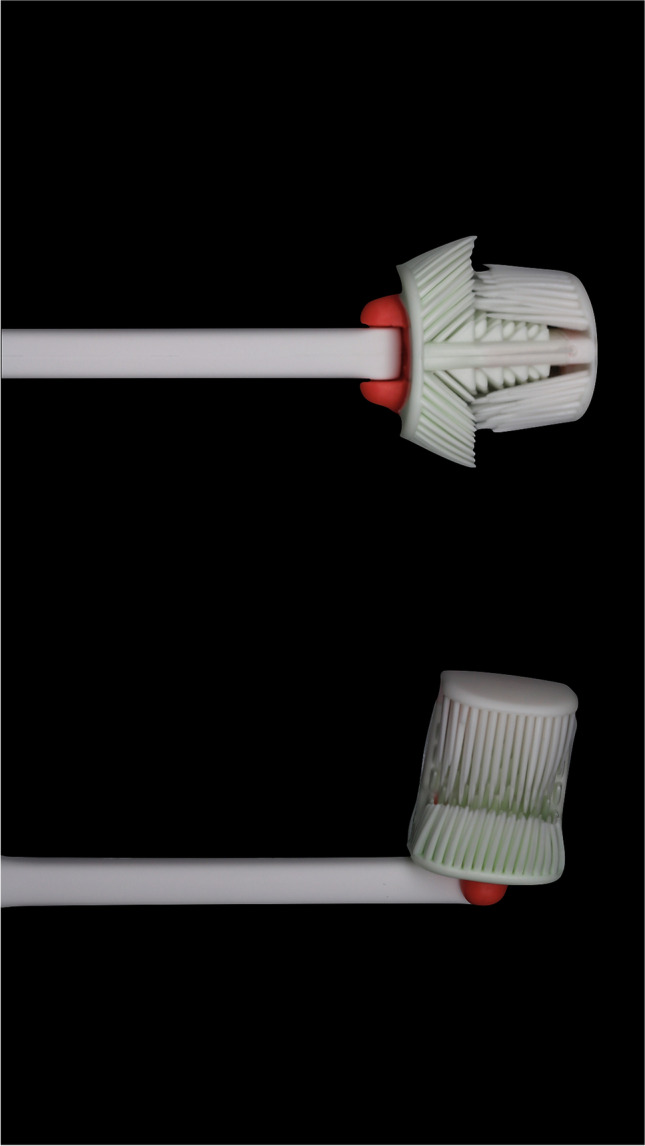
The study group consisted of 25 adults with acquired brain injury. The participants underwent 2 sessions of toothbrushing lasting 1 min, one with a conventional toothbrush and the other with the Balene toothbrush. This new double-headed toothbrush has 6 active sides, which allows for the simultaneous toothbrushing of both alveolar arches, with elastomer bristles angled at 45°, as well a handle that rotates up to 180°. Therefore, the user does not need to remove the toothbrush from the oral cavity during the toothbrushing process. Dental plaque accumulation was assessed using the simplified oral hygiene index of Greene and Vermillion.
The plaque index was significantly reduced both with the Balene toothbrush (p < 0.001) and with the conventional toothbrush (p < 0.001). The dental plaque removal efficacy was similar with the two toothbrushes. There were also no statistically significant differences in the removal of plaque with the Balene toothbrush between the autonomous and assisted toothbrushing modalities (p = 0.345).
For patients with acquired brain injury, the Balene toothbrush was as effective as a conventional toothbrush, regardless of whether the toothbrushing modality was autonomous or assisted.
The Balene® toothbrush's efficacy in removing dental plaque is similar to that of conventional toothbrushes, both with the autonomous and assisted toothbrushing modality. Given its particular ergonomics, this toothbrush could be indicated for certain select patients with acquired brain injury (i.e., those whose degree of cooperation allows for toothbrushing, with a sufficient mouth opening, with no substantial abnormalities in the intermaxillary relationship, and with no significant edentulous sections).
评估新型牙刷(Balene)在脑外伤患者中机械去除牙菌斑的效果。
研究组由 25 名成人脑外伤患者组成。参与者接受了 2 次持续 1 分钟的刷牙治疗,一次使用传统牙刷,另一次使用 Balene 牙刷。这种新型双头牙刷有 6 个活动面,可以同时对两个牙槽进行刷牙,弹性刷毛呈 45°角,牙刷柄可旋转 180°。因此,使用者在刷牙过程中无需将牙刷从口腔中取出。使用简化的 Greene 和 Vermillion 口腔卫生指数评估牙菌斑的积累情况。
Balene 牙刷(p<0.001)和传统牙刷(p<0.001)都显著降低了菌斑指数。两种牙刷的牙菌斑去除效果相似。在自主和辅助刷牙模式下,Balene 牙刷去除牙菌斑的效果在脑外伤患者之间也没有统计学上的显著差异(p=0.345)。
对于脑外伤患者,Balene 牙刷与传统牙刷一样有效,无论刷牙模式是自主还是辅助。
Balene®牙刷去除牙菌斑的效果与传统牙刷相似,无论是自主还是辅助刷牙模式。鉴于其特殊的人体工程学设计,这种牙刷可能适用于某些特定的脑外伤患者(即那些合作程度允许刷牙、张口度足够、颌间关系无明显异常、无明显缺牙部位的患者)。