Division of Infectious Diseases, Children's Hospital Los Angeles, Los Angeles, CA, United States.
Division of Infectious Diseases, Children's Hospital Los Angeles, Los Angeles, CA, United States; Division of Infectious Diseases, Department of Pediatrics, University of California San Diego, La Jolla, CA, United States.
J Immunol Methods. 2023 Aug;519:113520. doi: 10.1016/j.jim.2023.113520. Epub 2023 Jun 29.
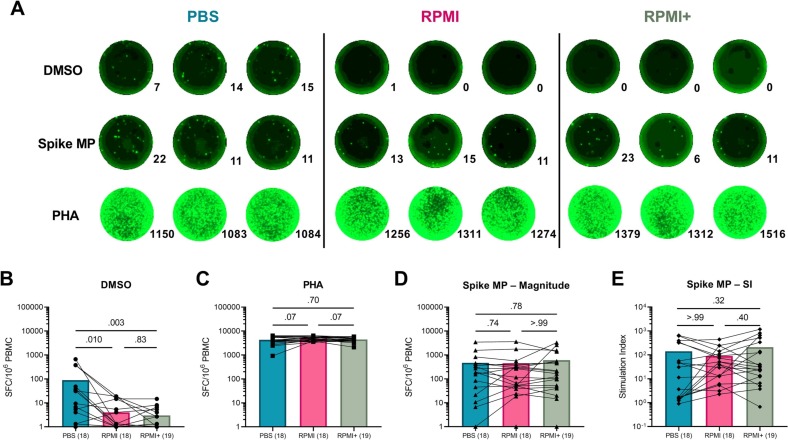
Protocols for the isolation of peripheral blood mononuclear cells (PBMCs) from whole blood vary greatly between laboratories, especially in published studies of SARS-CoV-2-specific T cell responses following infection and vaccination. Research on the effects of different wash media types or centrifugation speeds and brake usage during the PBMC isolation process on downstream T cell activation and functionality is limited. Blood samples from 26 COVID-19-vaccinated participants were processed with different PBMC isolation methods using either PBS or RPMI as the wash media with high centrifugation speed and brakes or RPMI as the wash media with low speed and brakes (RPMI+ method). SARS-CoV-2 spike-specific T cells were quantified and characterized via a flow cytometry-based activation induced markers (AIM) assay and an interferon-γ (IFNγ) FluoroSpot assay and responses were compared between processing methods. Samples washed with RPMI showed higher AIM CD4 T cell responses than those washed with PBS and showed a shift away from naïve and towards an effector memory phenotype. The activation marker OX40 showed higher SARS-CoV-2 spike-induced upregulation on RPMI-washed CD4 T cells, while differences in CD137 upregulation were minimal between processing methods. The magnitude of the AIM CD8 T cell response was similar between processing methods but showed higher stimulation indices. Background frequencies of CD69 CD8 T cells were increased in PBS-washed samples and were associated with higher baseline numbers of IFNγ-producing cells in the FluoroSpot assay. Slower braking in the RPMI+ method did not improve detection of SARS-CoV-2-specific T cells and caused longer processing times. Thus, the use of RPMI media with full centrifugation brakes during the wash steps of PBMC isolation was found to be most effective and efficient. Further studies are needed to elucidate the pathways involved in RPMI-mediated preservation of downstream T cell activity.
外周血单个核细胞(PBMCs)的分离方案在不同实验室之间差异很大,尤其是在感染和接种 SARS-CoV-2 后针对特异性 T 细胞反应的已发表研究中。关于在 PBMC 分离过程中不同洗涤介质类型或离心速度和刹车使用对下游 T 细胞激活和功能的影响的研究有限。使用 PBS 或 RPMI 作为洗涤介质的高离心速度和刹车或 RPMI 作为洗涤介质的低速度和刹车(RPMI+方法),用不同的 PBMC 分离方法处理了 26 名 COVID-19 疫苗接种者的血液样本。通过基于流式细胞术的激活诱导标志物(AIM)测定和干扰素-γ(IFNγ)荧光斑点测定来定量和表征 SARS-CoV-2 刺突特异性 T 细胞,并比较不同处理方法之间的反应。与用 PBS 洗涤的样本相比,用 RPMI 洗涤的样本显示出更高的 AIM CD4 T 细胞反应,并显示出从幼稚细胞向效应记忆表型的转变。激活标志物 OX40 在 RPMI 洗涤的 CD4 T 细胞上显示出更高的 SARS-CoV-2 刺突诱导上调,而不同处理方法之间 CD137 上调的差异最小。AIM CD8 T 细胞反应的幅度在不同处理方法之间相似,但刺激指数较高。在 PBS 洗涤的样本中,CD69 CD8 T 细胞的背景频率增加,并且与 FluoroSpot 测定中 IFNγ 产生细胞的基线数量较高相关。在 RPMI+方法中较慢的刹车并没有提高 SARS-CoV-2 特异性 T 细胞的检测效率,反而导致处理时间延长。因此,在 PBMC 分离的洗涤步骤中使用 RPMI 培养基并充分离心刹车被发现是最有效和高效的。需要进一步的研究来阐明 RPMI 介导的下游 T 细胞活性保存所涉及的途径。