Sella Aluma Chovel, Becker Kendra R, Slattery Meghan, Hauser Kristine, Asanza Elisa, Stern Casey, Kuhnle Megan, Micali Nadia, Eddy Kamryn T, Misra Madhusmita, Thomas Jennifer J, Lawson Elizabeth A
Neuroendocrine Unit, Massachusetts General Hospital, 55 Fruit St., Boston, MA, 02114, USA.
Division of Pediatric Endocrinology, Mass General Hospital for Children, Boston, MA, USA.
J Eat Disord. 2023 Jul 1;11(1):106. doi: 10.1186/s40337-023-00822-y.
Avoidant/restrictive food intake disorder (ARFID) is a restrictive eating disorder commonly associated with medical complications of undernutrition and low weight. In adolescence, a critical time for bone accrual, the impact of ARFID on bone health is uncertain. We aimed to study bone health in low-weight females with ARFID, as well as the association between peptide YY (PYY), an anorexigenic hormone with a role in regulation of bone metabolism, and bone mineral density (BMD) in these individuals. We hypothesized that BMD would be lower in low-weight females with ARFID than healthy controls (HC), and that PYY levels would be negatively associated with BMD.
We performed a cross-sectional study in 14 adolescent low-weight females with ARFID and 20 HC 10-23 years old. We assessed BMD (total body, total body less head and lumbar spine) using dual x-ray absorptiometry (DXA) and assessed fasting total PYY concentration in blood.
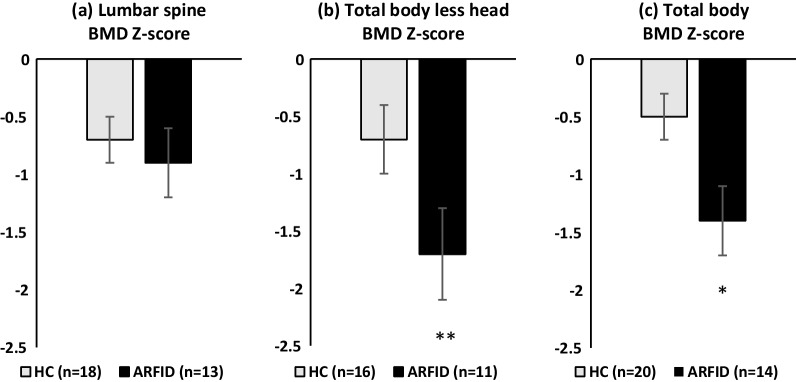
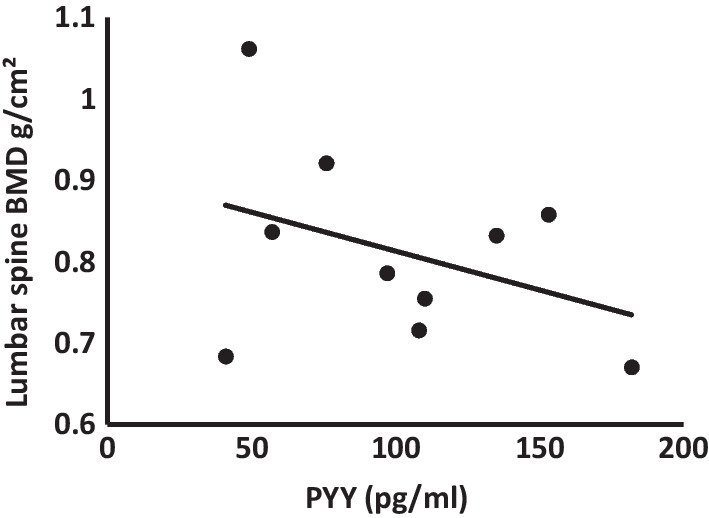
Total body BMD Z-scores were significantly lower in ARFID than in HC (- 1.41 ± 0.28 vs. - 0.50 ± 0.25, p = 0.021). Mean PYY levels trended higher in ARFID vs. HC (98.18 ± 13.55 pg/ml vs. 71.40 ± 5.61 pg/ml, p = 0.055). In multivariate analysis within the ARFID group, PYY was negatively associated with lumbar BMD adjusted for age (β = -0.481, p = 0.032).
Our findings suggest that female adolescents with low-weight ARFID may have lower BMD than healthy controls and that higher PYY levels may be associated with lower BMD at some, but not all, sites in ARFID. Further research with larger samples will be important to investigate whether high PYY drives bone loss in ARFID.
回避/限制性食物摄入障碍(ARFID)是一种限制性饮食障碍,通常与营养不良和体重过低的医学并发症相关。在青春期这个骨骼积累的关键时期,ARFID对骨骼健康的影响尚不确定。我们旨在研究体重过低的ARFID女性的骨骼健康状况,以及厌食激素肽YY(PYY)在这些个体中对骨代谢调节的作用与骨密度(BMD)之间的关联。我们假设体重过低的ARFID女性的骨密度低于健康对照(HC),并且PYY水平与骨密度呈负相关。
我们对14名10 - 23岁体重过低的ARFID青少年女性和20名HC进行了横断面研究。我们使用双能X线吸收法(DXA)评估骨密度(全身、头部以外的全身和腰椎),并评估血液中空腹总PYY浓度。
ARFID组的全身骨密度Z值显著低于HC组(-1.41±0.28 vs. -0.50±0.25,p = 0.021)。ARFID组的平均PYY水平与HC组相比有升高趋势(98.18±13.55 pg/ml vs. 71.40±5.61 pg/ml,p = 0.055)。在ARFID组的多变量分析中,调整年龄后PYY与腰椎骨密度呈负相关(β = -0.481,p = 0.032)。
我们的研究结果表明,体重过低的ARFID女性青少年的骨密度可能低于健康对照,并且较高的PYY水平可能与ARFID某些但并非所有部位的较低骨密度相关。进一步开展更大样本量的研究对于调查高PYY是否导致ARFID患者骨质流失至关重要。