School of Medical Sciences, The Faculty of Medicine and Health, The University of Sydney, Sydney, New South Wales, Australia.
School of Chemistry, The Faculty of Science, The University of Sydney, Sydney, New South Wales, Australia.
Biotechnol Bioeng. 2023 Oct;120(10):3079-3091. doi: 10.1002/bit.28470. Epub 2023 Jul 3.
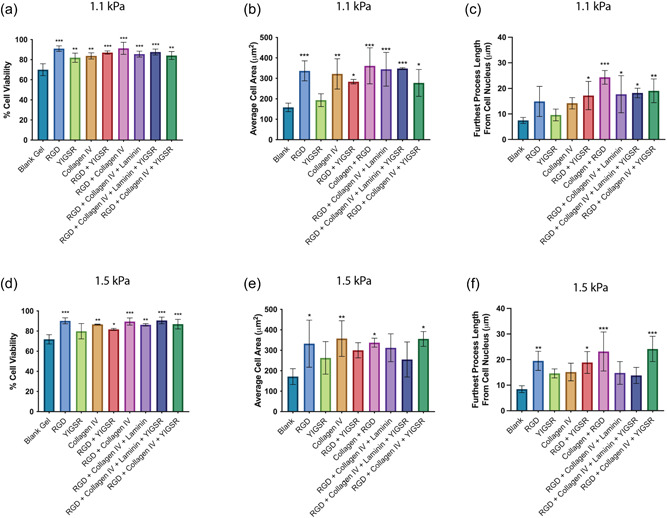
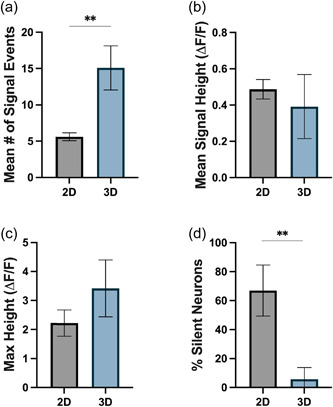
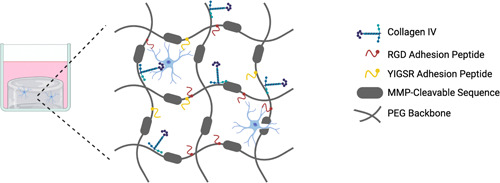
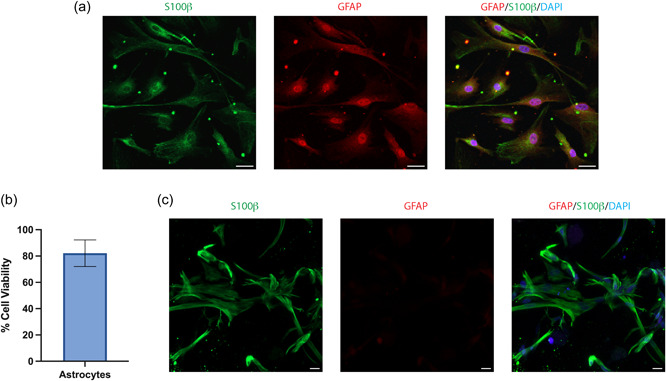
Current research tools for preclinical drug development such as rodent models and two-dimensional immortalized monocultures have failed to serve as effective translational models for human central nervous system (CNS) disorders. Recent advancements in the development of induced pluripotent stem cells (iPSCs) and three-dimensional (3D) culturing can improve the in vivo-relevance of preclinical models, while generating 3D cultures though novel bioprinting technologies can offer increased scalability and replicability. As such, there is a need to develop platforms that combine iPSC-derived cells with 3D bioprinting to produce scalable, tunable, and biomimetic cultures for preclinical drug discovery applications. We report a biocompatible poly(ethylene glycol)-based matrix which incorporates Arg-Gly-Asp and Tyr-Ile-Gly-Ser-Arg peptide motifs and full-length collagen IV at a stiffness similar to the human brain (1.5 kPa). Using a high-throughput commercial bioprinter we report the viable culture and morphological development of monocultured iPSC-derived astrocytes, brain microvascular endothelial-like cells, neural progenitors, and neurons in our novel matrix. We also show that this system supports endothelial-like vasculogenesis and enhances neural differentiation and spontaneous activity. This platform forms a foundation for more complex, multicellular models to facilitate high-throughput translational drug discovery for CNS disorders.
目前用于临床前药物开发的研究工具,如啮齿动物模型和二维永生化单细胞培养,未能成为人类中枢神经系统(CNS)疾病的有效转化模型。诱导多能干细胞(iPSC)和三维(3D)培养的最新进展可以提高临床前模型的体内相关性,而通过新型生物打印技术生成 3D 培养物可以提供更高的可扩展性和可重复性。因此,需要开发将 iPSC 衍生细胞与 3D 生物打印相结合的平台,以生产用于临床前药物发现应用的可扩展、可调谐和仿生培养物。我们报告了一种生物相容性的聚(乙二醇)基质,其中包含 Arg-Gly-Asp 和 Tyr-Ile-Gly-Ser-Arg 肽基序和全长胶原蛋白 IV,其硬度与人类大脑相似(1.5 kPa)。使用高通量商业生物打印机,我们报告了在我们的新型基质中单细胞培养的 iPSC 衍生星形胶质细胞、脑微血管内皮样细胞、神经祖细胞和神经元的可行培养和形态发育。我们还表明,该系统支持内皮样血管生成,并增强神经分化和自发活动。该平台为更复杂的多细胞模型奠定了基础,以促进 CNS 疾病的高通量转化药物发现。