Nordman Matilda, Lassen Anne Dahl, Stockmarr Anders, van 't Veer Pieter, Biesbroek Sander, Trolle Ellen
National Food Institute, Technical University of Denmark, Kgs. Lyngby, Denmark.
Department of Applied Mathematics and Computer Science, Technical University of Denmark, Kgs. Lyngby, Denmark.
Front Nutr. 2023 Jun 15;10:1158257. doi: 10.3389/fnut.2023.1158257. eCollection 2023.
A transition to healthy and sustainable diets has the potential to improve human and planetary health but diets need to meet requirements for nutritional adequacy, health, environmental targets, and be acceptable to consumers.
The objective of this study was to derive a nutritionally adequate and healthy diet that has the least deviation possible from the average observed diet of Danish adults while aiming for a greenhouse gas emission (GHGE) reduction of 31%, corresponding to the GHGE level of the Danish plant-rich diet, which lays the foundation for the current healthy and sustainable food-based dietary guidelines (FBDGs) in Denmark.
With an objective function minimizing the departure from the average observed diet of Danish adults, four diet optimizations were run using quadratic programming, with different combinations of diet constraints: (1) nutrients only (), (2) nutrients and health-based targets for food amounts (), (3) GHGE only (), and finally, (4) combined nutrient, health and GHGE constraints ().
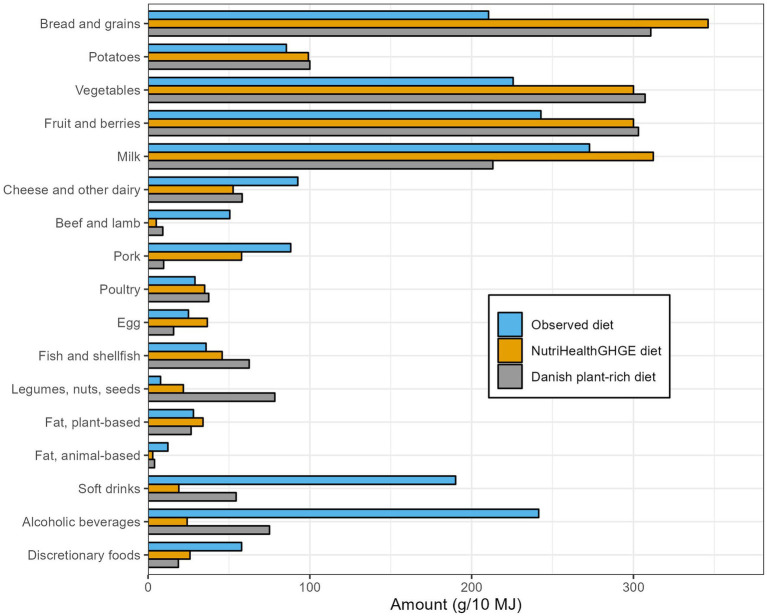
The GHGE of the four optimized diets were 3.93 kg CO-eq (), 3.77 kg CO-eq () and 3.01 kg CO-eq (), compared to 4.37 kg CO-eq in the observed diet. The proportion of energy from animal-based foods was 21%-25% in the optimized diets compared to 34% in the observed diet and 18% in the Danish plant-rich diet. Moreover, compared to the average Danish diet, the diet contained more grains and starches (44 E% vs. 28 E%), nuts (+230%), fatty fish (+89%), eggs (+47%); less cheese (-73%), animal-based fats (-76%), total meat (-42%); and very limited amounts of ruminant meat, soft drinks, and alcoholic beverages (all-90%), while the amounts of legumes and seeds were unchanged. On average, the mathematically optimized diet showed a smaller deviation from the average Danish diet compared to the Danish plant-rich diet (38% vs. 169%, respectively).
The final optimized diet presented in this study represents an alternative way of composing a nutritionally adequate and healthy diet that has the same estimated GHGE as a diet consistent with the climate-friendly FBDGs in Denmark. As this optimized diet may be more acceptable for some consumers, it might help to facilitate the transition toward more healthy and sustainable diets in the Danish population.
向健康且可持续的饮食模式转变有改善人类和地球健康的潜力,但饮食需要满足营养充足、健康、环境目标等要求,并且要为消费者所接受。
本研究的目的是得出一种营养充足且健康的饮食,它与丹麦成年人的平均观察饮食的偏差尽可能小,同时目标是将温室气体排放量(GHGE)降低31%,这与丹麦富含植物的饮食的GHGE水平相当,而丹麦富含植物的饮食为丹麦当前基于食物的健康和可持续饮食指南(FBDGs)奠定了基础。
通过一个使与丹麦成年人平均观察饮食的偏差最小化的目标函数,使用二次规划进行了四次饮食优化,采用了不同的饮食约束组合:(1)仅营养成分(),(2)营养成分和基于健康的食物量目标(),(3)仅GHGE(),最后,(4)综合营养、健康和GHGE约束()。
四种优化饮食的GHGE分别为3.93千克二氧化碳当量()、3.77千克二氧化碳当量()和3.01千克二氧化碳当量(),而观察饮食中的GHGE为4.37千克二氧化碳当量。优化饮食中来自动物性食物的能量比例为21% - 25%,观察饮食中为34%,丹麦富含植物的饮食中为18%。此外,与丹麦平均饮食相比,饮食中谷物和淀粉含量更多(44能量%对28能量%)、坚果(+230%)、富含脂肪的鱼类(+89%)、鸡蛋(+47%);奶酪(-73%)、动物性脂肪(-76%)、总肉类(-42%)更少;反刍动物肉、软饮料和酒精饮料的量非常有限(均减少90%),而豆类和种子的量不变。平均而言,与丹麦富含植物的饮食相比,通过数学优化的饮食与丹麦平均饮食的偏差更小(分别为38%对169%)。
本研究中呈现的最终优化饮食代表了一种构成营养充足且健康饮食的替代方式,其估计的GHGE与符合丹麦气候友好型FBDGs的饮食相同。由于这种优化饮食可能对一些消费者更具可接受性,它可能有助于推动丹麦人群向更健康和可持续的饮食转变。