Yu Kai, Wang Lan, Bu Fan, Zhang Jingxuan, Hai Yubin, Hu Rui, Lu Ji, Shi Xiaoju
Department of Urology, The First Hospital of Jilin University, Changchun, China.
Department of Hepatobiliary and Pancreatic Surgery, The First Hospital of Jilin University, Changchun, China.
Front Surg. 2023 Jun 15;10:1166764. doi: 10.3389/fsurg.2023.1166764. eCollection 2023.
Undifferentiated pleomorphic sarcoma (UPS) is a highly malignant soft tissue sarcoma with a poor prognosis and no clear effective clinical means for treatment, and there has been no significant progress in research within this field in recent years. This study aimed to investigate the epidemiology, etiology, clinical features, diagnostic modalities, various treatment modalities, and prognosis of retroperitoneal undifferentiated pleomorphic sarcoma and to contribute to the clinical management of this type of disease. In this study, we report a case of undifferentiated pleomorphic sarcoma with a primary origin in the retroperitoneum. Undifferentiated pleomorphic sarcoma occurring in the retroperitoneum is rarely reported.
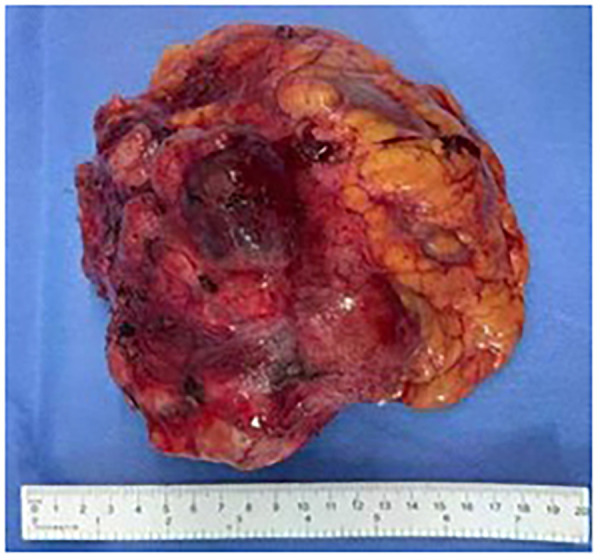
A 59-year-old man with abdominal distension and pain for 4 months presented to our hospital after the failure of conservative treatment. A 9.6 cm by 7.4 cm mass in the left retroperitoneum was found on a CT scan of the whole abdomen with three degrees of enhancement. After surgical treatment, the tumor and the left kidney were completely removed, and pathological examination and genetic sequencing showed an apparent undifferentiated pleomorphic sarcoma. The patient subsequently declined follow-up treatment and is currently alive and well.
At the current level of clinical technology, the treatment of undifferentiated pleomorphic sarcoma is still in the exploratory stage, and the scarcity of clinical cases of this disease may have hindered the acquisition of clinical trials and research data for this disease. At present, the first choice of treatment for undifferentiated pleomorphic sarcoma is still radical resection. In the existing clinical studies, there are no strong data to support the effect of preoperative neoadjuvant chemoradiotherapy and adjuvant chemoradiotherapy in clinical practice. Similar to other diseases, the use of radiotherapy and chemotherapy before and after surgery may be a potential treatment for this disease in the future. Targeted therapy for this disease still needs further exploration, and we need more reports on related diseases to promote future treatment and research on this disease.
未分化多形性肉瘤(UPS)是一种高度恶性的软组织肉瘤,预后较差,且尚无明确有效的临床治疗方法,近年来该领域的研究也未取得显著进展。本研究旨在探讨腹膜后未分化多形性肉瘤的流行病学、病因、临床特征、诊断方法、各种治疗方式及预后情况,为该类疾病的临床管理提供参考。在本研究中,我们报告了一例原发于腹膜后的未分化多形性肉瘤病例。腹膜后发生的未分化多形性肉瘤鲜有报道。
一名59岁男性,因腹胀、腹痛4个月,在保守治疗无效后前来我院就诊。全腹CT扫描发现左腹膜后有一个9.6厘米×7.4厘米的肿块,呈三度强化。手术治疗后,肿瘤及左肾被完整切除,病理检查及基因测序显示为明显的未分化多形性肉瘤。患者随后拒绝后续治疗,目前生存状况良好。
在当前临床技术水平下,未分化多形性肉瘤的治疗仍处于探索阶段,该疾病临床病例的稀缺可能阻碍了其临床试验及研究数据的获取。目前,未分化多形性肉瘤的首选治疗方法仍是根治性切除。在现有的临床研究中,尚无有力数据支持术前新辅助放化疗及辅助放化疗在临床实践中的效果。与其他疾病类似,手术前后使用放疗和化疗可能是该疾病未来的一种潜在治疗方法。针对该疾病的靶向治疗仍需进一步探索,我们需要更多相关疾病的报道以推动该疾病未来的治疗和研究。