Titmarsh Helen F, von Kriegsheim Alex, Wills Jimi C, O'Connor Richard A, Dhaliwal Kevin, Frame Margaret C, Pattle Samuel B, Dorward David A, Byron Adam, Akram Ahsan R
The EPSRC and MRC Centre for Doctoral Training in Optical Medical Imaging, Queen's Medical Research Institute, University of Edinburgh, Edinburgh Bioquarter, Edinburgh, United Kingdom.
Centre for Inflammation Research, Queen's Medical Research Institute, University of Edinburgh, Edinburgh Bioquarter, Edinburgh, United Kingdom.
Front Oncol. 2023 Jun 16;13:1194515. doi: 10.3389/fonc.2023.1194515. eCollection 2023.
The composition and remodelling of the extracellular matrix (ECM) are important factors in the development and progression of cancers, and the ECM is implicated in promoting tumour growth and restricting anti-tumour therapies through multiple mechanisms. The characterisation of differences in ECM composition between normal and diseased tissues may aid in identifying novel diagnostic markers, prognostic indicators and therapeutic targets for drug development.
Using tissue from non-small cell lung cancer (NSCLC) patients undergoing curative intent surgery, we characterised quantitative tumour-specific ECM proteome signatures by mass spectrometry.
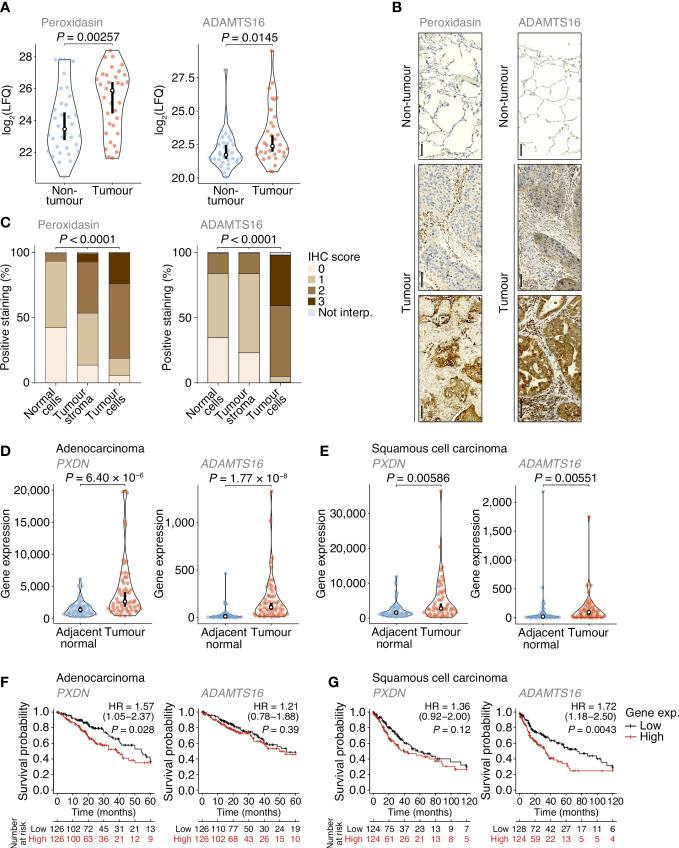
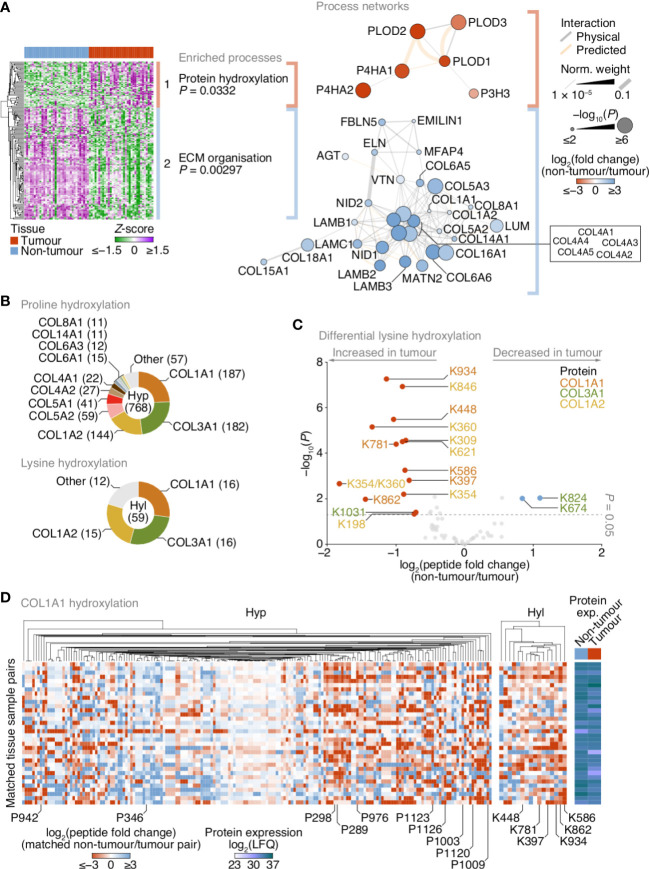
We identified 161 matrisome proteins differentially regulated between tumour tissue and nearby non-malignant lung tissue, and we defined a collagen hydroxylation functional protein network that is enriched in the lung tumour microenvironment. We validated two novel putative extracellular markers of NSCLC, the collagen cross-linking enzyme peroxidasin and a disintegrin and metalloproteinase with thrombospondin motifs 16 (ADAMTS16), for discrimination of malignant and non-malignant lung tissue. These proteins were up-regulated in lung tumour samples, and high and gene expression was associated with shorter survival of lung adenocarcinoma and squamous cell carcinoma patients, respectively.
These data chart extensive remodelling of the lung extracellular niche and reveal tumour matrisome signatures in human NSCLC.
细胞外基质(ECM)的组成和重塑是癌症发生发展的重要因素,ECM通过多种机制促进肿瘤生长并限制抗肿瘤治疗。表征正常组织与病变组织之间ECM组成的差异可能有助于识别新的诊断标志物、预后指标和药物开发的治疗靶点。
我们使用接受根治性手术的非小细胞肺癌(NSCLC)患者的组织,通过质谱分析表征了定量的肿瘤特异性ECM蛋白质组特征。
我们鉴定出161种在肿瘤组织和附近非恶性肺组织之间差异调节的基质体蛋白,并定义了一个在肺肿瘤微环境中富集的胶原羟基化功能蛋白网络。我们验证了两种新的NSCLC假定细胞外标志物,胶原交联酶过氧化物酶和含血小板反应蛋白基序的解整合素和金属蛋白酶16(ADAMTS16),用于区分恶性和非恶性肺组织。这些蛋白在肺肿瘤样本中上调,高 和 基因表达分别与肺腺癌和鳞状细胞癌患者的较短生存期相关。
这些数据描绘了肺细胞外生态位的广泛重塑,并揭示了人类NSCLC中的肿瘤基质体特征。