Yang Wei, Liu Xingfang, Zhang Xinyue, Li Cong, Li Zhenghong, Li Yiming, Li Mingquan
The Affiliated Hospital of Changchun University of Chinese Medicine, Changchun, China.
Research Department, Swiss University of Traditional Chinese Medicine, Bad Zurzach, Switzerland.
Front Neurosci. 2023 Jun 15;17:1209262. doi: 10.3389/fnins.2023.1209262. eCollection 2023.
This study aims to analyze the current research status of acupuncture in the treatment of mild cognitive impairment (MCI) using bibliometric methods, explore current research hotspots, and predict future research trends.
Literature on acupuncture for MCI in China National Knowledge Infrastructure (CNKI) and Web of Science (WOS) databases were searched from their inception to December 31, 2022. Articles were then filtered using inclusion and exclusion criteria and imported into VOSviewer 1.6.11 and CiteSpace 6.1.6msi software for descriptive analysis of publication numbers, network analysis of author/institution collaborations, and cluster analysis of keywords, as well as analysis of keyword emergence and linear relationships with time.
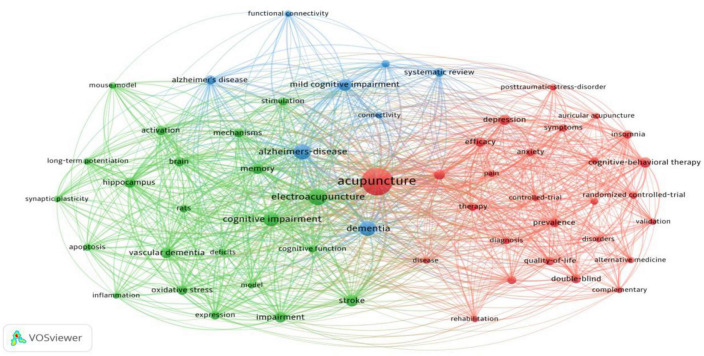
The Chinese and English databases included 243 and 565 relevant articles, respectively. The overall volume of Chinese and English literature was stable, with the annual volume generally increasing. In terms of countries, institutions, and authors, China had the highest number of English-language publications; however, the number of joint publications among institutions/authors was low. Research institutions were independent and dispersed, with no collaborative teams formed around a single institution/author. The hotspots in Chinese literature were "needling, treatment, electric acupuncture, nimodipine, cognitive training" and other clinical research directions. The hotspots in English literature were "acupuncture, electro-acupuncture, Alzheimer's disease, dementia, cognitive impairment, memory, vascular dementia, mild cognitive impairment, stroke, hippocampus, injury," and other mechanisms of action.
The popularity of acupuncture for MCI is increasing year by year. Acupuncture for MCI, along with cognitive training, can help improve cognitive function. "Inflammation" is the frontier of acupuncture for MCI research. In the future, strengthening effective communication and cooperation among institutions, especially international cooperation, is essential for conducting high-quality research on acupuncture for MCI. This will help obtain high-level evidence and improve the output and translation of research results.
本研究旨在运用文献计量学方法分析针灸治疗轻度认知障碍(MCI)的当前研究现状,探索当前研究热点,并预测未来研究趋势。
检索中国知网(CNKI)和科学网(WOS)数据库中自建库至2022年12月31日关于针灸治疗MCI的文献。然后根据纳入和排除标准对文章进行筛选,并导入VOSviewer 1.6.11和CiteSpace 6.1.6 msi软件,进行发表数量的描述性分析、作者/机构合作的网络分析、关键词聚类分析,以及关键词出现情况和与时间的线性关系分析。
中文和英文数据库分别纳入243篇和565篇相关文章。中文和英文文献的总体数量稳定,年发文量总体呈上升趋势。在国家、机构和作者方面,中国的英文发文量最多;然而,机构/作者之间的合作发文数量较少。研究机构独立且分散,未形成围绕单一机构/作者的合作团队。中文文献的热点为“针刺、治疗、电针、尼莫地平、认知训练”等临床研究方向。英文文献的热点为“针灸、电针、阿尔茨海默病、痴呆、认知障碍、记忆、血管性痴呆、轻度认知障碍、中风、海马体、损伤”等作用机制。
针灸治疗MCI的热度逐年上升。针灸结合认知训练有助于改善认知功能。“炎症”是针灸治疗MCI研究的前沿领域。未来,加强机构间的有效沟通与合作,尤其是国际合作,对于开展高质量的针灸治疗MCI研究至关重要。这将有助于获得高水平证据,提高研究成果的产出与转化。