Cho Eun Bin, Jung Se Young, Jung Jin-Hyung, Yeo Yohwan, Kim Hee Jin, Han Kyungdo, Shin Dong Wook, Min Ju-Hong
Department of Neurology, College of Medicine, Gyeongsang Institute of Health Science, Gyeongsang National University, Jinju, Republic of Korea.
Department of Neurology, Gyeongsang National University Changwon Hospital, Changwon, Republic of Korea.
Front Neurosci. 2023 Jun 15;17:1214652. doi: 10.3389/fnins.2023.1214652. eCollection 2023.
Cognitive impairment is a common feature of multiple sclerosis (MS) and neuromyelitis optica spectrum disorder (NMOSD). However, there is a lack of population-based study of dementia risk in these disorders. In the present study, the risk of dementia in MS and NMOSD patients in Republic of Korea was estimated.
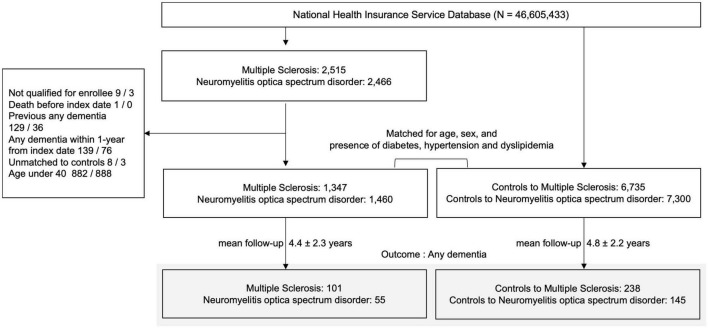
Data analyzed in this study were obtained from the Korean National Health Insurance Service (KNHIS) database between January 2010 and December 2017. The study included 1,347 MS patients and 1,460 NMOSD patients ≥40 years of age who had not been diagnosed with dementia within 1 year prior to the index date. Matched controls were selected based on age, sex, and the presence of hypertension, diabetes mellitus, or dyslipidemia.
In MS and NMOSD patients, the risk of developing any dementia [adjusted hazard ratio (aHR) = 2.34; 95% confidence interval (CI) = 1.84-2.96 and aHR = 2.19; 95% CI = 1.61-3.00, respectively], Alzheimer's disease [AD; aHR = 2.23; 95% confidence interval (CI) = 1.70-2.91 and aHR = 1.99; 95% CI = 1.38-2.88, respectively], and vascular dementia (aHR = 3.75; 95% CI = 1.91-7.35 and aHR = 3.21; 95% CI = 1.47-7.02, respectively) was higher compared with the matched controls. NMOSD patients had a lower risk of any dementia and AD compared with MS patients after adjusting for age, sex, income, hypertension, diabetes, and dyslipidemia (aHR = 0.67 and 0.62).
The risk of dementia increased in MS and NMOSD patients and dementia risk was higher in MS than in NMOSD.
认知障碍是多发性硬化症(MS)和视神经脊髓炎谱系障碍(NMOSD)的常见特征。然而,目前缺乏针对这些疾病中痴呆风险的基于人群的研究。在本研究中,我们估计了韩国MS和NMOSD患者患痴呆症的风险。
本研究分析的数据来自2010年1月至2017年12月的韩国国民健康保险服务(KNHIS)数据库。该研究纳入了1347例MS患者和1460例年龄≥40岁且在索引日期前1年内未被诊断为痴呆症的NMOSD患者。根据年龄、性别以及是否患有高血压、糖尿病或血脂异常选择匹配的对照组。
与匹配的对照组相比,MS和NMOSD患者发生任何痴呆症的风险[调整后风险比(aHR)=2.34;95%置信区间(CI)=1.84-2.96和aHR=2.19;95%CI=1.61-3.00]、阿尔茨海默病[AD;aHR=2.23;95%置信区间(CI)=1.70-2.91和aHR=1.99;95%CI=1.38-2.88]以及血管性痴呆(aHR=3.75;95%CI=1.91-7.35和aHR=3.21;95%CI=1.47-7.02)均更高。在调整年龄、性别、收入、高血压、糖尿病和血脂异常后,NMOSD患者发生任何痴呆症和AD的风险低于MS患者(aHR=0.67和0.62)。
MS和NMOSD患者患痴呆症的风险增加,且MS患者的痴呆风险高于NMOSD患者。