Department of Medicine, Seoul National University College of Medicine, Seoul, Republic of Korea.
Department of Family Medicine, Seoul National University Health Service Center, Seoul, Republic of Korea.
JAMA Netw Open. 2023 Jan 3;6(1):e2251506. doi: 10.1001/jamanetworkopen.2022.51506.
Several observational studies have reported that smoking cessation is associated with a lower risk of dementia. However, no studies have examined the association between change in smoking intensity and risk of dementia.
To investigate the association between a change in smoking intensity, including smoking reduction and smoking cessation, and risk of all dementia.
DESIGN, SETTING, AND PARTICIPANTS: This cohort study used data from the National Health Insurance Service database of Korea. The cohort included participants 40 years or older who underwent biennial health examinations (2009 and 2011) and had current smoking status at the first health examination. The cohort was followed up until December 31, 2018, and statistical analysis was performed between July and December 2021.
Change in smoking intensity from baseline was defined operationally as follows: quitters (stopped smoking), reducers I (decreased number of cigarettes smoked per day by ≥50%), reducers II (decreased number of cigarettes smoked per day by 20%-50%), sustainers (maintained [decreased or increased] number of cigarettes smoked per day by less than 20%), or increasers (increased number of cigarettes smoked per day by ≥20%).
The primary outcome was newly diagnosed dementia, which was identified by prescribed antidementia medications with concomitant International Statistical Classification of Diseases and Related Health Problems, Tenth Revision diagnosis codes for dementia. Adjusted hazard ratios and 95% CIs were used to determine the association between change in smoking intensity and incidence of dementia, including Alzheimer disease (AD) and vascular dementia (VaD).
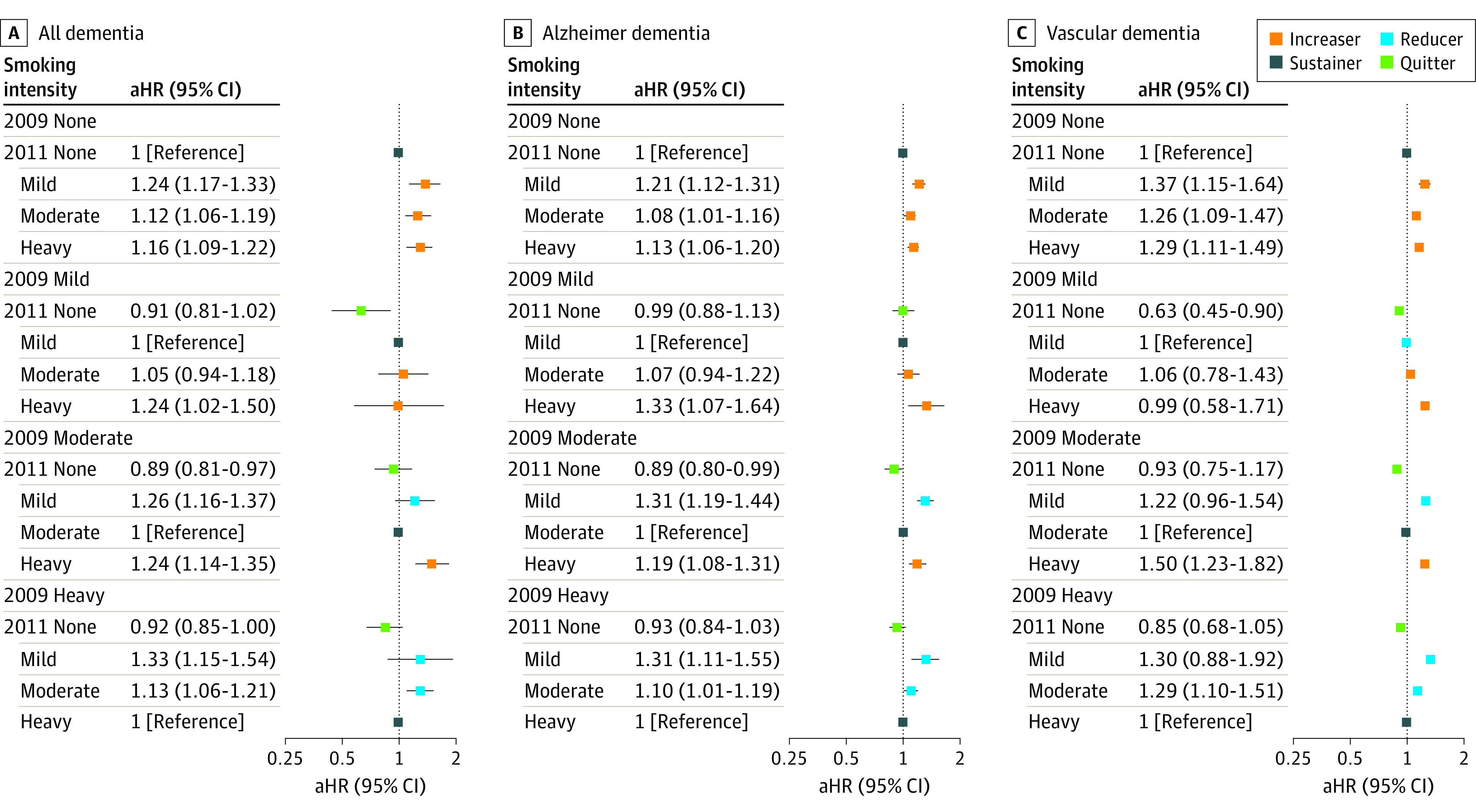
A total of 789 532 participants (756 469 males [95.8%]; mean [SD] age, 52.2 [8.5] years) were included. During a median (IQR) follow-up period of 6.3 (6.1-6.6) years, 11 912 dementia events, including 8800 AD and 1889 VaD events, were identified. Overall, participants in the quitter group had a significantly lower risk of all dementia (adjusted hazard ratio [aHR], 0.92; 95% CI, 0.87-0.97) compared with those in the sustainer group. Those in the reducer I (aHR, 1.25; 95% CI, 1.18-1.33) and increaser (aHR, 1.12; 95% CI, 1.06-1.18) groups had a significantly higher risk of all dementia compared with those in the sustainer group.The patterns for AD and VaD remained consistent with patterns for all dementia.
The results of this study showed that smoking cessation was associated with a lower risk of dementia compared with sustained smoking intensity, while smoking reduction was associated with a higher risk. Smoking cessation should be emphasized in efforts to reduce the disease burden of dementia.
几项观察性研究报告称,戒烟与痴呆风险降低有关。然而,尚无研究探讨吸烟强度变化与痴呆风险之间的关系。
研究吸烟强度变化(包括减少和戒烟)与所有痴呆风险之间的关系。
设计、地点和参与者:这项队列研究使用了来自韩国国家健康保险服务数据库的数据。该队列纳入了在第一次健康检查时年龄在 40 岁及以上且当前有吸烟状况的参与者。该队列随访至 2018 年 12 月 31 日,统计分析于 2021 年 7 月至 12 月进行。
从基线开始,吸烟强度的变化被定义为:戒烟者(停止吸烟)、减少者 I(每天吸烟量减少≥50%)、减少者 II(每天吸烟量减少 20%-50%)、维持者(每天吸烟量减少或增加少于 20%)或增加者(每天吸烟量增加≥20%)。
主要结局是新诊断的痴呆症,通过同时伴有国际疾病分类和相关健康问题第十次修订诊断代码的规定抗痴呆药物来确定。使用调整后的危险比(aHR)和 95%置信区间(CI)来确定吸烟强度变化与痴呆症(包括阿尔茨海默病[AD]和血管性痴呆[VaD])发病风险之间的关系。
共纳入 789532 名参与者(756469 名男性[95.8%];平均[SD]年龄 52.2[8.5]岁)。在中位(IQR)随访期 6.3(6.1-6.6)年期间,共确定了 11912 例痴呆症事件,包括 8800 例 AD 和 1889 例 VaD。总体而言,与维持者相比,戒烟者全因痴呆症的风险显著降低(调整后 HR[aHR],0.92;95%CI,0.87-0.97)。与维持者相比,减少者 I(aHR,1.25;95%CI,1.18-1.33)和增加者(aHR,1.12;95%CI,1.06-1.18)的全因痴呆症风险更高。AD 和 VaD 的发病模式与全因痴呆症的发病模式一致。
本研究结果表明,与维持吸烟强度相比,戒烟与痴呆症风险降低相关,而减少吸烟与风险增加相关。在减少痴呆症疾病负担的努力中,应强调戒烟。