Vadakedath Sabitha, Kandi Venkataramana, Ca Jayashankar, Vijayan Swapna, Achyut Kushal C, Uppuluri Shivani, Reddy Praveen Kumar K, Ramesh Monish, Kumar P Pavan
Biochemistry, Prathima Institute of Medical Sciences, Karimnagar, IND.
Clinical Microbiology, Prathima Institute of Medical Sciences, Karimnagar, IND.
Cureus. 2023 Jun 1;15(6):e39812. doi: 10.7759/cureus.39812. eCollection 2023 Jun.
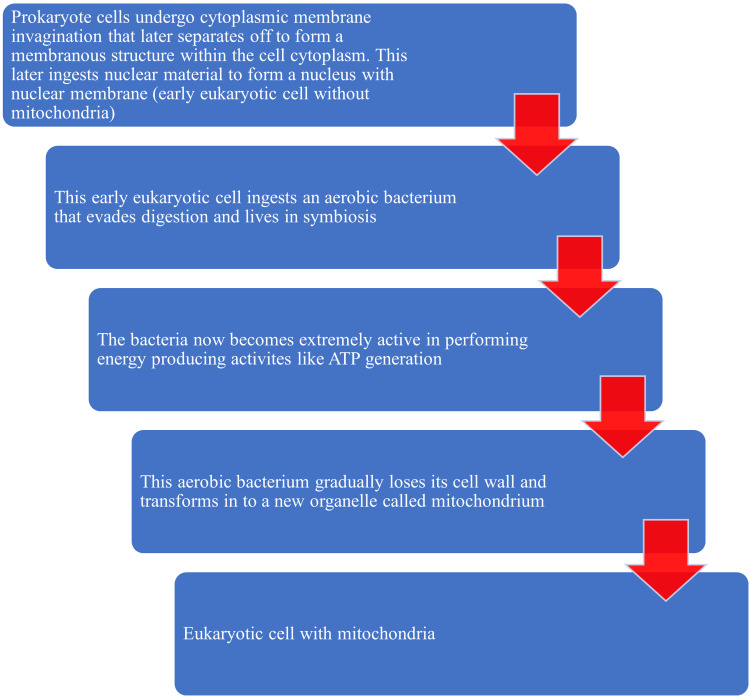
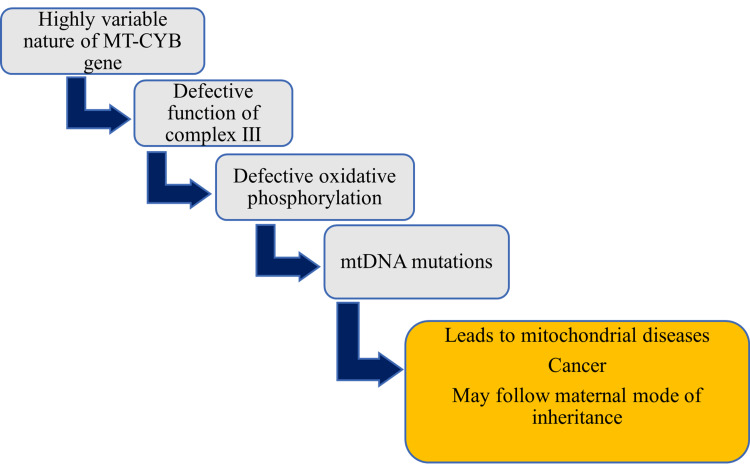
Mitochondrial DNA (mtDNA) is a small, circular, double-stranded DNA inherited from the mother during fertilization. Evolutionary evidence supported by the endosymbiotic theory identifies mitochondria as an organelle that could have descended from prokaryotes. This may be the reason for the independent function and inheritance pattern shown by mtDNA. The unstable nature of mtDNA due to the lack of protective histones, and effective repair systems make it more vulnerable to mutations. The mtDNA and its mutations could be maternally inherited thereby predisposing the offspring to various cancers like breast and ovarian cancers among others. Although mitochondria are considered heteroplasmic wherein variations among the multiple mtDNA genomes are noticed, mothers can have mitochondrial populations that are homoplasmic for a given mitochondrial mutation. Homoplasmic mitochondrial mutations may be transmitted to all maternal offspring. However, due to the complex interplay between the mitochondrial and nuclear genomes, it is often difficult to predict disease outcomes, even with homoplasmic mitochondrial populations. Heteroplasmic mtDNA mutations can be maternally inherited, but the proportion of mutated alleles differs markedly between offspring within one generation. This led to the genetic bottleneck hypothesis, explaining the rapid changes in allele frequency witnessed during the transmission of mtDNA from one generation to the next. Although a physical reduction in mtDNA has been demonstrated in several species, a comprehensive understanding of the molecular mechanisms is yet to be demonstrated. Despite initially thought to be limited to the germline, there is evidence that blockages exist in different cell types during development, perhaps explaining why different tissues in the same organism contain different levels of mutated mtDNA. In this review, we comprehensively discuss the potential mechanisms through which mtDNA undergoes mutations and the maternal mode of transmission that contributes to the development of tumors, especially breast and ovarian cancers.
线粒体DNA(mtDNA)是一种小型环状双链DNA,在受精过程中从母亲那里遗传而来。内共生理论支持的进化证据表明,线粒体是一种可能起源于原核生物的细胞器。这可能是mtDNA表现出独立功能和遗传模式的原因。由于缺乏保护性组蛋白和有效的修复系统,mtDNA的性质不稳定,使其更容易发生突变。mtDNA及其突变可能通过母系遗传,从而使后代易患各种癌症,如乳腺癌和卵巢癌等。虽然线粒体被认为是异质性的,即多个mtDNA基因组之间存在变异,但母亲可能有针对特定线粒体突变的同质性线粒体群体。同质性线粒体突变可能会传递给所有母系后代。然而,由于线粒体基因组和核基因组之间复杂的相互作用,即使是同质性线粒体群体,也往往难以预测疾病的结果。异质性mtDNA突变可以通过母系遗传,但一代内后代之间突变等位基因的比例差异显著。这导致了遗传瓶颈假说,解释了mtDNA从一代传递到下一代过程中等位基因频率的快速变化。虽然在几个物种中已经证明了mtDNA在物理上的减少,但对分子机制的全面理解还有待证明。尽管最初认为仅限于种系,但有证据表明在发育过程中不同细胞类型中存在阻滞,这也许可以解释为什么同一生物体内的不同组织含有不同水平的突变mtDNA。在这篇综述中,我们全面讨论了mtDNA发生突变的潜在机制以及导致肿瘤尤其是乳腺癌和卵巢癌发生的母系遗传模式。