Li Yi, Wang Mengyao, Liu Xue, Rong Jian, Miller Patricia Emogene, Joehanes Roby, Huan Tianxiao, Guo Xiuqing, Rotter Jerome, Smith Jennifer, Yu Bing, Nayor Matthew, Levy Daniel, Liu Chunyu, Ma Jiantao
Department of Biostatistics, School of Public Health, Boston University, Boston, MA, U.S.
Department of Neurology, Chobanian & Avedisian School of Medicine, Boston University, Boston, MA, U.S.
medRxiv. 2023 May 29:2023.05.24.23290487. doi: 10.1101/2023.05.24.23290487.
Metabolite signatures of long-term alcohol consumption are lacking. To better understand the molecular basis linking alcohol drinking and cardiovascular disease (CVD), we investigated circulating metabolites associated with long-term alcohol consumption and examined whether these metabolites were associated with incident CVD.
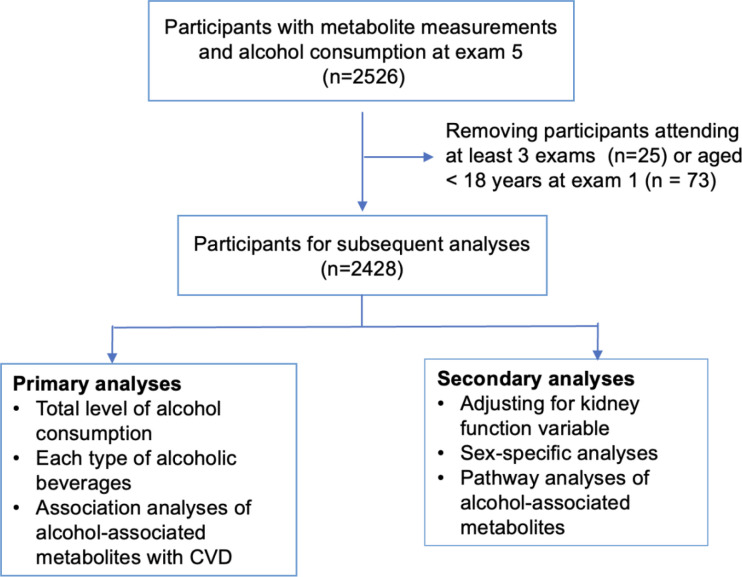
Cumulative average alcohol consumption (g/day) was derived from the total consumption of beer, wine and liquor on average of 19 years in 2,428 Framingham Heart Study Offspring participants (mean age 56 years, 52% women). We used linear mixed models to investigate the associations of alcohol consumption with 211 log-transformed plasma metabolites, adjusting for age, sex, batch, smoking, diet, physical activity, BMI, and familial relationship. Cox models were used to test the association of alcohol-related metabolite scores with fatal and nonfatal incident CVD (myocardial infarction, coronary heart disease, stroke, and heart failure).
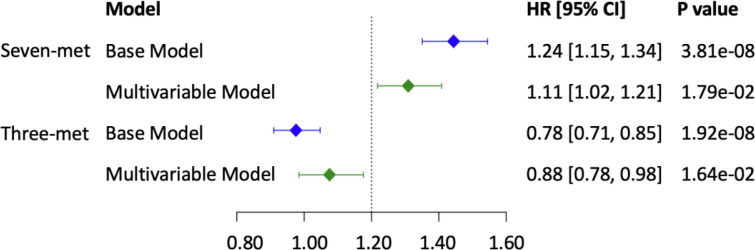
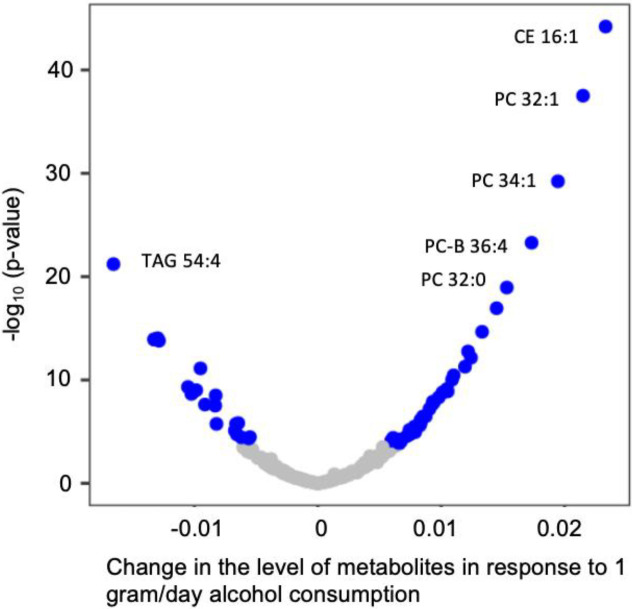
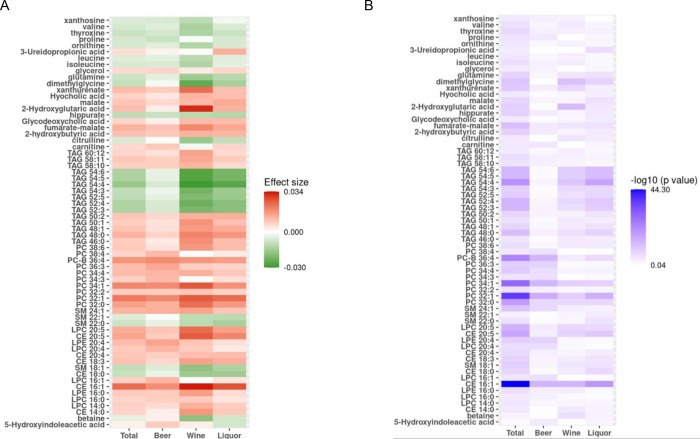
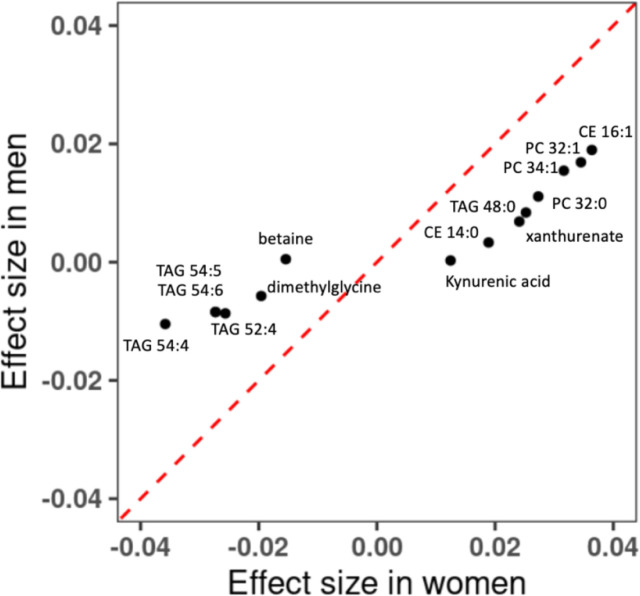
We identified 60 metabolites associated with cumulative average alcohol consumption (p<0.05/211≈0.00024). For example, one g/day increase of alcohol consumption was associated with higher levels of cholesteryl esters (e.g., CE 16:1, beta=0.023±0.002, p=6.3e-45) and phosphatidylcholine (e.g., PC 32:1, beta=0.021±0.002, p=3.1e-38). Survival analysis identified that 10 alcohol-associated metabolites were also associated with a differential CVD risk after adjusting for age, sex, and batch. Further, we built two alcohol consumption weighted metabolite scores using these 10 metabolites and showed that, with adjustment age, sex, batch, and common CVD risk factors, the two scores had comparable but opposite associations with incident CVD, hazard ratio 1.11(95% CI=[1.02, 1.21],p=0.02) vs 0.88 (95% CI=[0.78, 0.98], p=0.02).
We identified 60 long-term alcohol consumption-associated metabolites. The association analysis with incident CVD suggests a complex metabolic basis between alcohol consumption and CVD.
长期饮酒的代谢物特征尚不明确。为了更好地理解饮酒与心血管疾病(CVD)之间的分子基础,我们研究了与长期饮酒相关的循环代谢物,并探讨了这些代谢物是否与新发CVD相关。
在2428名弗雷明汉心脏研究后代参与者(平均年龄56岁,52%为女性)中,根据19年期间啤酒、葡萄酒和烈酒的总消费量计算累积平均酒精摄入量(克/天)。我们使用线性混合模型研究酒精摄入量与211种经对数转换的血浆代谢物之间的关联,并对年龄、性别、批次、吸烟、饮食、体力活动、BMI和家族关系进行了调整。Cox模型用于检验与酒精相关的代谢物评分与致命和非致命性新发CVD(心肌梗死、冠心病、中风和心力衰竭)之间的关联。
我们确定了60种与累积平均酒精摄入量相关的代谢物(p<0.05/211≈0.00024)。例如,每天酒精摄入量每增加1克,胆固醇酯(如CE 16:1,β=0.023±0.002,p=6.3e-45)和磷脂酰胆碱(如PC 32:1,β=0.021±0.002,p=3.1e-38)水平会升高。生存分析表明,在调整年龄、性别和批次后,10种与酒精相关的代谢物也与不同的CVD风险相关。此外,我们使用这10种代谢物构建了两个酒精摄入量加权代谢物评分,并表明,在调整年龄、性别、批次和常见CVD风险因素后,这两个评分与新发CVD的关联具有可比性但相反,风险比分别为1.11(95%CI=[1.02, 1.21],p=0.02)和0.88(95%CI=[0.78, 0.98],p=0.02)。
我们确定了60种与长期饮酒相关的代谢物。与新发CVD的关联分析表明,饮酒与CVD之间存在复杂的代谢基础。