Department of Neuromuscular Diseases, UCL Queen Square Institute of Neurology and The National Hospital for Neurology and Neurosurgery, University College London, London, UK
Department of Neurology and Neurosurgery, Montreal Neurological Hospital and Institute, McGill University, Montreal, QC, Canada.
J Neurol Neurosurg Psychiatry. 2024 Jan 11;95(2):175-179. doi: 10.1136/jnnp-2023-331490.
Intronic GAA repeat expansions in the fibroblast growth factor 14 gene () have recently been identified as a common cause of ataxia with potential phenotypic overlap with -related cerebellar ataxia, neuropathy and vestibular areflexia syndrome (CANVAS). Our objective was to report on the frequency of intronic GAA repeat expansions in patients with an unexplained CANVAS-like phenotype.
We recruited 45 patients negative for biallelic repeat expansions with a combination of cerebellar ataxia plus peripheral neuropathy and/or bilateral vestibulopathy (BVP), and genotyped the repeat locus. Phenotypic features of GAA--positive versus GAA--negative patients were compared.
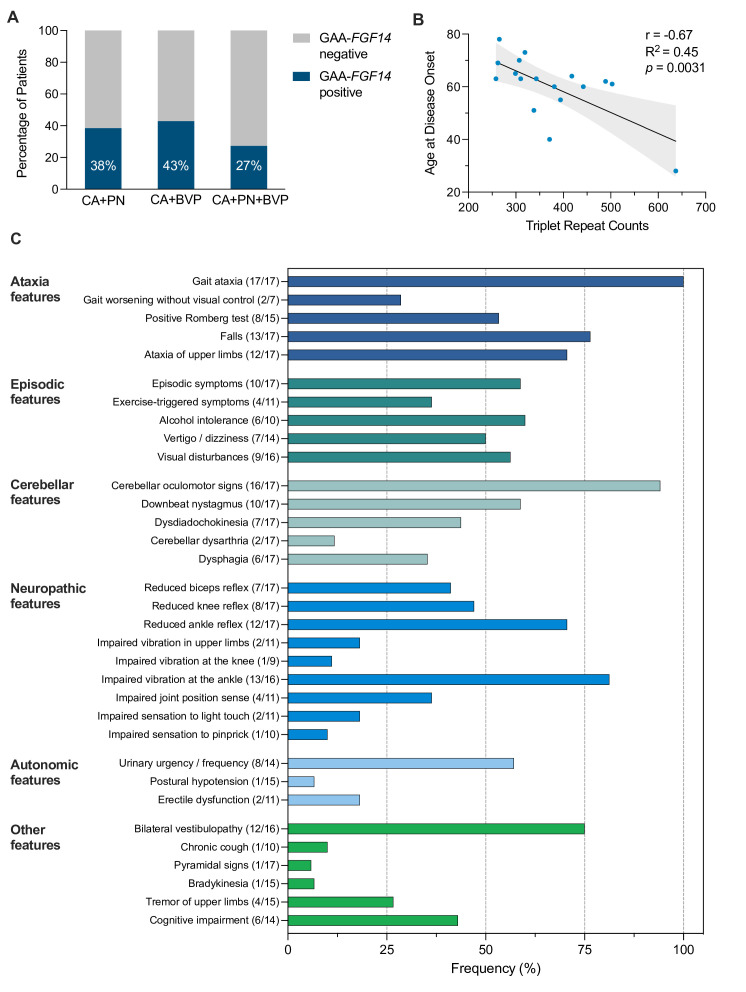
Frequency of GAA repeat expansions was 38% (17/45) in the entire cohort, 38% (5/13) in the subgroup with cerebellar ataxia plus polyneuropathy, 43% (9/21) in the subgroup with cerebellar ataxia plus BVP and 27% (3/11) in patients with all three features. BVP was observed in 75% (12/16) of GAA--positive patients. Polyneuropathy was at most mild and of mixed sensorimotor type in six of eight GAA--positive patients. Family history of ataxia (59% vs 15%; p=0.007) was significantly more frequent and permanent cerebellar dysarthria (12% vs 54%; p=0.009) significantly less frequent in GAA--positive than in GAA--negative patients. Age at onset was inversely correlated to the size of the repeat expansion (Pearson's r, -0.67; R=0.45; p=0.0031).
GAA--related disease is a common cause of cerebellar ataxia with polyneuropathy and/or BVP, and should be included in the differential diagnosis of CANVAS and disease spectrum.
成纤维细胞生长因子 14 基因()中的内含子 GAA 重复扩展最近被确定为一种常见的原因,与共济失调相关,具有潜在的表型重叠 - 相关小脑共济失调,神经病和前庭反射消失综合征(CANVAS)。我们的目的是报告在具有未解释的 CANVAS 样表型的患者中,内含子 GAA 重复扩展的频率。
我们招募了 45 例双侧小脑共济失调加周围神经病和/或双侧前庭病(BVP)的患者,这些患者均为双等位基因重复扩展阴性,并对重复基因座进行了基因分型。比较了 GAA--阳性和 GAA--阴性患者的表型特征。
整个队列中 GAA 重复扩展的频率为 38%(17/45),小脑共济失调加多发性神经病亚组为 38%(5/13),小脑共济失调加 BVP 亚组为 43%(9/21),所有三个特征的患者为 27%(3/11)。在 16 例 GAA--阳性患者中,75%(12/16)观察到 BVP。在 8 例 GAA--阳性患者中,有 6 例的多发性神经病最多为轻度,混合感觉运动类型。家族性共济失调史(59% vs 15%;p=0.007)在 GAA--阳性患者中明显更常见,永久性小脑构音障碍(12% vs 54%;p=0.009)明显更少。发病年龄与重复扩展的大小呈负相关(皮尔逊 r,-0.67;R=0.45;p=0.0031)。
GAA--相关疾病是小脑共济失调伴多发性神经病和/或 BVP 的常见原因,应纳入 CANVAS 和疾病谱的鉴别诊断。