Neurology Clinic, University Clinical Center of Serbia, Belgrade, Serbia.
Medical Faculty, University Belgrade, Belgrade, Serbia.
Mov Disord Clin Pract. 2024 Jun;11(6):626-633. doi: 10.1002/mdc3.14020. Epub 2024 Mar 15.
The newly discovered intronic repeat expansions in the genes encoding replication factor C subunit 1 (RFC1) and fibroblast growth factor 14 (FGF14) frequently cause late-onset cerebellar ataxia.
To investigate the presence of RFC1 and FGF14 pathogenic repeat expansions in Serbian patients with adult-onset cerebellar ataxia.
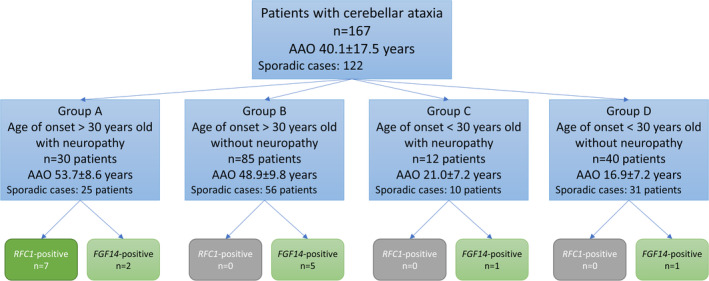
The study included 167 unrelated patients with sporadic or familial cerebellar ataxia. The RFC1 repeat expansion analysis was performed by duplex PCR and Sanger sequencing, while the FGF14 repeat expansion was tested for by long-range PCR, repeat-primed PCR, and Sanger sequencing.
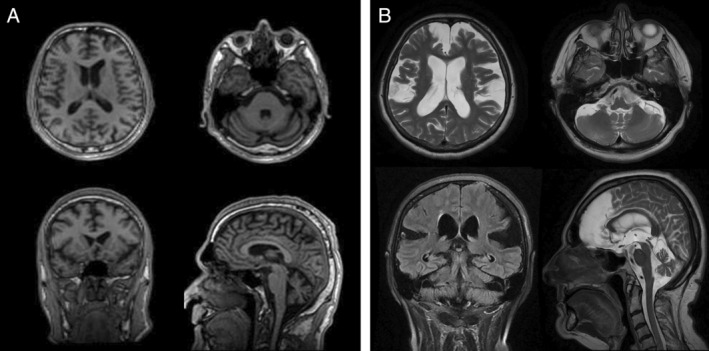
We identified pathogenic repeat expansions in RFC1 in seven patients (7/167; 4.2%) with late-onset sporadic ataxia with neuropathy and chronic cough. Two patients also had bilateral vestibulopathy. Repeat expansions in FGF14 were found in nine unrelated patients (9/167; 5.4%) with ataxia, less than half of whom presented with neuropathy and two-thirds with global brain atrophy. Tremor and episodic features were the most frequent additional characteristics in carriers of uninterrupted FGF14 repeat expansions. Among the 122 sporadic cases, 12 (9.8%) carried an expansion in either RFC1 or FGF14, comparable to 4/45 (8.9%) among the patients with a positive family history.
Pathogenic repeat expansions in RFC1 and FGF14 are relatively frequent causes of adult-onset cerebellar ataxia, especially among sporadic patients, indicating that family history should not be considered when prioritizing ataxia patients for testing of RFC1 or FGF14 repeat expansions.
编码复制因子 C 亚基 1(RFC1)和成纤维细胞生长因子 14(FGF14)的基因中新发现的内含子重复扩展经常导致迟发性小脑共济失调。
研究塞尔维亚成年发病小脑共济失调患者中 RFC1 和 FGF14 致病重复扩展的存在情况。
本研究纳入了 167 例散发性或家族性小脑共济失调的无关联患者。通过双 PCR 和 Sanger 测序进行 RFC1 重复扩展分析,通过长距离 PCR、重复引物 PCR 和 Sanger 测序检测 FGF14 重复扩展。
我们在 7 例(7/167;4.2%)迟发性散发性共济失调伴神经病和慢性咳嗽的患者中发现了 RFC1 的致病性重复扩展。其中 2 例患者还伴有双侧前庭病。在 9 例无关联的患者(9/167;5.4%)中发现了 FGF14 的重复扩展,其中不到一半的患者伴有神经病,三分之二的患者伴有全脑萎缩。在未中断的 FGF14 重复扩展携带者中,震颤和发作性特征是最常见的附加特征。在 122 例散发性病例中,有 12 例(9.8%)携带 RFC1 或 FGF14 扩展,与阳性家族史患者的 4/45(8.9%)相当。
RFC1 和 FGF14 的致病性重复扩展是成年发病小脑共济失调的相对常见原因,尤其是在散发性患者中,这表明在优先对共济失调患者进行 RFC1 或 FGF14 重复扩展检测时,不应考虑家族史。