School of Public Health, Li Ka Shing Faculty of Medicine, The University of Hong Kong, Hong Kong, China.
Graduate School of Public Health and Health Policy, City University of New York, New York, USA.
BMC Med. 2023 Jul 3;21(1):235. doi: 10.1186/s12916-023-02903-w.
Asialoglycoprotein receptor 1 (ASGR1) is emerging as a potential drug target to reduce low-density lipoprotein (LDL)-cholesterol and coronary artery disease (CAD) risk. Here, we investigated genetically mimicked ASGR1 inhibitors on all-cause mortality and any possible adverse effects.
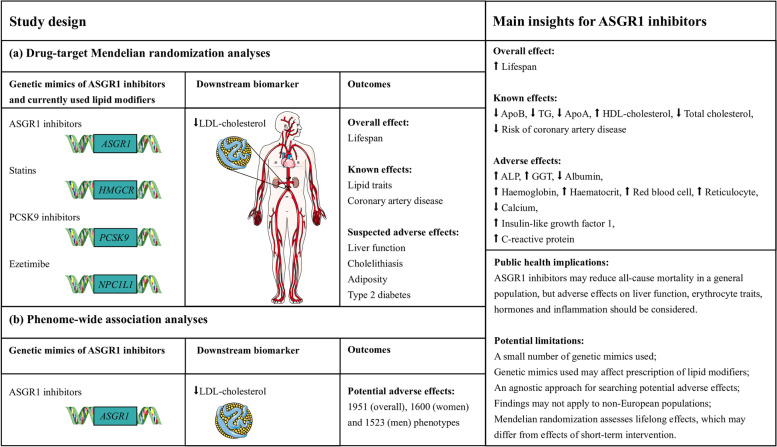
We conducted a drug-target Mendelian randomization study to assess genetically mimicked effects of ASGR1 inhibitors on all-cause mortality and 25 a priori outcomes relevant to lipid traits, CAD, and possible adverse effects, i.e. liver function, cholelithiasis, adiposity and type 2 diabetes. We also performed a phenome-wide association study of 1951 health-related phenotypes to identify any novel effects. Associations found were compared with those for currently used lipid modifiers, assessed using colocalization, and replicated where possible.
Genetically mimicked ASGR1 inhibitors were associated with a longer lifespan (3.31 years per standard deviation reduction in LDL-cholesterol, 95% confidence interval 1.01 to 5.62). Genetically mimicked ASGR1 inhibitors were inversely associated with apolipoprotein B (apoB), triglycerides (TG) and CAD risk. Genetically mimicked ASGR1 inhibitors were positively associated with alkaline phosphatase, gamma glutamyltransferase, erythrocyte traits, insulin-like growth factor 1 (IGF-1) and C-reactive protein (CRP), but were inversely associated with albumin and calcium. Genetically mimicked ASGR1 inhibitors were not associated with cholelithiasis, adiposity or type 2 diabetes. Associations with apoB and TG were stronger for ASGR1 inhibitors compared with currently used lipid modifiers, and most non-lipid effects were specific to ASGR1 inhibitors. The probabilities for colocalization were > 0.80 for most of these associations, but were 0.42 for lifespan and 0.30 for CAD. These associations were replicated using alternative genetic instruments and other publicly available genetic summary statistics.
Genetically mimicked ASGR1 inhibitors reduced all-cause mortality. Beyond lipid-lowering, genetically mimicked ASGR1 inhibitors increased liver enzymes, erythrocyte traits, IGF-1 and CRP, but decreased albumin and calcium.
作为一种新兴的药物靶点,去唾液酸糖蛋白受体 1(ASGR1)可降低低密度脂蛋白胆固醇(LDL-C)并降低冠心病(CAD)风险。在此,我们研究了基因模拟的 ASGR1 抑制剂对全因死亡率和任何可能的不良反应的影响。
我们进行了药物靶点孟德尔随机化研究,以评估基因模拟的 ASGR1 抑制剂对全因死亡率和 25 个与脂质特征、CAD 和可能的不良反应相关的预先设定结果的影响,即肝功能、胆石症、肥胖和 2 型糖尿病。我们还对 1951 种与健康相关的表型进行了全基因组关联研究,以确定任何新的影响。将发现的关联与目前使用的脂质调节剂进行比较,如有可能则进行复制。
基因模拟的 ASGR1 抑制剂与寿命延长相关(LDL-C 每标准偏差降低 3.31 年,95%置信区间 1.01 至 5.62)。基因模拟的 ASGR1 抑制剂与载脂蛋白 B(apoB)、甘油三酯(TG)和 CAD 风险呈负相关。基因模拟的 ASGR1 抑制剂与碱性磷酸酶、γ-谷氨酰转移酶、红细胞特征、胰岛素样生长因子 1(IGF-1)和 C 反应蛋白(CRP)呈正相关,但与白蛋白和钙呈负相关。基因模拟的 ASGR1 抑制剂与胆石症、肥胖或 2 型糖尿病无关。与目前使用的脂质调节剂相比,ASGR1 抑制剂与 apoB 和 TG 的关联更强,大多数非脂质作用是 ASGR1 抑制剂特有的。这些关联的共定位概率大多大于 0.80,但寿命和 CAD 的概率分别为 0.42 和 0.30。使用替代遗传工具和其他公开可用的遗传汇总统计数据复制了这些关联。
基因模拟的 ASGR1 抑制剂降低了全因死亡率。除了降低血脂外,基因模拟的 ASGR1 抑制剂还增加了肝酶、红细胞特征、IGF-1 和 CRP,但降低了白蛋白和钙。