Department of Dermatology, La Paz University Hospital, Faculty of Medicine, Autonomous University of Madrid, Madrid, Spain.
Department of Hospital Pharmacy, La Paz University Hospital, Autonomous University of Madrid, Madrid, Spain.
Clin Drug Investig. 2023 Jul;43(7):517-527. doi: 10.1007/s40261-023-01280-9. Epub 2023 Jul 4.
Guselkumab is a drug used to treat moderate to severe plaque psoriasis. However, real-life clinical data on its off-label use are limited, especially regarding the optimal drug dosage regimen for different patient profiles.
The main objective of this real-world, single-centre, retrospective study was to identify the off-label guselkumab dosing regimen used in clinical practice. The study also aimed to evaluate the drug's efficacy, safety, and survival, as well as the proportion of super-responders (SR) based on a newly proposed definition.
The study included 69 patients who started treatment with guselkumab between March 2019 and July 2021. Patients were followed up until April 2022, during which time their efficacy, safety, persistence, and use of guselkumab were recorded. Patients were aged ≥ 18 years and had moderate to severe plaque psoriasis.
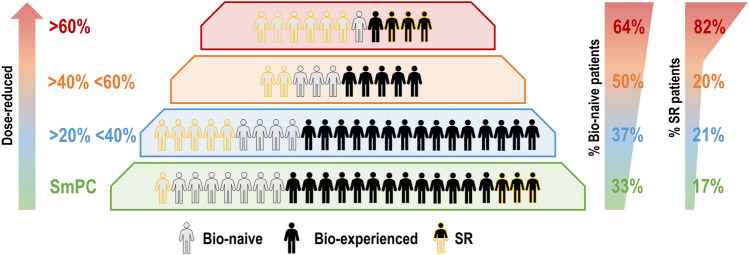
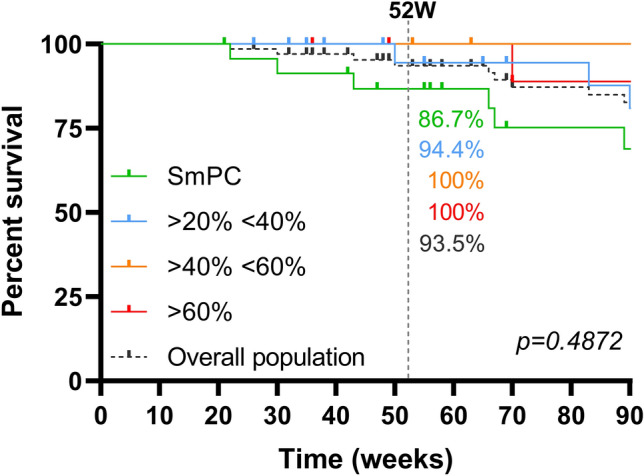
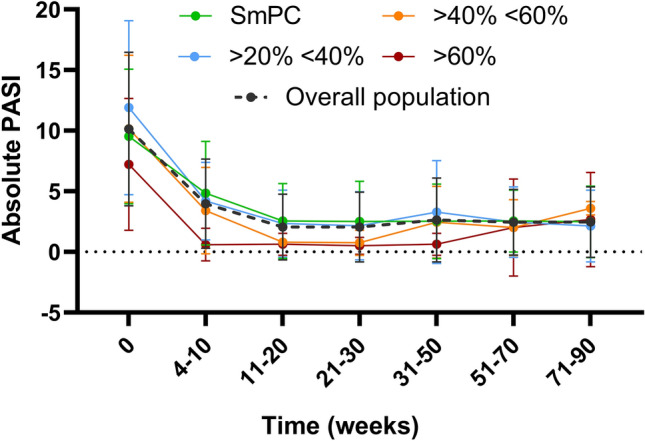
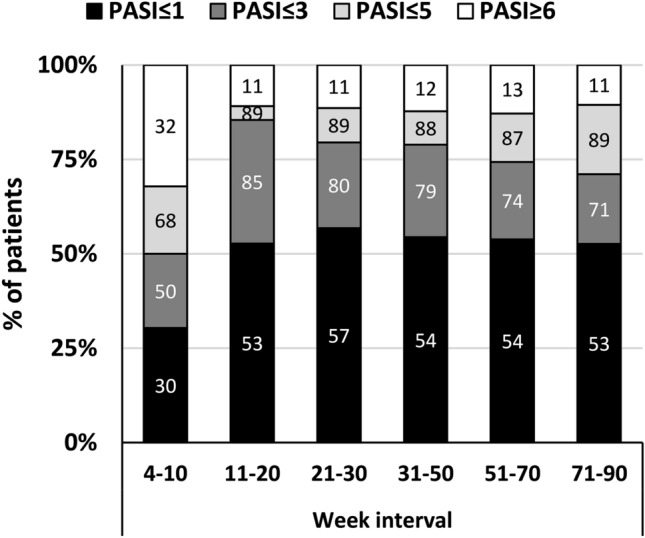
The mean disease duration was 18.6 years, and 59% of patients had received at least one biologic treatment before guselkumab with a mean of 1.3 biologics per patient. The initial absolute Psoriasis Area and Severity Index (PASI) was 10.1 and decreased to 2.1 between Week 11-20 without significant changes in the PASI value throughout the 90 weeks of follow-up. The cumulative probability of drug survival was 93.5% at Week 52. No differences were found in terms of efficacy and survival associated with the off-label drug dosage regimens compared to the doses described in the Summary of Product Characteristics (SmPC). The greatest adjustments in the drug administration regimen were achieved in the subgroups of bio-naïve and SR patients, with a reduction in the number of administrations by 40% and 47% compared to the regimen described in the SmPC. Super-response to guselkumab was mainly associated with patients naïve to previous biologic treatment.
The study demonstrated that off-label use of guselkumab was safe and effective in real-life clinical practice. The findings suggest that adjustments to the drug administration regimen may be necessary to optimise its use in different patient profiles, especially in SR and bio-naïve patients. Further studies are needed to confirm these findings.
古塞库单抗是一种用于治疗中度至重度斑块状银屑病的药物。然而,关于其超说明书使用的真实世界临床数据有限,特别是关于不同患者人群的最佳药物剂量方案。
本真实世界、单中心、回顾性研究的主要目的是确定古塞库单抗在临床实践中的超说明书剂量方案。该研究还旨在评估药物的疗效、安全性和存活率,以及根据新提出的定义确定超级应答者(SR)的比例。
该研究纳入了 2019 年 3 月至 2021 年 7 月期间开始接受古塞库单抗治疗的 69 例患者。患者随访至 2022 年 4 月,期间记录了他们的疗效、安全性、持续性和古塞库单抗的使用情况。患者年龄≥18 岁,患有中度至重度斑块状银屑病。
平均疾病持续时间为 18.6 年,59%的患者在接受古塞库单抗治疗前至少接受过一种生物制剂治疗,每位患者平均接受 1.3 种生物制剂。初始绝对银屑病面积和严重程度指数(PASI)为 10.1,在第 11-20 周降至 2.1,在 90 周的随访过程中 PASI 值无明显变化。在第 52 周时,药物存活率的累积概率为 93.5%。与药品说明书(SmPC)中描述的剂量相比,超说明书剂量方案与疗效和生存相关的差异无统计学意义。在生物制剂初治和 SR 患者亚组中,药物管理方案的调整最大,与 SmPC 描述的方案相比,给药次数减少了 40%和 47%。古塞库单抗的超级应答主要与以前未接受过生物制剂治疗的患者相关。
该研究表明,古塞库单抗的超说明书使用在真实世界的临床实践中是安全有效的。研究结果表明,可能需要调整药物管理方案,以优化其在不同患者人群中的使用,特别是在 SR 和生物制剂初治患者中。需要进一步的研究来证实这些发现。