Institute for Medical Microbiology, Virology and Hygiene, Department Infection Prevention and Control, University Medical Center Hamburg-Eppendorf, Hamburg, Germany.
Institute for Medical Microbiology, Virology and Hygiene, University Medical Center Hamburg-Eppendorf, Hamburg, Germany.
Antimicrob Resist Infect Control. 2023 Jul 4;12(1):63. doi: 10.1186/s13756-023-01259-3.
Admission to a room previously occupied by patients carrying environmentally robust pathogens implies an increased risk of acquiring those pathogens. Therefore, 'No-touch' automated room disinfection systems, including devices based on UV-C irradiation, are discussed to improve terminal cleaning. It is still unclear if clinical isolates of relevant pathogens behave differently under UV-C irradiation compared to laboratory strains used in the approval process of disinfection procedures. In this study we analysed the susceptibility of well characterized clonally divergent vancomycin-resistant enterococci (VRE) strains, including a linezolid-resistant isolate, against UV-C radiation.
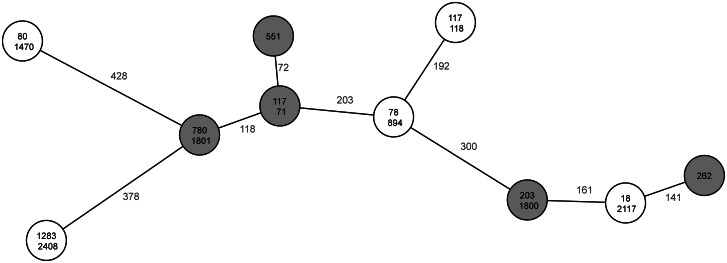
Susceptibility against UV-C of ten clonally divergent clinical isolates of VRE was determined in comparison to the commonly used test organism Enterococcus hirae ATCC 10541. Ceramic tiles contaminated with 10 to 10 colony forming units/25 cm² of the different enterococci were positioned at a distance of 1.0 and 1.5 m and irradiated for 20 s, resulting in a UV-C dose of 50 and 22 mJ/cm², respectively. Reduction factors were calculated after quantitative culture of the bacteria recovered from treated and untreated surfaces.
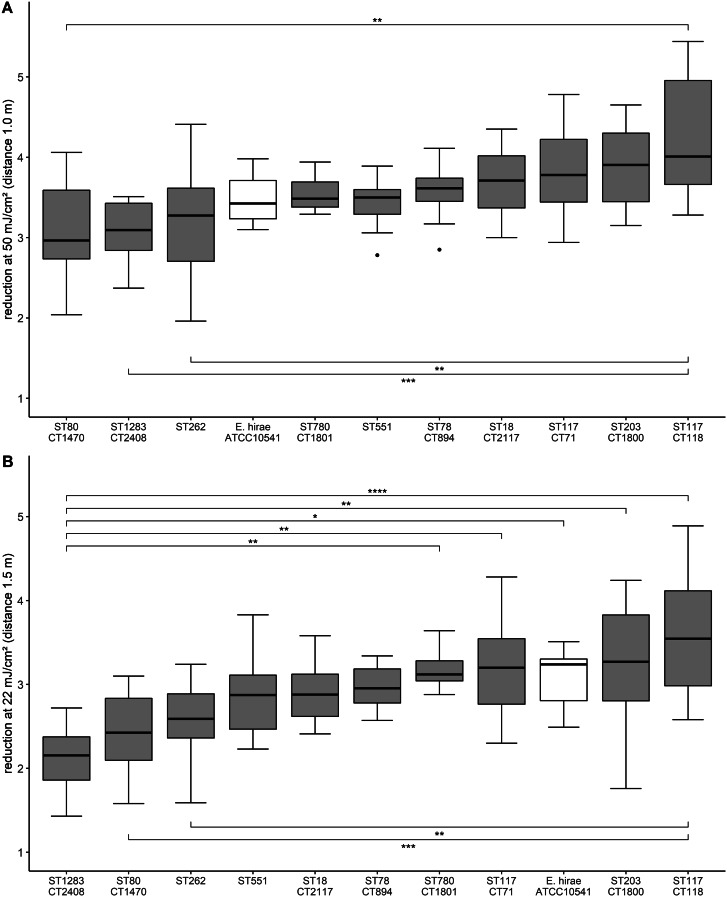
Susceptibility to UV-C varied considerably among the strains studied, with the mean value of the most robust strain being up to a power of ten lower compared to the most sensitive strain at both UV-C doses. The two most tolerant strains belonged to MLST sequence types ST80 and ST1283. The susceptibility of the laboratory strain E. hirae ATCC 10541 ranged between the most sensitive and most tolerant isolates for both irradiation doses. However, for UV-C dose of 22 mJ/cm², the reduction of the most tolerant isolate of ST1283 was statistically significantly lower compared to E. hirae ATCC 10541. The most susceptible strains belonged to the MLST sequence types ST117 and ST203.
These results indicate that UV-C doses reported in the literature are sufficient for the reduction of commonly used reference strains of enterococci but could be insufficient for the reduction of tolerant patient VRE-isolates in a hospital setting. Therefore, for future studies, the most tolerant clinical isolates should be used to validate automated UV-C devices or longer exposure times should be expected to ensure efficacy in the real world.
入住曾有环境坚韧病原体携带者入住的病房会增加感染这些病原体的风险。因此,人们讨论了“无接触”自动化房间消毒系统,包括基于紫外线 (UV-C) 照射的设备,以改善终末清洁。目前尚不清楚相关病原体的临床分离株在 UV-C 照射下的行为是否与消毒程序批准过程中使用的实验室菌株不同。在这项研究中,我们分析了经过充分特征描述的、克隆不同的万古霉素耐药肠球菌 (VRE) 菌株的易感性,包括耐利奈唑胺的分离株,以对抗 UV-C 辐射。
将十种克隆不同的临床 VRE 分离株与常用测试生物粪肠球菌 ATCC 10541 进行比较,确定其对 UV-C 的敏感性。将不同肠球菌污染至每 25 cm² 10 至 10 个菌落形成单位的陶瓷砖放置在 1.0 和 1.5 m 的距离处,照射 20 s,分别产生 50 和 22 mJ/cm² 的 UV-C 剂量。从处理和未处理表面回收的细菌定量培养后,计算减少因子。
在所研究的菌株中,对 UV-C 的敏感性差异很大,在两种 UV-C 剂量下,最耐辐射菌株的平均值比最敏感菌株低至 10 倍。两种最耐受的菌株属于 MLST 序列类型 ST80 和 ST1283。实验室菌株粪肠球菌 ATCC 10541 的敏感性在两种照射剂量下均介于最敏感和最耐受的分离株之间。然而,对于 22 mJ/cm² 的 UV-C 剂量,ST1283 最耐受分离株的减少量与粪肠球菌 ATCC 10541 相比统计学上显著较低。最敏感的菌株属于 MLST 序列类型 ST117 和 ST203。
这些结果表明,文献中报道的 UV-C 剂量足以减少医院环境中常用的肠球菌参考菌株,但对于减少耐多药患者 VRE 分离株可能不够。因此,对于未来的研究,应使用最耐受的临床分离株来验证自动化 UV-C 设备,或预计需要更长的暴露时间以确保在现实世界中的效果。