Agriculture Victoria Research, AgriBio - Centre for AgriBioscience, 5 Ring Road, Bundoora, VIC, 3083, Australia.
School of Applied Systems Biology, La Trobe University, Bundoora, VIC, 3083, Australia.
Sci Rep. 2023 Jul 5;13(1):10895. doi: 10.1038/s41598-023-37721-w.
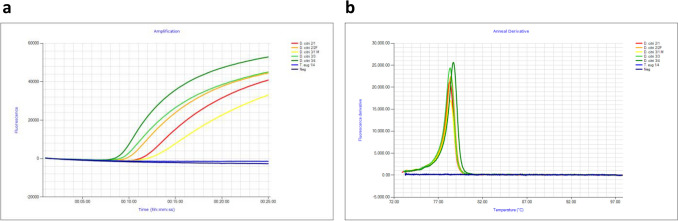
Diaphorina citri Kuwayama, also known as the Asian citrus psyllid (ACP), can vector the bacterium Candidatus Liberibacter asiaticus (CLas), agent of Huanglongbing (HLB): an incurable disease affecting citrus trees worldwide. In citrus growing regions where ACP and HLB are absent, such as Australia, the risk of an incursion and consequent economic damage to citrus industries make this psyllid one of the top-priority pests. Due to ACP's small dimensions and the generally poorly studied native psylloid fauna worldwide, morphological identification of this insect to distinguish it from harmless species is challenging, especially in the field, and with immature, partial or damaged specimens. To allow rapid and efficient detection of ACP in the field, we designed and optimised a new Loop-mediated isothermal amplification (LAMP) assay for the detection of D. citri based on the mitochondrial 16S locus. The optimised ACP 16S LAMP assay produced amplification from D. citri samples within 13.3 ± 3.6 min, with an anneal derivative of ~ 78.5 °C. A synthetic gBlock gene fragment was also developed to be used as positive control for the new LAMP assay with a different anneal derivative of ~ 83 °C. An existing commercially available LAMP assay for detection of the bacterium CLas was also tested in this study on ACP DNA. The ACP 16S LAMP assay we developed and tested here provides a valuable new in-field compatible tool that can allow early detections of ACP, enabling a quick biosecurity response, and could potentially be adopted by a wide range of users, from farmers to agronomists and from researchers to industry.
桔小实蝇,又称亚洲柑橘木虱(ACP),可传播细菌黄化曲叶病毒(HLB):一种影响全球柑橘树的不治之症。在没有 ACP 和 HLB 的柑橘种植区,如澳大利亚,该实蝇入侵并对柑橘产业造成经济损失的风险使其成为首要关注的害虫之一。由于 ACP 体积小,以及全球范围内对本地木虱动物区系的研究普遍不足,因此通过形态学鉴定将其与无害物种区分开来具有挑战性,尤其是在野外,以及对未成熟、部分或受损的标本进行鉴定时。为了能够在野外快速有效地检测 ACP,我们基于线粒体 16S 基因座,为 D. citri 设计并优化了一种新的环介导等温扩增(LAMP)检测方法。优化后的 ACP 16S LAMP 检测方法可在 13.3±3.6 分钟内从 D. citri 样本中扩增出产物,退火衍生物约为 78.5°C。还开发了一个合成的 gBlock 基因片段,用作新的 LAMP 检测的阳性对照,其退火衍生物约为 83°C。本研究还测试了现有的一种用于检测细菌 CLas 的商业上可用的 LAMP 检测方法在 ACP DNA 上的检测效果。我们在这里开发和测试的 ACP 16S LAMP 检测方法提供了一种有价值的新的田间兼容工具,可以早期检测 ACP,从而快速采取生物安全应对措施,并且可能被广泛的用户采用,包括农民、农学家、研究人员和行业。