Hrdy Ondrej, Duba Milos, Dolezelova Andrea, Roskova Ivana, Hlavaty Martin, Traj Rudolf, Bönisch Vit, Smrcka Martin, Gal Roman
Department of Anesthesiology and Intensive Care Medicine, University Hospital Brno, Brno, Czech Republic.
Department of Anesthesiology and Intensive Care Medicine, Faculty of Medicine, Masaryk University, Brno, Czech Republic.
Perioper Med (Lond). 2023 Jul 5;12(1):32. doi: 10.1186/s13741-023-00321-3.
The positive effects of goal-directed hemodynamic therapy (GDHT) on patient-orientated outcomes have been demonstrated in various clinical scenarios; however, the effects of fluid management in neurosurgery remain unclear. Therefore, this study was aimed at assessing the safety and feasibility of GDHT using non-invasive hemodynamic monitoring in elective neurosurgery. The incidence of postoperative complications was compared between GDHT and control groups.
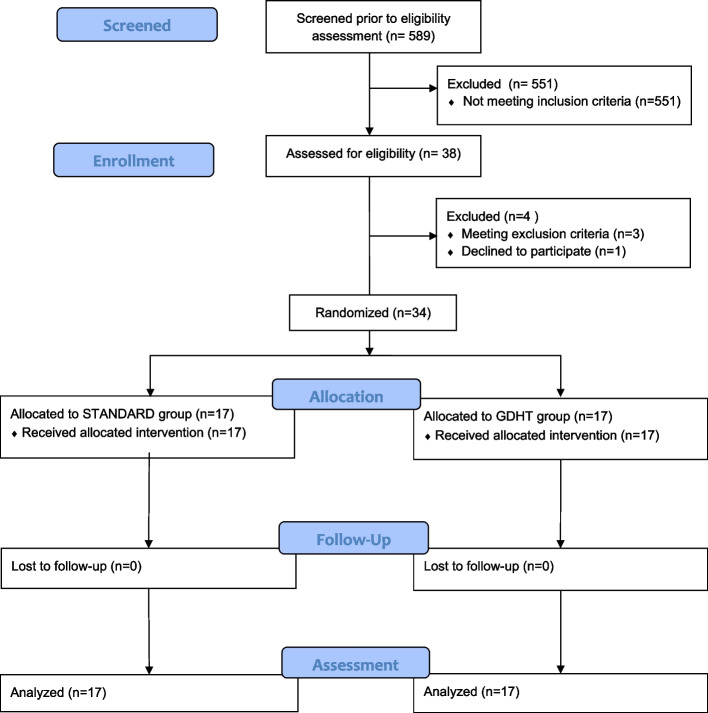
We conducted a single-center randomized pilot study with an enrollment target of 34 adult patients scheduled for elective neurosurgery. We randomly assigned the patients equally into control and GDHT groups. The control group received standard therapy during surgery and postoperatively, whereas the GDHT group received therapy guided by an algorithm based on non-invasive hemodynamic monitoring. In the GDHT group, we aimed to achieve and sustain an optimal cardiac index by using non-invasive hemodynamic monitoring and bolus administration of colloids and vasoactive drugs. The number of patients with adverse events, feasibility criteria, perioperative parameters, and incidence of postoperative complications was compared between groups.
We successfully achieved all feasibility criteria. The GDHT protocol was safe, because no patients in either group had unsatisfactory brain tissue relaxation after surgery or brain edema requiring therapy during surgery or 24 h after surgery. Major complications occurred in two (11.8%) patients in the GDHT group and six (35.3%) patients in the control group (p = 0.105).
Our results suggested that a large randomized trial evaluating the effects of GDHT on the incidence of postoperative complications in elective neurosurgery should be safe and feasible. The rate of postoperative complications was comparable between groups.
Trial registration: ClininalTrials.gov, registration number: NCT04754295, date of registration: February 15, 2021.
目标导向血流动力学治疗(GDHT)对以患者为导向的结局的积极影响已在各种临床场景中得到证实;然而,神经外科手术中液体管理的效果仍不清楚。因此,本研究旨在评估在择期神经外科手术中使用无创血流动力学监测进行GDHT的安全性和可行性。比较GDHT组和对照组术后并发症的发生率。
我们进行了一项单中心随机试点研究,纳入目标为34例计划进行择期神经外科手术的成年患者。我们将患者随机平均分为对照组和GDHT组。对照组在手术期间和术后接受标准治疗,而GDHT组接受基于无创血流动力学监测的算法指导的治疗。在GDHT组中,我们旨在通过无创血流动力学监测以及胶体和血管活性药物的推注给药来实现并维持最佳心脏指数。比较两组不良事件患者数量、可行性标准、围手术期参数和术后并发症发生率。
我们成功达到了所有可行性标准。GDHT方案是安全的,因为两组均没有患者在术后出现脑组织松弛不充分或在手术期间或术后24小时出现需要治疗的脑水肿。GDHT组有2例(11.8%)患者发生主要并发症,对照组有6例(35.3%)患者发生主要并发症(p = 0.105)。
我们的结果表明,一项评估GDHT对择期神经外科手术术后并发症发生率影响的大型随机试验应该是安全可行的。两组术后并发症发生率相当。
试验注册:ClinicalTrials.gov,注册号:NCT04754295,注册日期:2021年2月15日。