Stoian Raluca, Exner Jan-Philipp Harald, Gainey Mark, Erbes Thalia, Gkika Eleni, Popp Ilinca, Spohn Simon K B, Krug David, Juhasz-Böss Ingolf, Grosu Anca-Ligia, Sprave Tanja
Department of Radiation Oncology, University Hospital of Freiburg, Robert-Koch-Strasse, Freiburg, Germany.
German Cancer Consortium (DKTK) Partner Site Freiburg, German Cancer Research Center (dkfz), Neuenheimer Feld, Heidelberg, Germany.
Front Oncol. 2023 Jun 20;13:1210879. doi: 10.3389/fonc.2023.1210879. eCollection 2023.
Currently, there are no data from randomized trials on the use of intraoperative radiotherapy (IORT) as a tumor bed boost in women at high risk of local recurrence. The aim of this retrospective analysis was to compare the toxicity and oncological outcome of IORT or simultaneous integrated boost (SIB) with conventional external beam radiotherapy (WBI) after breast conserving surgery (BCS).
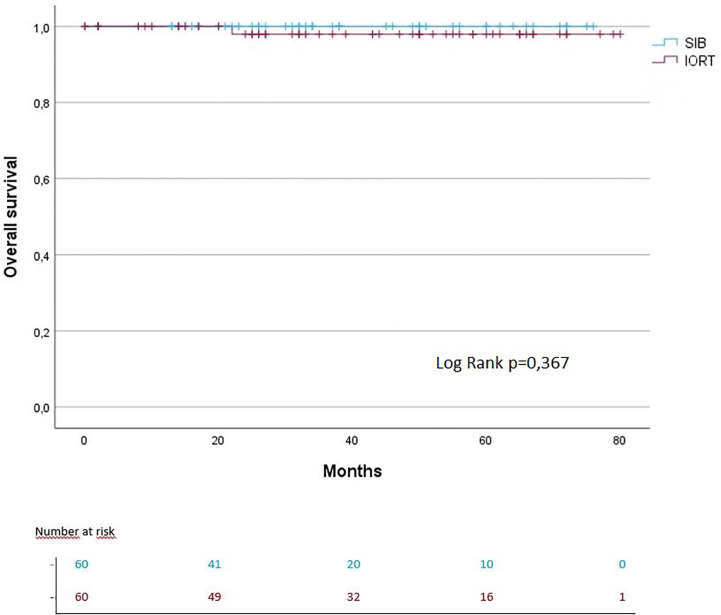
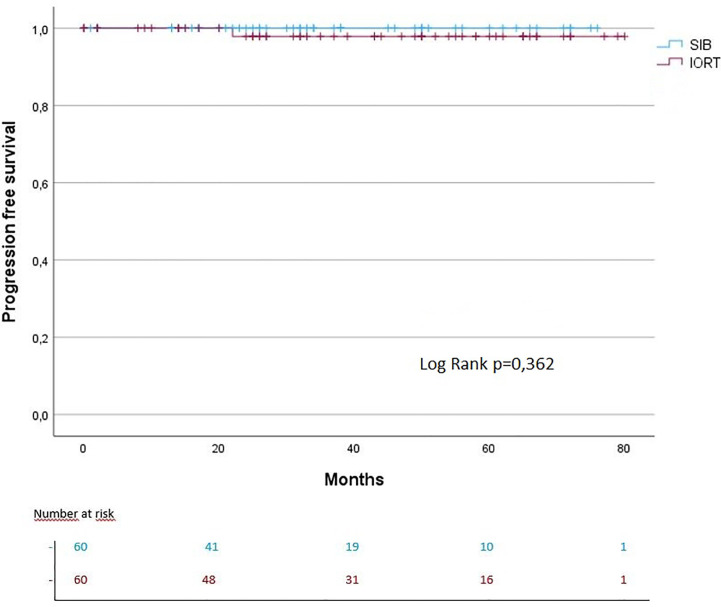
Between 2009 and 2019, patients were treated with a single dose of 20 Gy IORT with 50 kV photons, followed by WBI 50 Gy in 25 or 40.05 in 15 fractions or WBI 50 Gy with SIB up to 58.80-61.60 Gy in 25-28 fractions. Toxicity was compared after propensity score matching. Overall survival (OS) and progression-free survival (PFS) were calculated using the Kaplan-Meier method.
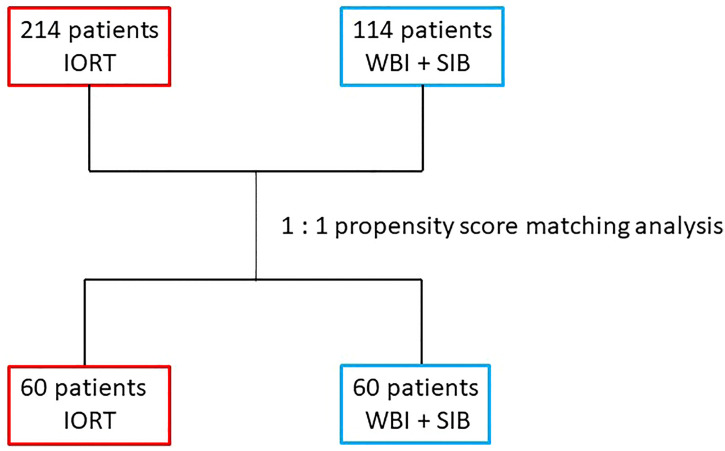
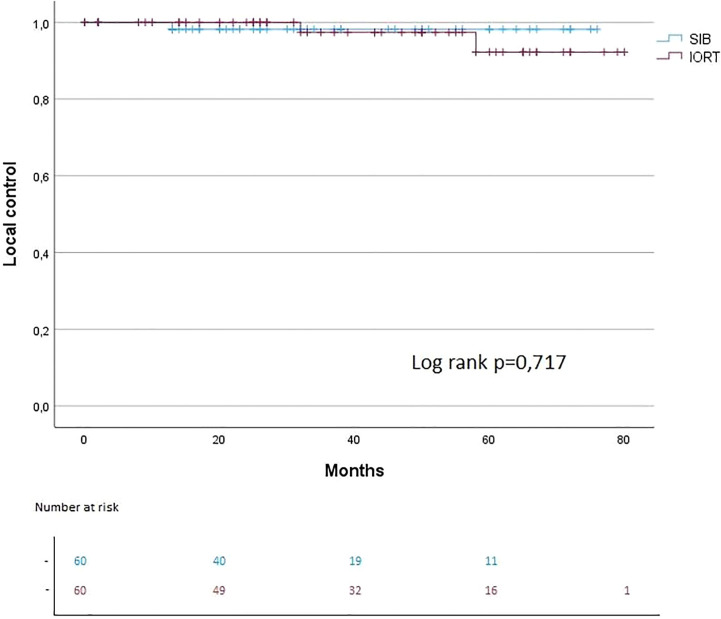
A 1:1 propensity-score matching resulted in an IORT + WBI and SIB + WBI cohort of 60 patients, respectively. The median follow-up for IORT + WBI was 43.5 vs. 32 months in the SIB + WBI cohort. Most women had a pT1c tumor: IORT group 33 (55%) vs. 31 (51.7%) SIB group (p = 0.972). The luminal-B immunophenotype was most frequently diagnosed in the IORT group 43 (71.6%) vs. 35 (58.3%) in the SIB group (p = 0.283). The most reported acute adverse event in both groups was radiodermatitis. In the IORT cohort, radiodermatitis was grade 1: 23 (38.3%), grade 2: 26 (43.3%), and grade 3: 6 (10%) vs. SIB cohort grade 1: 3 (5.1%), grade 2: 21 (35%), and grade 3: 7 (11.6%) without a meaningful difference (p = 0.309). Fatigue occurred more frequently in the IORT group (grade 1: 21.7% vs. 6.7%; p = 0.041). In addition, intramammary lymphedema grade 1 occurred significantly more often in the IORT group (11.7% vs. 1.7%; p = 0.026). Both groups showed comparable late toxicity. The 3- and 5-year local control (LC) rates were each 98% in the SIB group vs. 98% and 93% in the IORT group (LS: log rank p = 0.717).
Tumor bed boost using IORT and SIB techniques after BCS shows excellent local control and comparable late toxicity, while IORT application exhibits a moderate increase in acute toxicity. These data should be validated by the expected publication of the prospective randomized TARGIT-B study.
目前,尚无关于术中放疗(IORT)作为局部复发高危女性瘤床加量治疗的随机试验数据。本回顾性分析的目的是比较保乳手术(BCS)后IORT或同步整合加量(SIB)与传统外照射放疗(WBI)的毒性和肿瘤学结局。
2009年至2019年间,患者接受单次剂量20 Gy的50 kV光子IORT治疗,随后接受25次分割共50 Gy的WBI或15次分割共40.05 Gy的WBI,或25 - 28次分割共50 Gy且SIB达58.80 - 61.60 Gy的WBI。在倾向评分匹配后比较毒性。采用Kaplan-Meier法计算总生存期(OS)和无进展生存期(PFS)。
1:1倾向评分匹配后,IORT + WBI组和SIB + WBI组各有60例患者。IORT + WBI组的中位随访时间为43.5个月,而SIB + WBI组为32个月。大多数女性为pT1c肿瘤:IORT组33例(55%),SIB组31例(51.7%)(p = 0.972)。IORT组最常诊断为管腔B免疫表型的患者有43例(71.6%),SIB组为35例(58.3%)(p = 0.283)。两组最常报告的急性不良事件均为放射性皮炎。在IORT队列中,放射性皮炎1级23例(38.3%),2级26例(43.3%),3级6例(10%);SIB队列中1级3例(5.1%),2级21例(3